Name spelling approval is the moment you confirm that every name on a personalized order is correct and that the item can be made exactly as you see it. Once you say yes, the maker treats the spelling as yours. So check each name letter by letter, confirm how it will sit on the item, and send every correction in one message before you approve.
This guide covers what approval means, what to check, how to fix mistakes, and how name length affects patches, embroidery and prints. It is written for parents, event planners and gift buyers ordering names on loot bags, totes, pouches and tumblers.
TL;DR
- Approval means “print or stitch it exactly as shown.” Spelling, capitals, punctuation and placement are all covered.
- Read every name aloud from your own source list, not from the proof you were sent.
- Send all corrections in one clear message and approve only the updated version.
- Long names and small patches work against each other. Ask about line breaks, size and font before you approve.
- After approval, changes are not guaranteed, and they can delay your order.
Table of Contents
- What name spelling approval actually means
- Why spelling errors slip through
- What to check before you approve
- A simple approval routine
- How to fix a name mistake
- How long can a name be on a patch, bag or tumbler?
- Names on gifts and favours for events
- Our perspective: approval is a conversation, not a click
- Ordering personalized loot bags and gifts from us
- Common approval mistakes to avoid
- FAQ
- Sources
What name spelling approval actually means
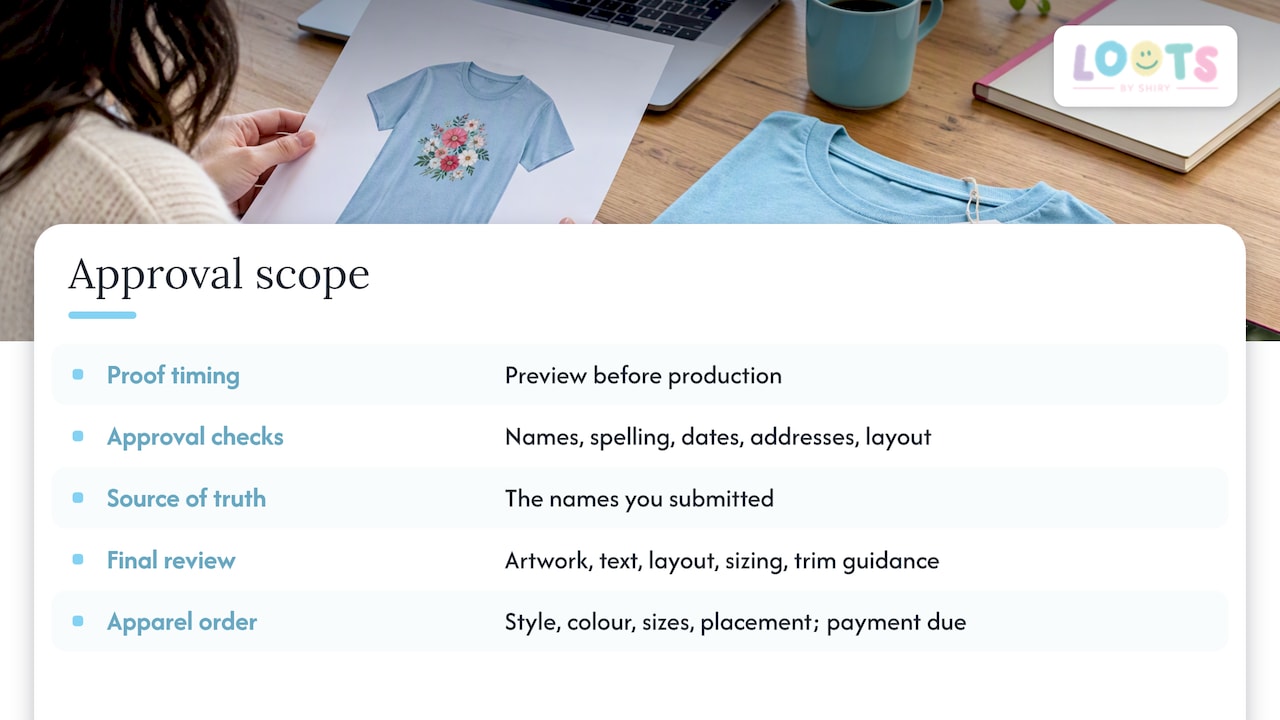
When you order something personalized, the maker usually shows you a preview of the finished item, often called a proof, before production starts. Approving that preview is a formal step. Printiverse describes approval as confirming that names, spelling, dates, addresses and the displayed layout are correct and that the order is ready to print exactly as shown.
That last phrase matters. The maker is not expected to know that “Aiden” should have been “Aidan” or that a child goes by “Mia-Rose.” They reproduce what you submitted and what you approved. Your name list is the source of truth, and the approval is your sign-off on it.
Approval also covers more than the name. A proof is the final review step before production and includes artwork, text, layout, sizing and any cut or trim guidance. A Canadian custom-apparel shop spells out the same logic: approving the order approves the artwork, garment style, colour, sizes and print placement, with payment due at that stage before production begins. Practices differ from shop to shop, so read the approval wording on any order page before you click.
Why spelling errors slip through
Most name mistakes are not typos by the maker. They come from three places:
- Copying from a message. A name typed quickly in a chat, a group text or a party RSVP often carries the original typo with it.
- Autocorrect. Phones love to “fix” unusual names. Saoirse becomes Sorry, and Siobhan becomes Sylvan.
- Approval by glance. A proof arrives, it looks nice, and the buyer replies “looks great” without reading the letters.
The third is the most common, and it is the one you control. A proof that looks good is not the same as a proof that is right.
What to check before you approve
Printiverse’s checklist is a good base: names, dates, times and addresses; spelling, punctuation and capitalization; front and back artwork; image crop and placement; size, orientation and any cut line. For a name on a loot bag, tote, pouch or tumbler, that becomes a short routine.
Check the letters
- Compare each name with your own master list, one letter at a time.
- Check double letters, silent letters and accents. A name like Zoë or Renée needs its accent entered on purpose.
- Check hyphens, apostrophes and spaces (Mary-Anne, O’Brien, De Silva).
- Read the name backwards if you are checking a long list. It breaks the habit of reading what you expect to see.
Check the capitalization
Decide before you order whether names should be in all capitals, title case or lowercase. A name that is correct in title case can look different in capitals, and some fonts handle capitals far better than lowercase. Ask to see the style you actually want on the proof.
Check the placement and product
Confirm which item each name sits on, and where. A name on the outside of a bag reads differently from a name inside. If the bag could be lost at a party, our guide to name placement on bags, including the top handle and interior walks through why placement is worth deciding early.
Check the details around the name
Order proofs often include a message, a date or a theme line. oBizee recommends checking the exact name, plus date, message wording, font, line breaks, placement and product version. The same page suggests the proof should show the real line breaks and alignment rather than a blurry screenshot. If your preview is too small to read the letters, ask for a clearer one before you approve.
A simple approval routine
This works for one tumbler or a hundred bags.
- Build a master list before you order. One column for the exact name, one for any notes (“two Ls,” “goes by Jo”). Ask the parent or guest directly when you are unsure.
- Submit the list as text. Typed text is easier to match than photos of handwriting. Where you can, copy and paste from the list rather than retyping.
- Open the proof and tick off each name. Use a pen on a printout, or a second person reading aloud while you follow your list.
- Check the item, not just the name. Colour, product, quantity and placement count too.
- Write one message with every correction. Number the fixes.
- Approve only the updated proof. Do not approve on the strength of “we’ll fix that” in an earlier message.
The second pair of eyes is not optional for big lists. For groups, bulk order personalization consistency is worth a read before you start, because mix-ups at volume are usually a list problem, not a production problem.
How to fix a name mistake
Before you approve
This is the easy window. Request revisions in one clear message, then review and approve the updated proof. Printiverse notes that spelling, date, address, layout, crop, cut-line and front-or-back corrections must be requested before approval, and requested revisions place the order on hold until the revised proof is approved.
A good correction message looks like this:
Please change “Emilly” to “Emily” on the pink tote and “Jaden” to “Jayden” on the blue pouch. Everything else is correct. Please send a new proof.
It names the item, shows old and new spellings, and states that nothing else changes.
After you approve
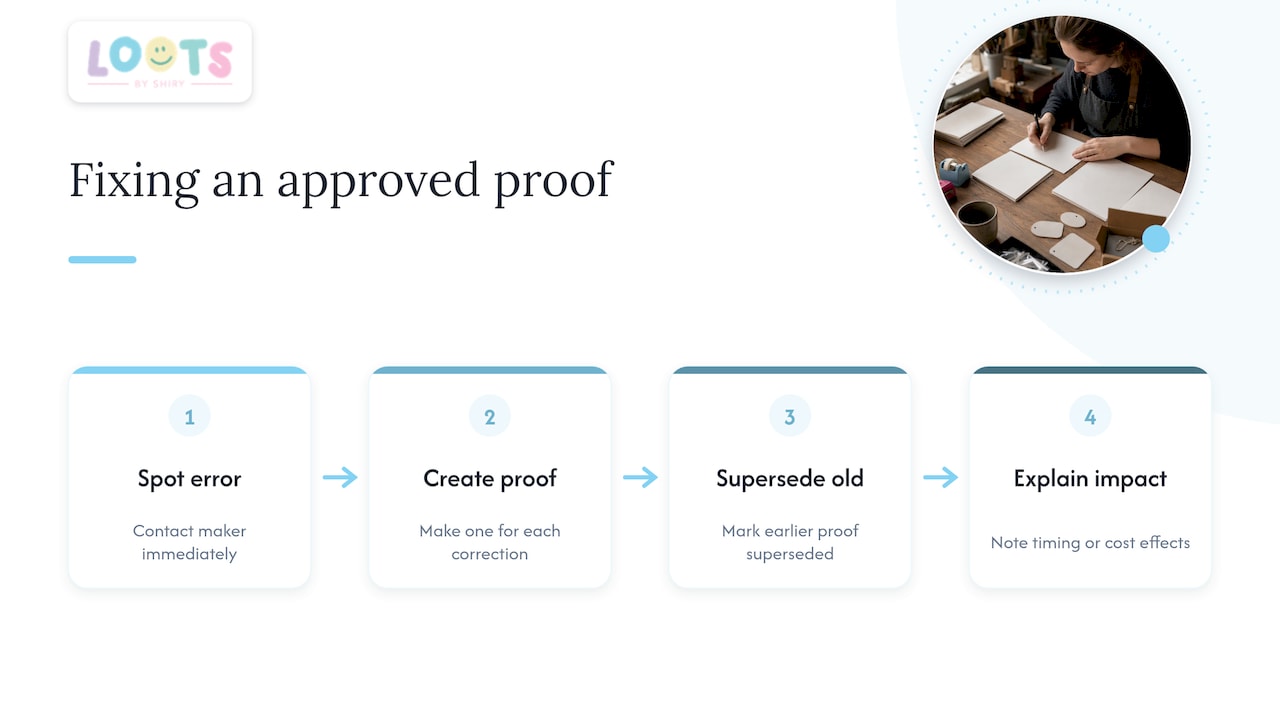
After approval, changes are not guaranteed and may delay the order if production has started, according to Printiverse’s proofing process. If you spot an error right after approving, contact the maker immediately. Do not wait for delivery. Speed gives you the best chance of catching the order before it is made.
oBizee suggests a tidy practice for fixes: create a new proof for every correction, mark the earlier proof superseded, and explain any timing or cost effect if production has begun. As a buyer, you can ask for the same: a fresh proof each time, and a clear note on whether the fix changes your delivery date.
If an order arrives wrong, the rules on returns for personalized goods in Canada are different from ordinary retail. Our page on returns of personalized items in Canada explains where defects still qualify.
How long can a name be on a patch, bag or tumbler?
There is no single universal limit. How many letters fit depends on the patch or print area, the letter height, the font and the method. Three things drive it.
1. The size of the space
A patch is a fixed rectangle. The more letters you put in, the smaller each letter must be. Patch makers commonly set a character cap, and some set a lower one for capital letters because capitals are wider. A cap that applies to a simple first name may not apply to a full name with a middle name.
2. Letter height and legibility
Embroidery is stitched with thread, not printed with ink, so very small letters fill in. Embroidery guidance often cites a minimum letter height of around 4 to 5 mm for legibility. Our own guide to embroidery-ready name fonts that read at 4 to 12 mm covers which fonts hold up at the small end. A bold, simple font at a modest size will beat a decorative script every time on a small patch.
3. Line breaks
A long name can sometimes be set on two lines, such as first name above and last name below. That keeps letters larger, but it changes the look, and it needs to be visible on the proof. If you want a two-line layout, say so before the proof is made, not after.
What this means for approval
When you review the proof of a long name, ask yourself:
- Can I read every letter at the size it will really be?
- Are any letters crowded or touching?
- Would a shorter version (a nickname, a first name and initial) look better?
For first name only versus initials or monogram, see our four production checks for monogram or name.
Quick guide to common name situations
| Situation | What to decide before approving |
|---|---|
| Short first name (3 to 6 letters) | Usually fits easily. Choose a font and size and check capitalization. |
| Long first name (9 or more letters) | Check letter height. Consider a simpler font or a slightly larger patch area. |
| First and last name | Decide one line or two lines. Check that both lines are legible. |
| Hyphenated or accented names | Confirm the hyphen and accent appear on the proof. |
| Nicknames | Confirm with the family which version they want. |
| Initials or monogram | Confirm the order of letters and whether periods are used. |
Names on gifts and favours for events
Party and event orders add another layer. You are not approving one name but many, and the people reading the names are often children, guests or clients who will notice an error at once.
- Birthday parties. Get the guest list spelled by parents, not by the birthday child. Siblings, cousins and friends with similar names are where swaps happen.
- Corporate events. Check titles, company names and how each person likes their name written. Our corporate gift personalization etiquette for Canada goes further on what is appropriate to print.
- Themed events. A themed name style, such as an uppercase block font for a construction party, must still be readable at the size of the item.
- Last-minute guests. Add a buffer for extra guests. Our party favour etiquette guide suggests ordering the guest count plus 10%. Blank spares or spare spellings should be approved with the same care.
Timelines matter too. Rushing an order tends to squeeze the approval stage, which is when mistakes get through. Our page on custom favour turnaround time explains how to leave room for proofing and avoid rush fees.
Our perspective: approval is a conversation, not a click
We make customizable loot bags, and the part of the process we care about most is the part where you tell us what you want. Names, patches, colours and themes all come from you. That is the point of personalization, and it is also why spelling matters so much. The design is driven by your input, so the name you give us is the name that matters.
Here is what we recommend to anyone ordering names from us or from anyone else:
- Send names in one typed list, not scattered across messages.
- Tell us if a name has an unusual spelling, an accent or a hyphen.
- Say whether you want capitals or lowercase.
- Tell us the product each name belongs on.
- If you are unsure how a long name will fit, ask before you order rather than after.
The best orders are the ones where the buyer has done two minutes of checking up front. A name that is right in the list is almost always right on the bag.
— Shiry
Ordering personalized loot bags and gifts from us
If you are planning a birthday, a themed party or a corporate event, our loot bags let you choose names, patches and colours. Wrapping is $0.50 per bag, and delivery is $10. Loot bag pricing is not published on the page, so ask us about your quantity.
For other personalized pieces, our shop lists cotton tote bags at $12.00, pastel pouches at $12.00 and colour-changing tumblers at $10.00. If you are weighing items for a group, our guides to event tote bags and tumbler personalization options for 20 tumblers can help you choose before you build your name list.
Common approval mistakes to avoid
- Approving from a phone screen. Small screens hide small errors. Open the proof on a laptop or zoom in.
- Checking only the first name. The last name, the second line and the date are also text.
- Assuming the maker will catch it. They match your submission. They cannot know your family’s spelling.
- Sending corrections in pieces. Several messages invite a missed fix. Send one.
- Approving a revised proof without rereading it. Fixes sometimes shift line breaks or placement, so check the whole thing again.
- Waiting for delivery to check. Once approval is given, time is on the maker’s side, not yours.
FAQ
What does name spelling approval mean?
It means you confirm that each name on your proof is spelled and styled the way you want, and that the item can be made exactly as shown. After you approve, the maker generally treats the spelling as correct. Always read the order terms for how your shop handles it.
Can I change a name after I approve my order?
Sometimes, but it is not guaranteed. If production has started, a change may delay your order or may not be possible. Contact the maker as soon as you see the error and ask whether a new proof can still be made.
How many letters can I put on a name patch?
It depends on the patch size, the font, the letter height and whether the name is on one line or two. Some patch sellers set a character limit, and capitals usually allow fewer letters than lowercase. Ask the maker how your longest name will look, and check it on the proof.
What should I send so my names are right the first time?
Send a typed list with the exact spelling, accents and hyphens, the capitalization you want, and the item each name belongs on. Flag any name that is easy to misspell. This makes the proof quicker to check and cuts the chance of a swap.
Sources
- Proofing & Approval Process – Printiverse
- Approve personalised gift wording before making the item – oBizee
- How to Order – Stay Golden Custom