
Choose a catalogue order when you want a ready-made option with a visible price and a quick checkout. Choose a custom order when the item itself has to change for your event: a new design, an unusual size, a one-off theme. For most birthdays, showers and corporate events, the best answer sits in between: a catalogue base that you personalize with names, colours and patches.
This guide explains what each route means, what it costs you in time and risk, and how Canadian consumer rules treat personalized goods. It is written for parents, event planners and hosts ordering loot bags, pouches, totes and tumblers.
TL;DR
- Catalogue means you pick from set products with clear prices. It is faster and easier to compare, but you get only what is listed.
- Custom means the product is shaped around your request. It gives the most control, but it needs a conversation, a specification and usually more lead time.
- Personalized catalogue items (choose a product, then add names, colours or patches) cover most party needs without a quote.
- In Canada, sellers generally don’t have to accept returns on non-defective items, so read the policy on personalized goods before you pay.
- Check names, spellings and quantities before you confirm. Mistakes in personalization are the most common reason a favour order goes wrong.
Table of Contents
- What “catalogue” and “custom” actually mean
- Side-by-side: how the routes compare
- When a catalogue order is the smarter choice
- When a custom order is worth it
- The middle path: personalize a catalogue product
- Our view: why personalization beats both extremes
- Returns, refunds and personalized goods in Canada
- How to decide: five quick questions
- Why the custom model can offer more choice
- Start your order
- FAQ
- Sources
What “catalogue” and “custom” actually mean
The two words get used loosely, which is why people end up disappointed. There are really three models.
Catalogue (standard) ordering. The product exists as a defined option. You choose it, pick the colour, size and quantity, and pay the listed price. Nothing about the product is negotiated.
Made to order. The item is built after you order, but from existing options. Made-to-order products are standard items produced only once an order is placed, whereas custom products are changed uniquely for each buyer, for example with specific dimensions or artwork, which calls for price and specification discussion.
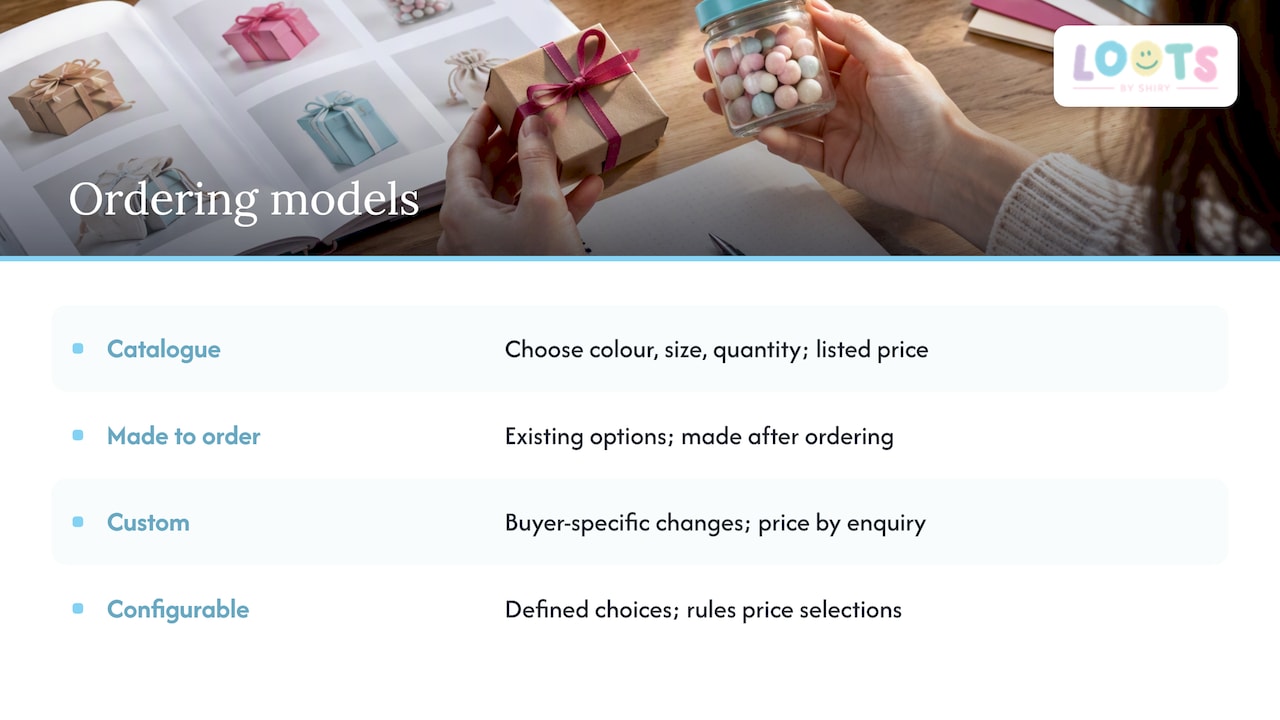
Custom. Designed around your brief. Price depends on what you ask for, so it is usually settled by enquiry rather than at a checkout button.
The same source describes a useful middle category, configurable products. These use defined rules to calculate a price from your selections, such as colour or size, with no manual negotiation. That is the model most personalized party favours follow, and it is the one we recommend you look for first.
Side-by-side: how the routes compare
| Catalogue | Personalized catalogue | Fully custom | |
|---|---|---|---|
| What you choose | A listed product | A listed product plus names, colours, patches | Design, size, materials, theme |
| Price | Fixed and visible | Fixed base, sometimes plus add-ons | Quoted after your brief |
| Back-and-forth | None | Light, mostly at checkout | Several messages |
| Speed | Fastest | Fast | Slowest |
| Risk of misunderstanding | Low | Low to medium (spelling, colours) | Higher unless the spec is written down |
| Best for | Simple gifts, last-minute needs | Birthdays, showers, team events | Unusual themes, special formats |
No route is better in itself. The right one depends on how much your event differs from what a seller already makes.
When a catalogue order is the smarter choice
A catalogue is easier to trust. You can see what you are buying and what it costs before you commit, and that matters when you are working to a per-guest budget.
Choose it when:
- The date is close. There is no design discussion to wait for.
- You are comparing totals. A fixed price lets you multiply by your guest list and see the budget at once.
- Your theme is flexible. If a pastel pouch or a cotton tote works for your event, there is no reason to pay for design work.
- You are ordering once. A one-off favour order rarely justifies a long specification process.
There is a wider point here too. Canada Post reports that 7 in 10 Canadians browse a printed catalogue before buying online. Buyers like to see a defined range first, then decide. A good catalogue gives you that confidence even when the final item is personalized.
When a custom order is worth it
Custom is worth the extra effort when a standard product cannot do the job. Typical cases: an unusual size for a gift set, a theme that needs specific colours and patches working together, or a mixed order where different guests get different versions.
The trade-off is that someone has to turn your wishes into something buildable. Businesses that sell custom goods online often capture requirements, agree a price and take a deposit before production starts, because a standard cart assumes a fixed price and full payment at once. Custom goods also need a production-ready specification rather than a wishlist, which is why a good seller will ask you questions before quoting.
That is a good sign, not a nuisance. If a seller accepts a vague custom request with no questions, expect surprises later.
What to put in a custom brief
- Quantity, and whether every item is identical or each carries a different name.
- Exact wording, spelled the way it should appear, including accents and capitals.
- Colours, named clearly. “Light blue” means different things to different people, so add a reference photo if you can.
- Delivery date, and the date of the event, since they are not the same.
- Budget per item, so the seller can propose options that fit.
If you want to see how a business shows a customer what they will receive before production, this explanation of how custom uniforms move from free mockup to delivery walks through the same mockup-then-approve logic. The scale is different, but the principle holds for any personalized order: see it, approve it, then make it.
The middle path: personalize a catalogue product
Most of our customers do not need a blank-page design. They need a good bag, with the right name on it, in the right colours, by a certain date. That is a catalogue product with personalization on top.
This route keeps the price clear and the process short, while still making the favour feel made for the guest. It also keeps your risk low, because the base product is known.
At Loots by Shiry, you can start from the range and shape the details:
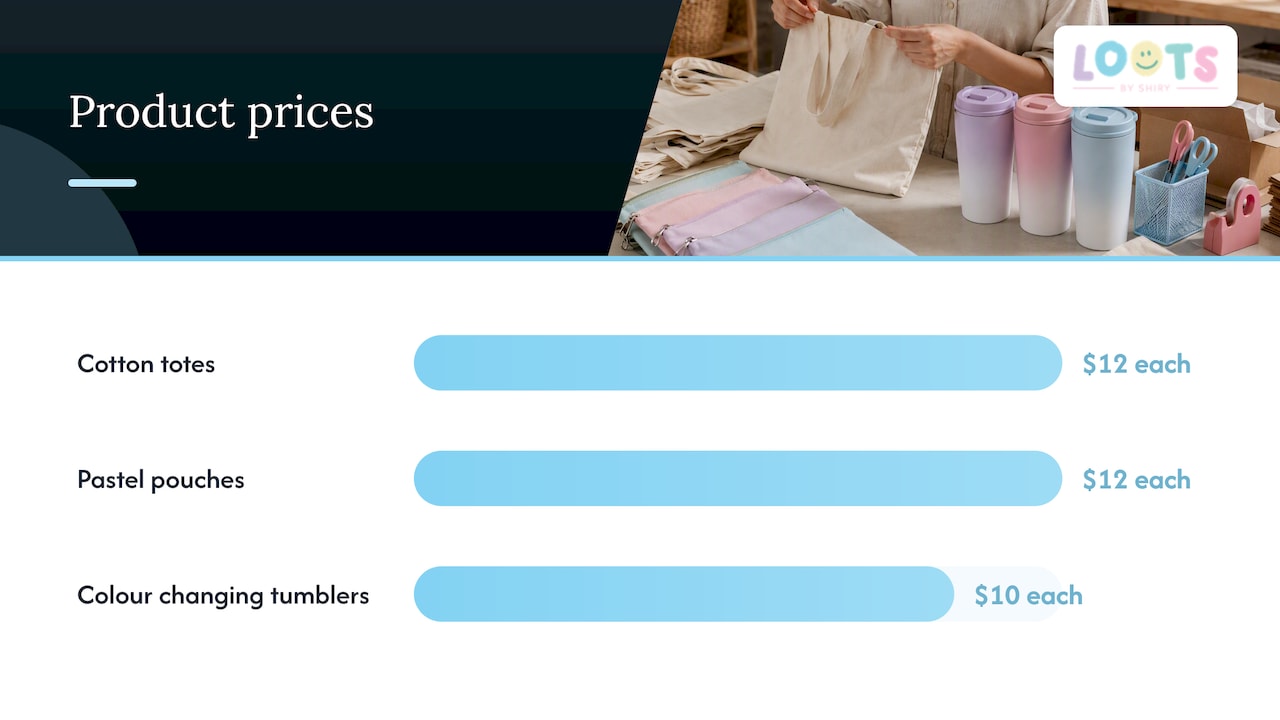
- Cotton tote bags at $12.00 each
- Pastel pouches at $12.00 each
- Colour changing tumblers at $10.00 each
- Loot bags, where you choose names, patches and colours
Wrapping is $0.50 per bag and delivery is $10. We have not published a price for loot bags on the page, so we will not guess one here: open the product page to see the options.
For ideas on what works in each product, our guides on pouch favours, custom tote bag ideas and loot bags by age group go into detail.
Our view: why personalization beats both extremes
We started from a simple annoyance. Party favours are often generic: the same plain bag, the same filler, no sign that anyone thought about the guest. At the other end, fully custom work can feel like a project of its own, with quotes, proofs and deadlines that a parent planning a birthday does not have time for.
So we built around the part that matters most to guests: their name, their colours, a patch that fits the theme. You make the creative decisions, and we handle the making. That keeps the experience interactive without turning it into a design commission.
Our honest advice:
- If a listed product with personalization does the job, use it. It is faster and the price is clear.
- If you need something we do not list, ask. We take custom orders by enquiry, and we would rather talk through your idea than have you settle.
- Whatever you choose, write every name down in one list and check it twice. Our guide to keeping names consistent across bulk orders shows how event planners avoid mix-ups.
— Shiry
Returns, refunds and personalized goods in Canada
This is where the custom versus catalogue question has real consequences. A bag with a child’s name on it cannot be resold, so sellers treat personalized goods differently from stock items.
What the official guidance says:
- Businesses in Canada are not obliged to accept the return of purchased items unless they are defective, although many offer refunds or exchanges to keep customers happy.
- Under the harmonized template for online sales, sellers must disclose all terms, including refund and cancellation policies, before a contract is entered into. The same document gives consumers a general right to cancel if delivery is delayed beyond 30 days of the agreed date.
Rules differ by province, and this is general information, not legal advice. If you have a dispute, your provincial consumer protection office is the place to ask.
In practice, this means you should do three things before paying for any personalized order, from any seller:
- Find the policy on personalized items and read it.
- Confirm who is responsible if a spelling error is in your order versus the seller’s production.
- Keep your written confirmation of names, colours and quantities.
Our own terms are on our refund and returns page. Read it before you order.
How to decide: five quick questions
- Is there a listed product that would work if it carried your guest’s name? If yes, order from the catalogue with personalization.
- Is your deadline under a few weeks? Lean on catalogue items. Custom work needs room for questions and approval.
- Do you need something not on the site? Send a custom enquiry with the brief above.
- Is your budget fixed per guest? Pick a catalogue base so the total is known before you commit.
- Are you ordering for an organization, with many names? Prepare a spreadsheet of names and confirm it before production.
If you are also weighing different kinds of sellers, our overviews of swag bag vendors in Canada and how to present gift bags at an event cover what organizers look for.
Why the custom model can offer more choice
One point that surprises buyers: made-to-order and custom businesses can often offer a wider range than a shop that stocks everything. Practitioners in Canadian on-demand production note that without inventory, a business can keep a much deeper catalogue than a warehouse could hold. Another Canadian producer explains that making items only after an order arrives avoids the cost and waste of overproduction.
For you, that means a catalogue and a custom service are not opposites. A seller who makes to order can list many colour and patch combinations, and still treat your order as yours.
Start your order
If you already know what you want, go to the shop for totes, pouches and tumblers, or to our loot bags page to choose names, patches and colours. If your idea does not fit a listed product, tell us what you have in mind and we will tell you honestly whether we can make it.
FAQ
Is a custom order always more expensive than a catalogue order?
Not always, but it is less predictable. A catalogue item has a fixed price, while a custom order is priced after your brief because the work differs each time. Personalizing a catalogue item usually keeps the cost close to the listed price, plus any stated add-ons such as wrapping at $0.50 per bag.
What is the difference between made to order and custom?
Made to order means the item is produced after you order, from options that already exist. Custom means it is designed to your own specifications, with price and details agreed first. Many personalized party favours sit between the two, with set products and your choice of names and colours.
Can I return a personalized item in Canada?
Generally, businesses are not required to accept returns unless the item is defective. Sellers must also disclose their refund and cancellation terms before you buy. Read the seller’s policy before you pay and keep your written order details.
How do I avoid name mistakes on a bulk order?
Send one clean list with exact spellings, check it with the host, and confirm it in writing before production. Mixed-up names are the usual cause of problems in bulk orders, so a single approved list prevents most of them.
Should I order a sample first?
For a large order, yes, if the seller offers that. A single item shows you the colours, the print and the quality before you commit to the full quantity. Ask about it when you enquire.
Sources
- Refund and exchange, Office of Consumer Affairs
- Internet Sales Contract Harmonization Template, Consumer Measures Committee
- Custom and made-to-order quotes on Shopify, QuotWay
- Bring your brand to life with catalogues, Canada Post
- Atelier Imparfait, custom manufacturing case study, Human After All
- Print on Demand Canada, Pick & Print
- Inside on-demand 3D printing, 3DCentral