Five methods cover almost every request you will ever make: laser engraving, UV printing, sublimation, screen printing, and vinyl decals. Pick engraving for permanent, premium keepsakes; UV printing or sublimation for full-colour art and photos; screen printing when you need hundreds of identical units cheaply; and decals when the tumbler is a one-day giveaway, not a keepsake. The details on materials, durability, and cost live in the sections below.
TL;DR:
- Laser engraving offers the most durable, scratch-proof design but can only produce monochrome images, making it ideal for simple logos and initials.
- UV printing and sublimation provide full-color, detailed images, with sublimation best suited for seamless 360-degree wraps on compatible polymer-coated blanks.
- Most sublimation blanks require specific coatings, and ordering the wrong type often results in failed bonding, especially on powder-coated or stainless steel surfaces.
- Vinyl decals are the cheapest, fastest, but least durable personalization option, suitable only for single-event use and not long-term keepsakes.
- Small-batch orders benefit from choosing engraving or UV printing, as they require less volume and avoid setup costs associated with high-volume screen printing.
Table of Contents
- What are the main tumbler personalization options?
- Which tumbler material works with each method?
- How durable is each tumbler personalization method?
- What are some creative tumbler design ideas by occasion?
- What should you ask a supplier before ordering personalized tumblers?
- Why small-batch tumbler orders need a different approach
- Custom tumblers and loot bags, ordered together
- Where to verify material specs and personalization claims
- Sources
- FAQ
What are the main tumbler personalization options?
Every personalization method makes a different trade between permanence, colour range, and price per unit. Knowing how each one physically works tells you which trade you’re actually making.
Laser engraving burns away a thin layer of coating with a focused beam, exposing the bare metal underneath. Because the mark is physically etched rather than applied on top, it can’t peel, fade, or wash off. That’s why laser engraving removes coating to reveal metal beneath, creating a scratch-proof permanent mark, and why suppliers push it hard for corporate gifts and wedding keepsakes. The trade-off is colour: engraving is monochrome by nature, showing the tumbler’s base metal against whatever finish surrounds it. Fine text, monograms, and simple logos engrave beautifully. Photographs and gradients do not.
UV printing cures ink with ultraviolet light almost instantly, which lets it hold fine detail, gradients, and full-colour photographic art. It also works across more substrate types than most other methods. According to one comparison of tumbler decoration methods, UV printing and sublimation reproduce gradients and full-colour artwork, though sublimation requires a special polymer coating while UV printing works across more substrates. The catch is that UV print sits on the surface rather than in it, so its lifespan depends heavily on how well it’s sealed.
Sublimation turns dye into gas under heat, which bonds into a special coating on the tumbler and produces a seamless, wraparound design with no visible print edges. It’s the best option for full 360-degree photo wraps or busy repeating patterns, since sublimation achieves seamless 360° coverage and is the preferred method for full-wrap photographic designs when the blank is sublimation-ready. That last qualifier matters more than most buyers realize, and it gets its own section below.
Screen printing and pad printing push ink through a stencil or plate, which makes them fast and cheap once the setup is done, but expensive per unit at low volumes. Screen printing remains the most cost-effective option for simple 1 to 2 colour logos at high volumes, typically hundreds of units and up. Below that threshold, the setup fee eats any savings.
Vinyl decals and stickers are the cheapest and fastest route to full colour, no printing equipment required. They’re also the least durable option on this list, which makes them a poor fit for anything meant to last past a single event.
A few niche processes round out the field: sandblast etching, which frosts glass or metal for a textured look, and hydro dipping, which floats a printed film onto the tumbler’s surface for marbled or camouflage-style patterns. Both are worth knowing about, but most suppliers treat them as specialty add-ons rather than everyday options.
Design complexity is really the deciding factor for most buyers. Monochrome logos and text favour engraving, while photographic or gradient art requires UV printing or sublimation almost by default.
Which tumbler material works with each method?
The method you want and the blank you order have to match, or the job simply won’t hold up. This is where most first-time buyers get burned, usually because a supplier never asked what coating was underneath.
Powder-coated stainless steel is the most common tumbler blank, and for good reason. The textured coating improves grip and resists everyday scuffs, and powder-coated exteriors increase grip and scratch resistance, while engraving through the coating reveals a durable metal contrast that looks intentional rather than accidental. UV printing also works well on powder coat, provided the ink is properly cured.
- Bare stainless steel: engraves cleanly but shows less contrast on a glossy finish than on a matte or powder-coated one.
- Sublimation-ready polymer coatings: required for sublimation to bond at all; ask suppliers to confirm these by name, not just “coated.”
- Plastic substrates (Tritan, SAN, polycarbonate): print well with UV ink but scratch more easily in daily use than metal.
- Glass and ceramic: take engraving and specialty printing beautifully but carry real breakage risk, so they suit gift and display use more than active outdoor use.
Sublimation is the method most likely to fail silently if you order the wrong blank. Sublimation cannot bond to standard powder-coated or bare stainless surfaces; it requires a polyester or polymer coating labelled specifically for sublimation, and ordering the wrong one is one of the most common production failures in the whole category. If a listing doesn’t say “sublimation-ready” or name the coating, assume it isn’t.
Pro Tip: Matte and satin powder coats give engraving noticeably more contrast than glossy finishes, since the exposed metal shows through more cleanly against a duller surrounding surface.
Choosing between stainless steel and plastic blanks in the first place comes down to insulation and how premium the gift needs to feel. Stainless steel offers superior insulation and durability, while plastic wins on lower cost and a wider range of stock colours.
How durable is each tumbler personalization method?
Durability claims on product pages are often vague on purpose, and the method behind the design is usually the real determinant of how long it lasts.
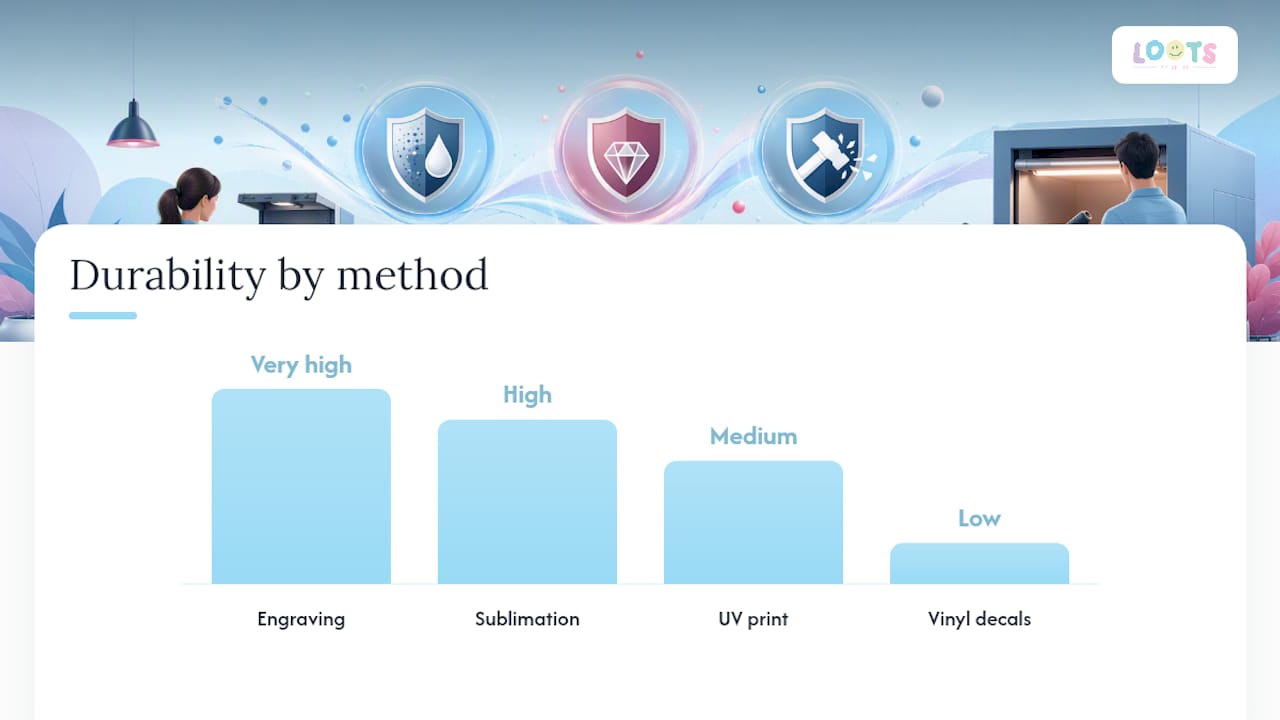
Engraving is the benchmark for permanence. Because the design is physically removed from the surface rather than sitting on it, there’s nothing to peel, fade, or scrub off short of grinding the metal down. The one caveat: coated finishes and printed lids can still wear or fade even when the engraved body doesn’t, so check both parts separately before promising a customer “lifetime” durability.
UV print sits closer to the middle of the durability spectrum, and the deciding factor is the clearcoat. UV printing durability depends on the ink stack and an overlaminate or clearcoat; when a vendor skips the UV clearcoat, expect earlier abrasion marks in cup holders or bags. Always ask whether a clearcoat is included, and request a sample if the design will see daily handling.
Sublimation holds colour well over time as long as it’s bonded into the correct coating, and it resists chipping since there’s no raised ink layer to catch on anything. Vinyl decals sit at the other end. Vinyl decals are cheap and full-colour but prone to lifting and peeling with repeated washing, which makes them a fine choice for a same-day event and a poor one for a keepsake meant to survive a dishwasher for years.
Speaking of dishwashers: that label deserves more scrutiny than most buyers give it. A general “dishwasher safe” claim on a tumbler listing doesn’t tell you much on its own, because manufacturer dishwasher claims are per-product, and the imprint method plus lid materials often determine real dishwasher tolerance more than the base tumbler does. An engraved body might survive years of dishwasher cycles while a printed lid on the same tumbler fades within months. If durability matters, ask what was actually tested, not just what the listing claims. Hand-washing extends the life of any printed or decal finish considerably, even when the label says otherwise.
What are some creative tumbler design ideas by occasion?
Good design ideas save you from staring at a blank template wondering where to even start. These work as-is or as a jumping-off point for your own version.
- Weddings: a monogram with the wedding date, engraved on stainless steel for a keepsake guests actually keep. This is a natural fit for wedding favours that guests want to hold onto rather than toss.
- Corporate events: logo plus a short tagline, in UV print or screen print depending on volume, kept to one or two brand colours for consistency across a large order.
- Kids’ birthday parties: a favourite character or motif paired with the child’s name, full colour, which is where sublimation or UV printing earns its keep over engraving’s single-tone limit.
- Sports teams and leagues: team name and jersey number, either engraved for a season-end award or screen printed for a full roster of identical cups.
- Novelty and colour-changing finishes: a gradient or colour-shift base with a simple engraved name on top, which reads as more premium than either method alone.
The decision between engraving and a full-colour wrap usually comes down to how much visual impact the design needs versus how permanent it needs to be. A monogram doesn’t need colour to look intentional; a photo or character illustration does.
A few layout rules keep any of these templates from looking amateurish: keep logos and text large enough to survive the tumbler’s curve without distortion, leave a safe margin near the base and lid where seams or handling wear happen first, and pick high-contrast colour pairings so text stays legible from a few feet away. Repeating pattern bands and partial wraps are easier to execute cleanly on a curved surface than a single large photo panel, which tends to stretch awkwardly near the edges.
What should you ask a supplier before ordering personalized tumblers?
A short checklist before you place an order avoids most of the regret that shows up after the box arrives.
- Decide the tumbler’s intended life first: a wedding keepsake justifies engraving’s higher cost, while an event giveaway doesn’t need to survive past the event itself.
- Ask directly whether the blank is sublimation-ready, powder-coated, or bare stainless, since vendors commonly require artwork in vector formats for engraving and screen printing and mismatched files or blanks cause most reorders.
- Request a physical or digital proof before full production, and get colour-matching tolerances in writing if brand colours matter.
- Confirm minimum order quantities, lead time, and shipping options up front. Screen printing’s cost advantage disappears fast below a few hundred units.
- Watch for red flags: a vague “dishwasher safe” claim with no specifics, a supplier who won’t name the coating on the blank, or no proofing step before your full run gets printed.
Event planners often split orders deliberately, since mixing materials lets planners use premium stainless steel for VIP gifts and lower-cost plastic for mass giveaways to balance budget and perceived value, balancing budget against how special a given guest list needs to feel.
Why small-batch tumbler orders need a different approach
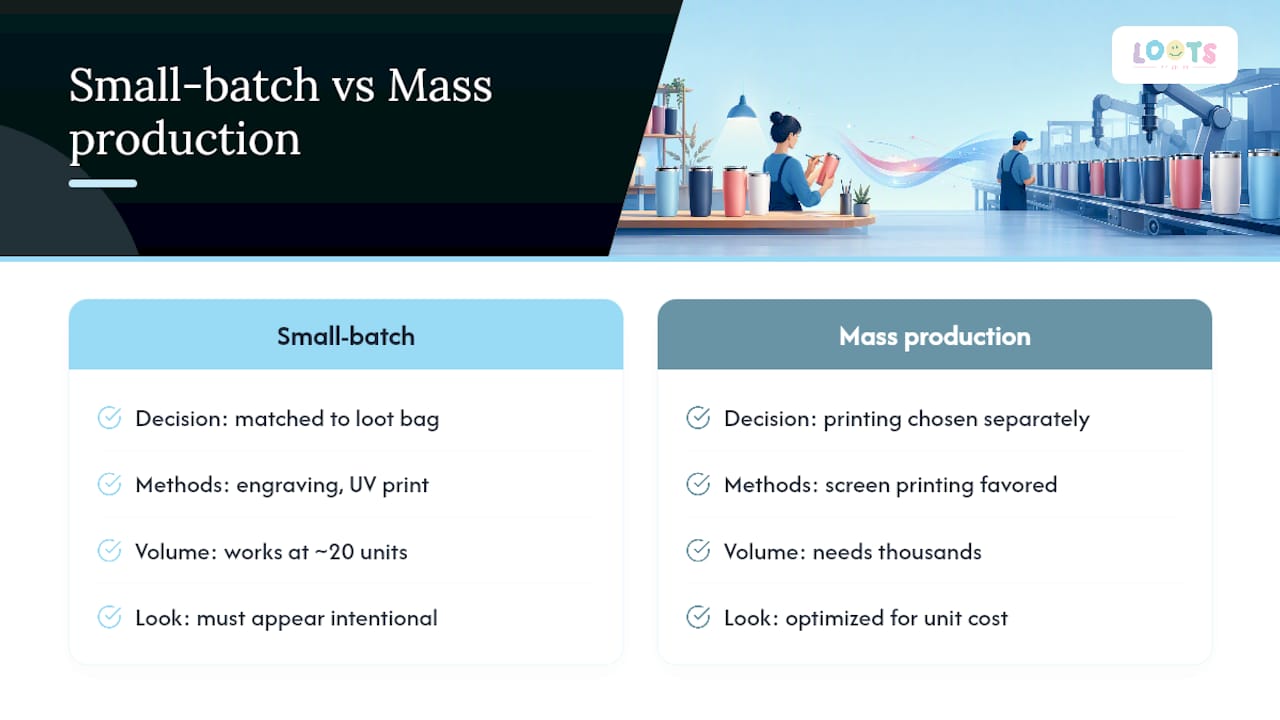
Most personalization guides are written for factories running thousands of identical units. Small event orders don’t work that way, and treating them like a mini version of a bulk order is where a lot of planners waste money.
At LootsByShiry, tumblers get chosen and matched to a loot bag theme as one coordinated decision, not two separate purchases that happen to arrive in the same box. That’s a different problem than picking a printing method in isolation. A colour-changing tumbler paired with a themed loot bag needs the personalization method to hold up on its own merits and to look intentional sitting next to everything else in the bag. Engraving and UV print earn their place in small runs precisely because they don’t require the volume that makes screen printing worthwhile, which matters when you’re ordering twenty tumblers, not two thousand. Getting personalization and packaging right at the same time is the actual job, not an afterthought tacked onto a printing decision.
— Shiry
Custom tumblers and loot bags, ordered together
LootsByShiry sells personalized tumblers, including colour-changing options, designed to be ordered alongside loot bags rather than sourced separately and matched up after the fact.
That matters most for small-batch orders, where mismatched colours, fonts, or themes between the tumbler and the bag are the easiest way to make an otherwise nice gift look thrown together. Ordering both from one place solves that without extra coordination on your end. To get started:
- Browse the loot bag shop or colour-changing tumbler page to see current styles.
- Reach out through personalize party favors to request a proof, confirm quantities, and get a lead time for your event date.
- Ask about bundling tumblers with themed loot bags if you’re planning a birthday, corporate event, or milestone celebration.
If you want the full range of customizable products beyond tumblers, the shop is the place to start browsing.
Where to verify material specs and personalization claims
A few outside resources are worth bookmarking if you want to double-check a supplier’s claims before you commit to an order. The stainless steel versus plastic comparison breaks down insulation and durability trade-offs in more detail than most product listings bother to. The scratch-proof durability guide covers what actually holds up to daily handling. For a side-by-side look at engraving, UV printing, screen printing, and sublimation, the tumbler printing methods comparison is a solid technical reference, and readers weighing longevity against upfront cost should look at the engraved versus decal durability breakdown.
Sources
- Stainless Steel vs. Plastic Tumblers: Which to Pick
- Scratch‑Proof Personalized Tumblers: The Durability Guide
- Laser engraved vs. vinyl decal tumblers: which actually lasts?
- Customised Tumbler Printing Methods: Laser Engraving vs UV Printing vs Screen Printing vs Sublimation
FAQ
What is the best way to personalize a tumbler?
There’s no single best method. Choose laser engraving for a permanent keepsake, UV printing or sublimation for full-colour or photographic art, and screen printing only once your order runs into the hundreds of units.
What are the different types of personalized tumblers?
The main categories are laser engraved, UV printed, sublimated, screen printed, and vinyl decal tumblers, each suited to different combinations of budget, colour needs, and how long the design needs to last.
Which personalized tumbler option lasts the longest?
Laser engraving lasts the longest because the design is cut into the metal itself rather than applied on top, so it can’t peel or wash off the way vinyl decals do.
What are some creative ways to decorate a tumbler?
Popular approaches include engraved monograms with a date for weddings, full-colour character designs for kids’ parties, and gradient or colour-changing bases paired with a simple engraved name for a premium look without a full photo wrap.
Is UV printing or sublimation better for photo-quality designs?
Both handle gradients and photographic detail well, but sublimation needs a specific polymer-coated blank while UV printing works across a wider range of tumbler materials, which makes UV printing the more flexible choice when you’re unsure what blank you’re starting with.