
Order simple stock-print favours 1 to 2 weeks out, moderately customized items 2 to 6 weeks out, and complex or handcrafted pieces 6 to 12 weeks out. The one thing that starts the clock on any of these windows is a finalized, approved design and a locked guest count. Submit those two things late, and even the fastest vendor can’t save your date.
TL;DR:
- Custom favors requiring molds, engraving, or handcrafted details can take 6 to 12 weeks or more, especially for larger or intricate orders.
- Proof approval, often causing delays, typically takes 2 to 3 business days per round, with many orders needing at least one revision before final sign-off.
- Lead times increase by 30 to 50% during peak seasons like Q4, so plan well in advance if your event falls in November or December.
- Ordering early, locking guest lists and artwork beforehand, and setting internal approval deadlines significantly reduce delays.
- Rush orders are expensive and may compromise quality, so they should only be considered when delays are unavoidable, not as a regular solution.
Table of Contents
- Custom favor turnaround time: the production stages behind the number
- Recommended lead times by favour type and order size
- Why proof approvals are where most delays actually happen
- Turning a vendor quote into an actual delivery date
- What rush orders actually cost you, in money and in quality
- What to have ready before you click order
- How LootsByShiry handles turnaround from order to doorstep
- What I’ve learned fulfilling custom favour orders
- Order your favours with a supplier that treats your date as fixed
- Sources
- FAQ
Custom favor turnaround time: the production stages behind the number
The “custom favor turnaround time” a vendor quotes you isn’t one block of days. There are five separate stages stacked together, and each one has its own rhythm. Knowing where the time actually goes helps you spot delays before they blow past your event date.
Here’s how a typical order breaks down once you hit “submit”:
- Order acknowledgement: usually same day to 2 business days, confirming your order and specs are received.
- Proof approval: budget 2 to 3 business days per round of back-and-forth revisions, and most orders need at least one round.
- Production: ranges from 3 days for simple printed items to 21 days for anything requiring molds, engraving, or hand assembly.
- Packing: 1 to 5 days depending on order size and whether items need individual bagging or tagging.
- Shipping: 1 to 7 business days for domestic ground delivery, faster with expedited service.
The most overlooked detail in that list: the vendor’s clock does not start until artwork and payment are both finalized. A quote of “10 to 14 business days” almost always means 10 to 14 days after approval, not from the moment you first emailed. Different favour categories move at genuinely different speeds. Printed photobooks or paper goods often ship in 3 to 7 business days once approved, engraved jewellery or metal pieces run 5 to 14 days, and handcrafted items can take 2 to 6 weeks because each piece is assembled individually rather than mass-printed.
A sticker sheet and a hand-stitched patch bag can carry the same order date and still land on your doorstep three weeks apart. That’s not a vendor being slow. That’s just what the item is.
Recommended lead times by favour type and order size
Matching your timeline to the actual complexity of what you’re ordering saves you from either panicking unnecessarily or, worse, ordering too late. Here’s how the ranges shake out by category.
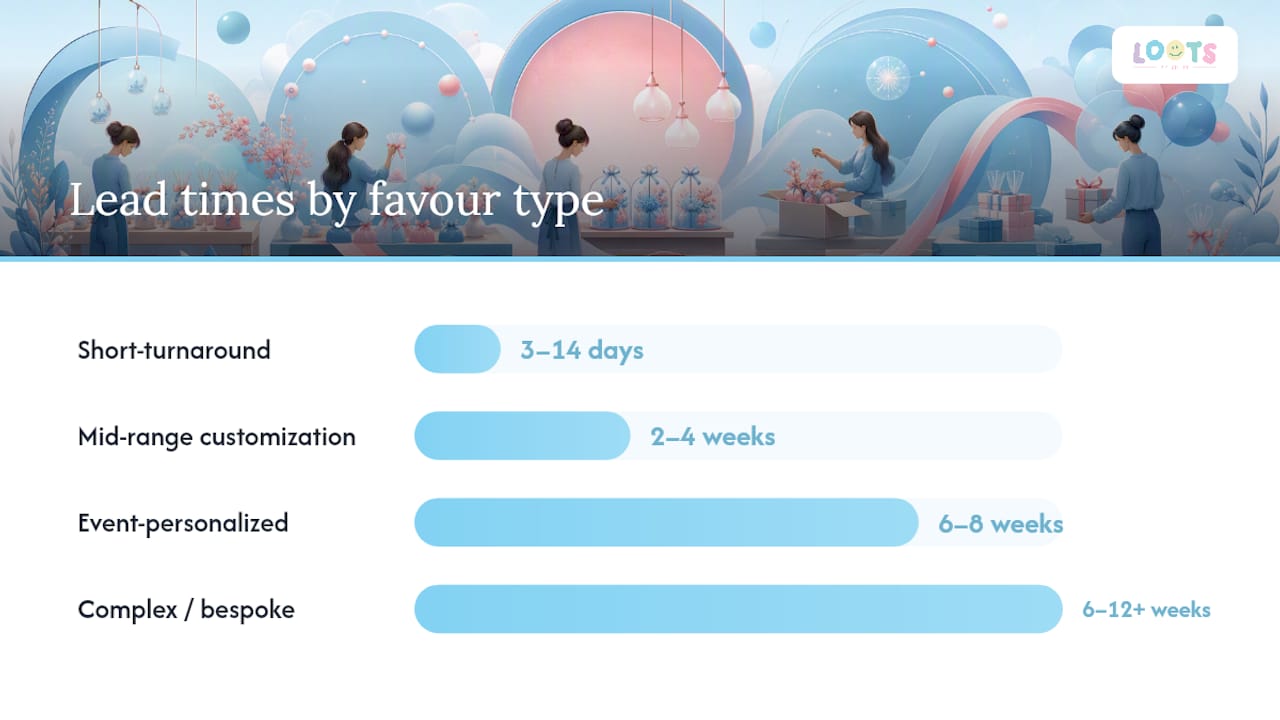
- Short-turnaround items (stock bags, simple one-color printing, generic labels): 3 to 14 days from approved artwork to delivery.
- Mid-range customization (custom-printed labels, embroidery, patches, name additions): 2 to 4 weeks, and vendors commonly recommend 6 to 8 weeks for personalized items tied to a fixed event date like weddings or milestone birthdays.
- Complex or bespoke work (molds, engraving with multiple proof rounds, fully handcrafted pieces): 6 to 12 or more weeks, especially for larger or more intricate orders.
- Large orders: add 1 to 4 extra weeks on top of any of the above, depending on minimum order quantities and where the goods are fulfilled from.
Quantity changes everything about a quote. A supplier who can turn around 25 loot bags in 10 days might need 4 extra weeks for 500, simply because the production line has to run longer and packing takes proportionally more hands.
Season matters just as much as size. Expect lead times to stretch by 30 to 50% during Q4 and other peak seasons, when every supplier’s production floor is booked with holiday orders ahead of yours. If your event lands in November or December, treat the upper end of every range above as your baseline, not your worst case.
Pro Tip: If you’re not sure which category your favour falls into, ask the vendor directly: “Is this a stock item with printing, or does it require a new setup?” That one question usually reveals whether you’re looking at a 2-week order or a 6-week one.
Why proof approvals are where most delays actually happen
Proofs, not production, are the real bottleneck in custom favor delivery time. A vendor can run a printing press in a single afternoon, but they can’t produce anything until you’ve said yes to the design, and that approval step is where orders quietly slip.
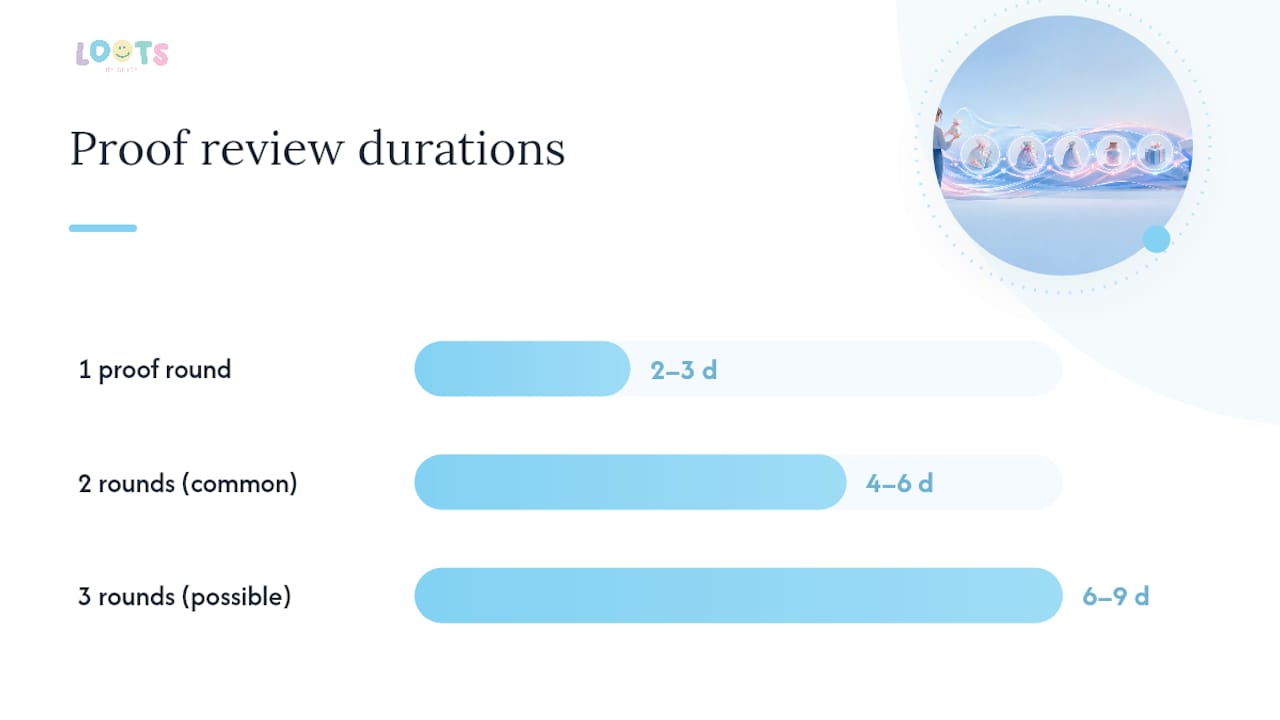
Each proof round typically takes 2 to 3 business days, and most custom orders need at least one revision before final sign-off. Two rounds is common. Three isn’t rare if you’re deciding on colours or wording as you go rather than before you submit the order.
A handful of things reliably stall this stage:
- Submitting an order before artwork files are finalized, forcing the vendor to wait on you before design work even starts.
- Unclear personalization rules, like not specifying which guests get names printed and which get a generic version.
- A guest list that changes after the order is placed, which can restart quantity confirmations.
- Files submitted in the wrong format or resolution, requiring a redo before the first proof can even be sent.
The fix is almost entirely on your side of the process. Have your files ready in the format your vendor requests before you order, not after. Decide your personalization rules (names, initials, colours) as a settled list rather than a work in progress. And set your own internal approval deadline about two weeks earlier than the vendor’s final cutoff, so a slow reply from your side doesn’t eat into production time. This detail, more than any other, decides whether your order processing time runs smooth or turns into a scramble.
Turning a vendor quote into an actual delivery date
A vendor telling you “10 business days” isn’t giving you a calendar date. You have to do the math yourself, and that math needs a buffer built in.
- Start with your event date and count backward. If your event is on a Saturday, your favours need to arrive by Thursday at the latest to leave room for unpacking and any last-minute fixes.
- Add shipping time based on the method you choose. Domestic ground shipping typically runs 1 to 7 business days; expedited or priority courier options cut that to 1 to 3 days for a fee.
- Add a buffer on top of the vendor’s quoted production window. For tight schedules, add at least 1 week. For a typical order, 2 to 4 weeks of buffer is comfortable. For complex or internationally sourced items, budget 4 to 8 weeks of buffer.
- Confirm your total against the calendar, not just the number of days quoted, since business days skip weekends and holidays that eat into your real timeline.
A useful worked example: one order tracked design approval at 5 days, sample proofing at 3 days, production at 10 days, and packing plus shipping at 7 days. That’s 25 days of actual work, but adding a 2-week contingency on top delivered the favours two weeks before the event instead of two days before it.
Choosing a domestically produced item over an imported one also removes a variable most planners forget to account for: customs delays. Domestic production paired with even a modest buffer tends to beat international sourcing whenever a fixed date matters more than shaving a few dollars off the unit cost.
What rush orders actually cost you, in money and in quality
Rush fulfilment is real, but it isn’t free and it isn’t magic. When a vendor compresses a 3-week job into 5 days, they’re paying for overtime labour, bumping your job ahead of others in the print queue, and paying premium shipping rates instead of standard ground.
- Expect a rush premium on top of your base price, and expect it to climb steeply for very short lead times or very small order quantities, since rush capacity is limited and vendors prioritize what fits their schedule.
- Quality can take a hit under rush conditions. Complex decoration, multi-colour prints, or hand-finished details are the first things vendors simplify to hit a shorter deadline.
- Ask for an expedited physical sample before full production runs, and get clear on acceptance criteria in writing so a rushed batch doesn’t surprise you at delivery.
- If your event is days away and a full custom order isn’t realistic, a same-day or local rush fulfiller may be your only workable path, though options narrow fast the closer you get to your date.
Rush is a real option. It’s a poor substitute for ordering early.
What to have ready before you click order
Half of every delay in custom favor production timelines traces back to something the buyer, not the vendor, was missing at order time. Here’s what to lock down first:
- Final guest count, plus roughly 10% extra units for breakage, last-minute additions, or gifting to vendors and staff.
- Finalized artwork files matching the vendor’s exact specs (format, resolution, colour mode).
- A clear personalization rule: who gets a name, initials, or custom colour, and who gets the standard version.
- One single point of contact approving proofs, so revisions don’t get delayed waiting on a second decision-maker.
- Your shipping address and preferred delivery window confirmed, especially if you’re shipping to a venue rather than home.
- Payment method ready to go, since many vendors won’t start the clock until payment clears.
For large or complex runs, order a small sample or pilot batch first. It costs a bit more upfront but catches colour, sizing, or personalization issues before they show up on 200 units instead of 2.
How LootsByShiry handles turnaround from order to doorstep
LootsByShiry’s production clock starts the same way any reliable vendor’s does: once your artwork is finalized, your proof is approved, and payment is confirmed. Before that point, nothing moves, which is exactly why getting those three things locked in early matters as much as the order date itself.
Here’s what that looks like in practice across our product range:
- Loot bags with name additions, patches, or colour choices generally follow a mid-range timeline, similar to the 2 to 4 week window common for customized print and embroidery work.
- Custom tote bags, duffle bags, and beanies follow a comparable production rhythm to other embroidered or printed fabric goods.
- Adult party favours and themed corporate gifts scale with quantity and complexity the same way any custom order does, so larger runs need more lead time built in.
- Rush requests are handled case by case. Reach out directly if your event is close and we’ll tell you honestly whether it’s realistic.
The pattern holds across every product line: the sooner your names, colours, and patch selections are locked, the sooner we can move your order into production. That’s true whether you’re ordering five bags for a birthday or two hundred for a corporate event.
What I’ve learned fulfilling custom favour orders
Two things stand out after years of watching orders move through production. First, the planners who lock their guest list and artwork early almost never panic later. Second, the ones who treat the proof stage as an afterthought are the same ones emailing us four days before an event asking if rush is possible.
Buffer time isn’t wasted time. It’s the only thing standing between you and a vendor’s honest answer of “we’ll try, but I can’t promise it.” Lock your names, your colours, and your guest count before you place the order, not after. That single habit does more for your delivery date than any rush fee ever will.
— Shiry
Order your favours with a supplier that treats your date as fixed
If you’ve been reading vendor quotes and wondering which one to trust, here’s the honest version: LootsByShiry’s advantage isn’t being the cheapest option. It’s giving you a straight answer on timing before you pay a cent, and a personalization process built specifically so names, patches, and colours get locked fast instead of dragging through email threads.
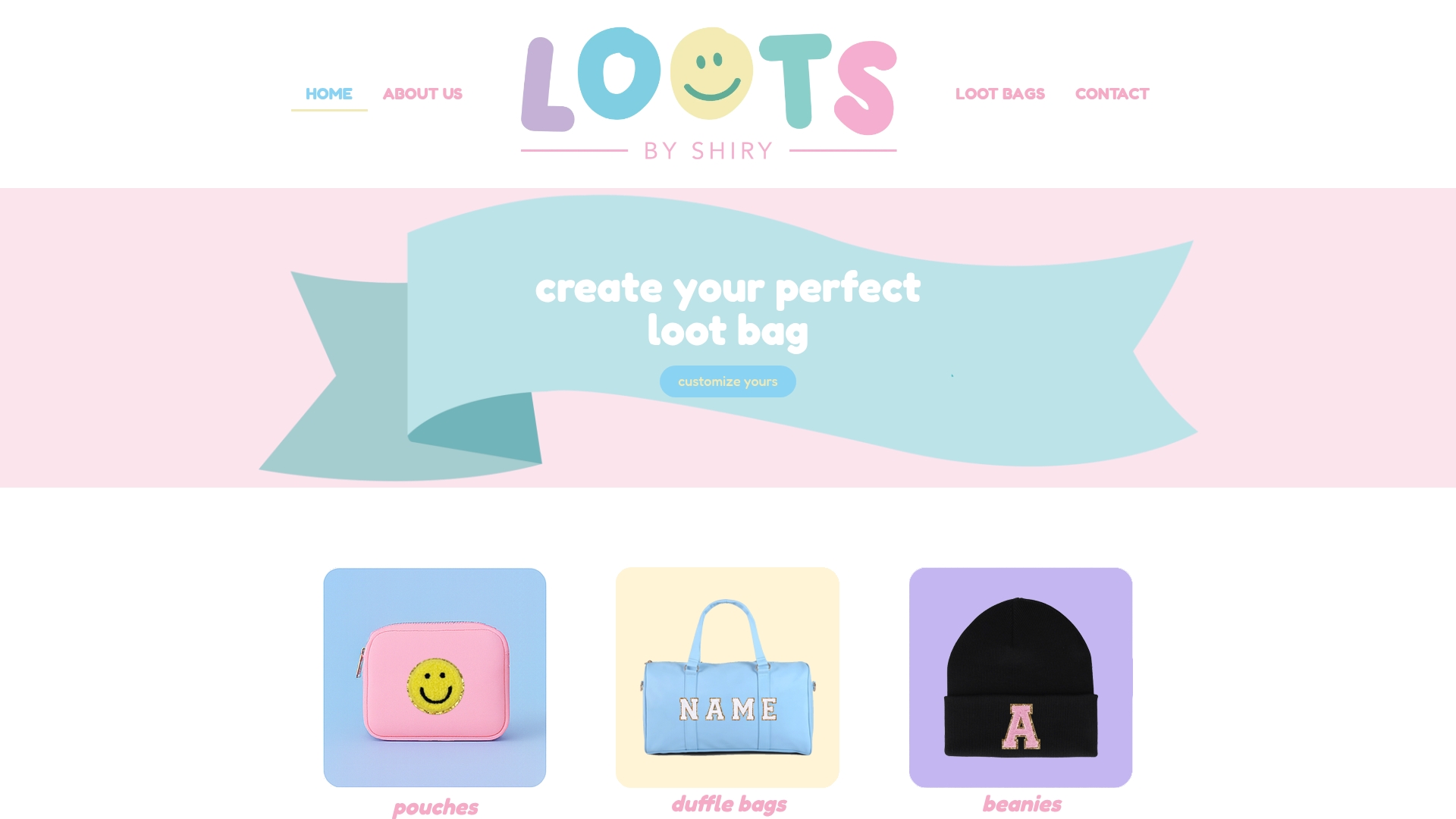
Typical orders move through design approval, proofing, and packing within the mid-range windows outlined above, and rush requests get a same-day honest assessment rather than a vague “we’ll see.” When you reach out, include your event date, guest count, and any personalization details (names, colours, patches) up front. That single step shaves days off your quote before production even starts.
Browse loot bags or cotton tote bags to see current options, or head to personalize your party favours to start building your order today.
Sources
- Perfect Timing For Personalized Wedding Favors: A Planning Guide | ShunBridal
- 7 common US–Canada shipping mistakes that cause delays | ZionShipping
- Shipping & production guide for timely keepsakes | Fondly
- Custom manufacturing lead time planning | Alibaba seller blog
FAQ
What is a normal amount to spend on wedding favours?
Costs vary widely by item type and personalization level, but the bigger planning risk is timing, not budget. Personalized favours generally need 6 to 8 weeks of lead time regardless of price point.
How many wedding favours should I order per guest?
Order one favour per guest, plus roughly 10% extra to cover last-minute additions, breakage, or gifting to vendors and helpers. Lock this final count before ordering, since a changing guest list is one of the most common causes of production delays.
Do people still give favours at weddings?
Yes, favours remain a common part of wedding planning, and personalized versions (names, colours, patches) are increasingly popular over generic giveaways. The timeline consideration is the same either way: personalized items simply need more lead time than stock ones.
What are wedding favours?
Wedding favours are small gifts given to guests as a thank-you for attending, ranging from simple stock items to fully personalized loot bags with names, colours, or patches. The more customized the favour, the longer the custom favor turnaround time you should plan for.