

The best spot for a name on any bag is the top handle or front panel near the main zipper, where a quick glance finds it. Add a second, interior label as backup in case the outside tag rips off or wears out. That combination solves the two things that actually matter: someone can spot the name fast, and it survives being tossed, washed, or dragged across an airport floor.
TL;DR:
- Place names on bags where they are quickly visible, such as the top handle, front panel, or zipper area, depending on the bag type.
- Use durable attachment methods like embroidery, sewn patches, or woven labels for fabrics like canvas, cotton, or leather to ensure longevity through washes and handling.
- Keep external tags simple with just a first name or initial and a phone number, reserving detailed contact information for the interior label to protect privacy and avoid loss.
- Match the placement and attachment method to how the bag is used and handled regularly, not just how it looks when resting.
- Always pair external tags with an interior label as backup, especially for luggage, to prevent loss from tearing or removal during travel or rough handling.
Table of Contents
- Best name placement on bags by type
- How to pick the right spot: a quick decision checklist
- Matching the attachment method to the bag’s material
- What to actually write on the tag
- Keeping names readable through washing and travel
- How LootsByShiry applies these placement rules to custom orders
- Are there rules about putting a child’s name on a bag?
- Making the name look like part of the bag, not an add-on
- What actually matters more than people think
- Order a bag with the name placement already sorted
- Sources
- FAQ
Best name placement on bags by type
Different bags get handled differently, so the right spot changes with the bag. What works on a backpack strap would get scraped off a duffle in a week.
Backpacks. Put the name on the top carrying handle if there is one, or as a small patch on the front pocket where teachers and coaches see it first. Add an interior label inside the main compartment as a fallback. That interior label matters more than most parents assume: a luggage and gear guide from Db Journey recommends the same main handle plus internal backup approach for suitcases, and the logic holds for any bag that gets grabbed, thrown, or shoved into a cubby.
Tote bags. Centre the name in the upper third of one side panel, roughly where a shopping logo would go. That’s the spot people scan first. If the tote carries a printed design or pattern you don’t want covered, tuck a second label inside the interior pocket instead of fighting for space up front.
Lunch bags. The zipper pull or a small clear window pocket beats anything near the bottom corners, which pick up crumbs, condensation, and grime within days. A name tag stuck low on a lunch bag is a name tag nobody can read by October.
Duffle and sports bags. The main carrying strap or the area right next to the top zipper works best, since that’s what gets grabbed at practice or in a locker room. Skip dangling clip-on tags here. They catch on locker doors, hooks, and other bags, and they’re usually the first thing to go missing.
Luggage. Use the main top handle and add a side tag as a secondary marker. For travel specifically, always pair the external tag with a full interior label, because external tags get torn off during handling more often than travellers expect. The Baggage Finder guide to luggage labelling makes this exact point: treat the outside tag as your first line of defence, not your only one.
- Backpacks: handle or front patch, plus an interior label
- Totes: upper side panel, or interior pocket if the design needs to stay clear
- Lunch bags: zipper pull or clear window, never the bottom
- Duffles: main strap or top zipper area, no dangling clips
- Luggage: top handle and side tag, always backed by an interior label
How to pick the right spot: a quick decision checklist
Before you commit a name to a spot, ask who actually needs to read it and how fast. A teacher scanning a cubby at pickup time needs something different than a baggage handler sorting suitcases on a conveyor. Design around whoever’s eyes will land on the bag first, not around what looks tidiest in a photo.
- Identify the reader. A teacher, coach, or baggage agent all look in different places and have different amounts of time. Placement that a Db Journey guide calls “line of sight” placement, meaning wherever that person’s eyes naturally go first, usually the top handle or the main opening, beats a technically more visible spot nobody actually checks.
- Think about how the bag gets used. A lunch bag gets washed weekly. A backpack gets stuffed and unstuffed daily. A duffle gets thrown into car trunks. Pick a placement, and a method, that survives the bag’s actual routine rather than its resting state on a shelf.
- Check the material and seams before deciding. Canvas takes a sewn patch beautifully. Nylon shrugs off most adhesives. Knowing this before you order printing saves you from redoing the whole thing.
- Balance visibility against privacy. A first name is usually enough for external tags. Add a last initial only if you’re worried about mix ups in a large group, like a summer camp with three kids named Liam.
Pro Tip: Never put a home address on an external tag. A phone number does the job faster and safer. If the bag genuinely needs a full address, like for international travel, save it for the interior label where only whoever opens the bag will see it.
Matching the attachment method to the bag’s material
The fabric decides more than most people realize when they’re choosing between iron-on letters, a sewn patch, or a sticker. Get this wrong and you’ll be redoing the name tag within a month.
Canvas and cotton bags are the most forgiving. Embroidery, a sewn-on patch, screen printing, or heat transfer vinyl all bond well and hold up through repeated washing. This is the material where you have the most freedom to pick based on looks rather than limitations, which is part of why cotton totes are such a popular canvas for custom printed designs.
Nylon and polyester, including most waterproof backpacks and gym bags, need a different approach. Standard adhesive stickers peel off these slick surfaces within weeks. Heat-transfer vinyl works if the fabric can handle the heat, and a woven label sewn into an interior pocket is a reliable fallback that never has to touch the outside surface at all.
Leather and coated surfaces reject almost every standard method. Skip paper stickers entirely. A debossed impression or a small riveted metal tag is the only combination that survives real handling, which is why quality luggage brands use exactly that approach rather than adhesive labels.
Temporary or one-time use, like a gift bag or a rental item, calls for something removable: a hang tag, a peel-off adhesive label, or even a washable fabric marker for a quick handwritten name.
- Embroidered patches and sewn-on labels for canvas and cotton, built for repeat washing
- Embroidered logo patches for a batch of matching bags with the same design
- Heat-transfer vinyl or interior woven labels for nylon and polyester
- Debossing or riveted metal tags for leather, never paper stickers
- Removable hang tags or adhesive labels for gifts and single-event use
If you’re ordering one bag, a hang tag or iron-on patch makes sense. If you’re ordering twenty for a birthday party or a team, embroidery or screen printing becomes the more practical choice per unit, both for cost and for consistency across the batch.
What to actually write on the tag
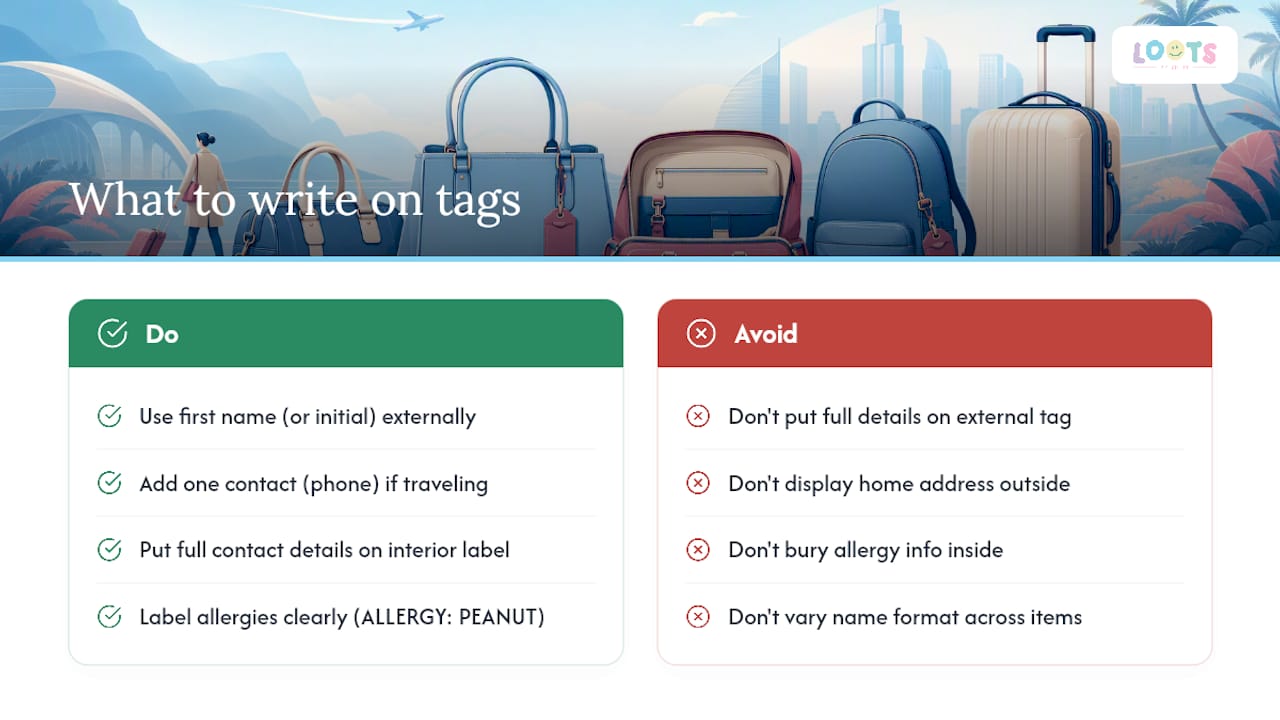
Keep the external tag short. A first name, or a first name plus a last initial, is enough for almost every situation, and it avoids handing a stranger more personal information than they need. Add one contact method, ideally a phone number, only if the bag is likely to travel outside a controlled setting like a school or daycare.
Save the full details for the inside. An interior label can carry a full name, a phone number, an email address, and for travel specifically, a destination address, since none of that needs to be visible to someone glancing at the bag from across a room. External tags routinely skip addresses for exactly this reason: airlines and baggage systems rarely rely on a home address for routing anyway, according to international travel labelling guidance, so an address sitting on the outside of a suitcase is a privacy risk with almost no practical upside.
If a child carries an allergy, flag it clearly and briefly. Something like “Allergy: PEANUT” in bold capital letters, placed where a caregiver or camp counsellor will see it fast, communicates far more urgency than burying the same detail in a paragraph on the inside tag.
One habit worth building early: keep the format identical across every bag, lunch box, and jacket a child owns. First name plus last initial on every single item means a teacher or camp staffer learns the pattern once and can identify anything at a glance, which speeds up recovery when something gets left behind.
Keeping names readable through washing and travel
A name tag that fades or falls off after three washes wasn’t worth attaching in the first place. Heat-transfer vinyl needs to be turned inside out before a wash cycle and air-dried rather than tumbled on high heat, which is where most of that peeling starts. Sewn patches hold up to almost anything, which is part of why they’re the standard choice for school uniforms that get washed weekly for a full year.
For anything travelling frequently, laminated or waterproof tags earn their slightly higher cost. A paper tag that survives one rainy commute rarely survives a second one.
Build a habit of checking threads, rivets, and loop attachments every few months, and replace anything that looks stressed before it actually fails, not after. A reported school trial found 92% of strategically placed, durable tags led to successful recovery, compared with 65% for bags with no visible name at all. That gap comes almost entirely down to placement and durability working together.
- Turn heat-transfer pieces inside out before washing
- Air dry rather than tumble dry whenever possible
- Inspect threads and rivets every few months, replace before they snap
- Keep a duplicate interior label as insurance against a lost external tag
- Photograph bags with visible name tags for insurance records if they’re ever lost in transit
How LootsByShiry applies these placement rules to custom orders
When someone orders personalised loot bags or cotton tote bags from LootsByShiry, the first question is almost always about use case. A bag going home from a single birthday party gets different placement advice than a tote a kid will carry to school every day for a year.
The workflow is straightforward: we ask how the bag will actually be used, recommend a placement based on that answer, share a mockup before anything gets produced, and confirm durability options like embroidery versus printed vinyl depending on the fabric and the client’s budget. A cotton loot bag headed home after one party doesn’t need the same reinforcement as a duffle a camper will use every summer for five years.
That case by case approach is really just the placement logic covered above, applied to real orders instead of general advice.
Are there rules about putting a child’s name on a bag?
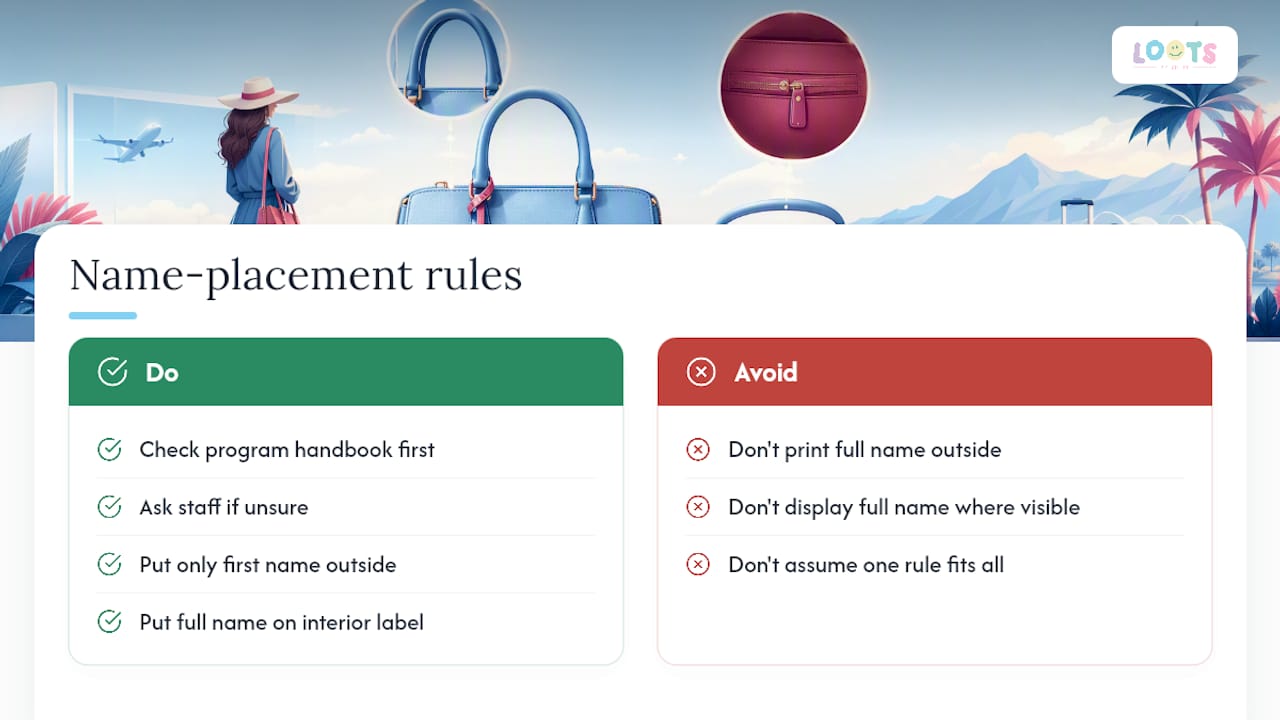
Most schools and camps don’t restrict name display outright, but many recommend caution around full names on the outside of a bag, particularly for younger children in public settings. The concern isn’t legal. It’s about strangers being able to address a child by name and create a false sense of familiarity.
Some daycare and camp programs specifically ask for first name only, or first name plus last initial, on anything visible from outside a cubby or bag hook. A handful go further and ask that full names appear only on interior labels, reserving external tags for a first name and a program-issued ID number instead.
There’s no single governing rule here since policies come from individual schools, camps, and daycare providers rather than any broader regulation, so the safest approach is simple: check your specific program’s handbook or ask staff directly before ordering a batch of bags with full names printed on the outside. When in doubt, default to first name only externally and save fuller details for the inside label, which satisfies almost every policy without needing to ask.
Making the name look like part of the bag, not an add-on
A name that looks stuck on rather than designed in usually comes down to one thing: mismatched colour or font against the bag itself. Pick a thread or print colour that either contrasts sharply with the base fabric for maximum visibility, or matches the bag’s existing trim for a cleaner look, depending on whether visibility or aesthetics matters more for that particular bag.
Font choice matters more than people expect. A bold block font reads faster from a distance, which matters on a school bag hook, while a script font looks better on a tote intended as a gift but is genuinely harder to read quickly. Match the font to the job the bag is doing.
Placement and design work together, too. A name centred on a patch pocket looks intentional. The same name crammed into a corner because that’s where there happened to be space looks like an afterthought. If the bag already has a graphic or pattern, let the name sit in open space near it rather than overlapping, so both elements stay legible.
What actually matters more than people think
Most advice on this topic treats name placement as a design decision first and a function decision second. That’s backwards. The single biggest factor in whether a name tag actually helps get a bag back isn’t how it looks. It’s whether the person who finds the bag can read it in three seconds without unzipping anything.
Conventional wisdom leans hard on cute fonts and colour matching, and there’s a place for that. But readability and durability deserve to come first, because a beautifully designed tag that peels off after two washes has already failed at its one job. Prioritize a placement a stranger or a tired teacher can find fast, choose an attachment method that matches the fabric honestly rather than what looks nicest in a photo, and treat the interior backup label as mandatory, not optional.
If you take one thing from this, it’s that visibility and durability aren’t competing goals. The best placements do both at once, and that’s a solvable problem with the right method for the right material.
— Shiry
Order a bag with the name placement already sorted
Working out placement, method, and wording yourself takes trial and error most people don’t have time for before a birthday party or the first day of camp. Some companies build that decision into the ordering process instead of leaving you to guess: you provide the bag type and its intended use, and they recommend a placement and attachment method designed to hold up, then send a mockup before anything gets produced.
Whether you’re outfitting one child’s loot bags for a birthday or ordering a batch of matching cotton tote bags for a class or team, you pick the name, initials, patch, or colour combination, and we handle the placement decisions that usually take the most guesswork. Start an order and ask for a placement mockup before checkout so you can see exactly how the name will sit before anything ships.
Sources
- Your Bag with Name Tag Guide: No More Lost Gear
- How to put on a luggage tag? | Db Journey
- Luggage Labeling Best Practices
FAQ
How do I put a name on a bag?
Attach the name to the top handle or a front panel near the main zipper for the best visibility, and match the method to the fabric: embroidery or a sewn patch for cotton and canvas, heat-transfer vinyl for nylon and polyester. Add a second interior label as backup in case the outside tag comes off.
How do I do initials on a bag?
Initials work the same way as a full name: place them where they’ll be spotted quickly, such as a front pocket or top handle, and choose embroidery or a printed patch depending on the fabric. Initials are a good privacy-friendly option for bags that will be visible in public settings.
How do I put a name tag on a bag?
Choose a sturdy point like a handle, strap, or zipper pull rather than a loose corner, since luggage guides consistently recommend attaching tags to strong parts of the bag rather than fragile edges. Always pair it with a fuller interior label as a backup.
How do I write names on gift bags?
For gift bags, a handwritten name or a printed tag tied to the handle works well since the bag typically only needs to be identified once. Keep it simple: a first name is usually enough, and there’s no need for contact details on a bag meant for a single occasion.
What should I write on an external bag tag versus an interior one?
Keep the external tag to a first name, or first name plus last initial, and one phone number if contact is needed. Save fuller details like a full name, email, and destination address for the interior label, since external tags are more prone to being lost or torn off during handling.