

The cleanest way to collect names for a group order is one shared list, one entry per person, built on a short form that asks for exactly what the maker needs: the name as it should appear, the item, the colour and any extra choice. Everyone confirms their own line, you freeze the list, and only then does anything go into production. At Loots by Shiry, where each loot bag can carry a name, patches and colours chosen by the customer, this is how we would run any group order, from 10 favours to 100.
TL;DR
- Keep one master list as the single source of truth. Do not collect names across texts, DMs and screenshots.
- Ask for each name exactly as it should be printed, with spelling, capitalization, punctuation and any length limit stated up front.
- Give every entry a line number so two guests with the same first name never get swapped.
- Have each person (or their parent) confirm their own line, then approve one final proof or list in writing.
- Tell people why you are collecting names and who will see them. In Canada, privacy law expects that.
Table of Contents
- Why group orders go wrong
- What to ask each person
- Build the list step by step
- Collecting names in person or at the event
- Check spelling before anything is made
- Approve one final proof or list
- Handle late additions without breaking the list
- Privacy: you are collecting personal information
- What we offer for group orders
- Match the item to the group
- A worked example: a birthday party of 18
- Corporate and team orders
- FAQ
- Sources
Why group orders go wrong
A group order fails in the same few ways. Names arrive in six different chats. One guest writes “Mia” in a text and “Maya” on the RSVP. Someone’s colour choice sits in a voice note. A late addition gets squeezed in the night before the order goes in.
None of this is about the product. It is about where the information lives. When details are spread over chats and screenshots, mistakes show up quickly: missing names, wrong sizes, duplicate entries, forgotten extras. The fix is structure: one place, one format, one approval step.
For party favours the stakes are small per item and large in total. A misspelled name on one bag is a disappointed child. Ten of them is a party where the favours become the story. The routine below takes about an hour for a typical party and removes most of that risk.
What to ask each person
Before you send anything out, decide what the maker needs. Record each customization detail in its own field: the wording, the lettering style if there is a choice, the position, and the colour. If a favour has more than one part, such as a bag with a name and a patch, label each placement separately.
For party favours, here is a field set that covers almost every order:
| Field | What to collect | Why it matters |
|---|---|---|
| Line number | A number you assign, 1 to N | Keeps two "Emma"s or two "Liam"s apart |
| Name as printed | Exact spelling, capitals, hyphens, apostrophes | The most common source of errors |
| Item | Loot bag, pouch, tote, tumbler | Matches the right name to the right product |
| Colour | Chosen from the options you offer | Avoids “I thought it was blue” |
| Patch or theme | One pick per person, if offered | Keeps the design consistent across the group |
| Notes | Allergies to avoid in fillers, special characters | Catches the exceptions early |
| Confirmed by | Initials or a tick from the guest or parent | Puts the responsibility for spelling on the right person |
If the occasion matters, add it to your own header: the birthday, the team, the corporate event and the date you need everything by. That context helps whoever prepares the order understand the whole set, not only the lines.
Say the limits before people answer
If the product has a character or line limit, state it in the form itself, not after people have submitted. Nobody enjoys being told that their child’s four-part name has to be shortened once the list is closed. Our guide to name length limits on personalized bags and party favours explains how to plan for long names and nicknames before you collect them.
Build the list step by step
- Create one master list. A shared spreadsheet or a single online form works. The point is that it is the only place names are accepted. Anything sent elsewhere gets copied in by you, or politely redirected.
- Add a line number to every entry. Two guests can share a first name, a last name or a nickname. A number lets you refer to “line 14” in every message and keeps the finished items matched to the right person.
- Write the instructions at the top. Ask for names exactly as they should appear, tell people the deadline, and show one example row filled in. An example row prevents most formatting problems.
- Send the form once, to everyone. Use the same message for all guests. For a children’s party, send it to parents and say that the parent is confirming the spelling.
- Chase blanks, not people. After a few days, filter for empty fields and message only those guests.
- Review the whole list in one pass. Look for missing names, duplicates, unfilled colours and entries that break your length limit.
- Ask for confirmation. Each person or parent confirms their own line. This is far more reliable than you proofreading 40 names you have never seen written.
- Freeze the list. Once approved, note the date and treat any change as a revision, not an edit.
This routine works the same whether you are ordering 12 favours or running a corporate event. If you are ordering at larger volume, our page on bulk order personalization and avoiding name mix-ups goes deeper on consistency across a big batch.
Collecting names in person or at the event
Sometimes the names come from an RSVP table, a sign-in sheet or a message wall rather than a form. The same rules apply: capture the exact spelling, the exact wording and the exact punctuation. If you gather names and messages at an event, a printed card for each guest is better than a shared page where handwriting varies. For ideas on setting up that kind of capture, these photo booth guestbook ideas show how event hosts get guests to write clearly and completely, which is exactly what a clean name list needs.
Whatever the method, copy the result into your master list the same day, while you still remember whose handwriting is whose.
Check spelling before anything is made
Most reprints come from names that looked right to the person who typed them. Run these checks on the finished list:
- Look-alike characters. The number 1 and the capital I, the number 0 and the letter O.
- Hyphens, apostrophes and suffixes. “Anne-Marie”, “O’Brien” and “Jr.” are easily flattened into something else.
- Capitalization. “McKenzie” and “Mckenzie” are different to the person who owns the name.
- Accents and special characters. Ask whether the product can carry them and record them in the notes field.
- Duplicates. Two identical lines are either a double entry or two guests who need separate line numbers.
One rule saves a lot of trouble: never silently correct a name on an approved list. If you think “Jhon” is a typo, ask. It may be exactly how that guest spells it. Our guide to checking the spelling approval on a personalized order walks through the same logic from the buyer’s side.
Approve one final proof or list
Production should begin after final approval, not when you first place the order. Before you approve, take one careful pass through everything that appears on the items: names, spelling, punctuation, capitalization, placement, colours, the product itself and the count.
A good approval is specific. Instead of replying “okay?”, write: “I have checked the spelling, the colours and the quantity on the list dated [date], and approve it.” That names the version you reviewed and what you checked.
A useful proof or preview:
- shows the real arrangement, including line breaks, alignment and placement;
- identifies the product and the version;
- is large enough to read each name clearly.
Keep every version and the date you approved it. If a question comes up later, you have a record of what was agreed. Better to use a round of changes at the review stage than to discover an error on the finished bags.
Handle late additions without breaking the list
A guest is added the week before the party. It happens in almost every group. Do not slip the new name into the middle of the approved list. Treat it as a separate revision: add a new line number at the end, mark the date, send the changed list for confirmation, and note what changed. That way nothing that was already correct gets disturbed, and you can see exactly what moved.
Plan for it in advance. Our guide on party favour etiquette and the guest count buffer suggests ordering ten percent above the guest count, which covers surprise guests and siblings without a rushed second order.
Privacy: you are collecting personal information
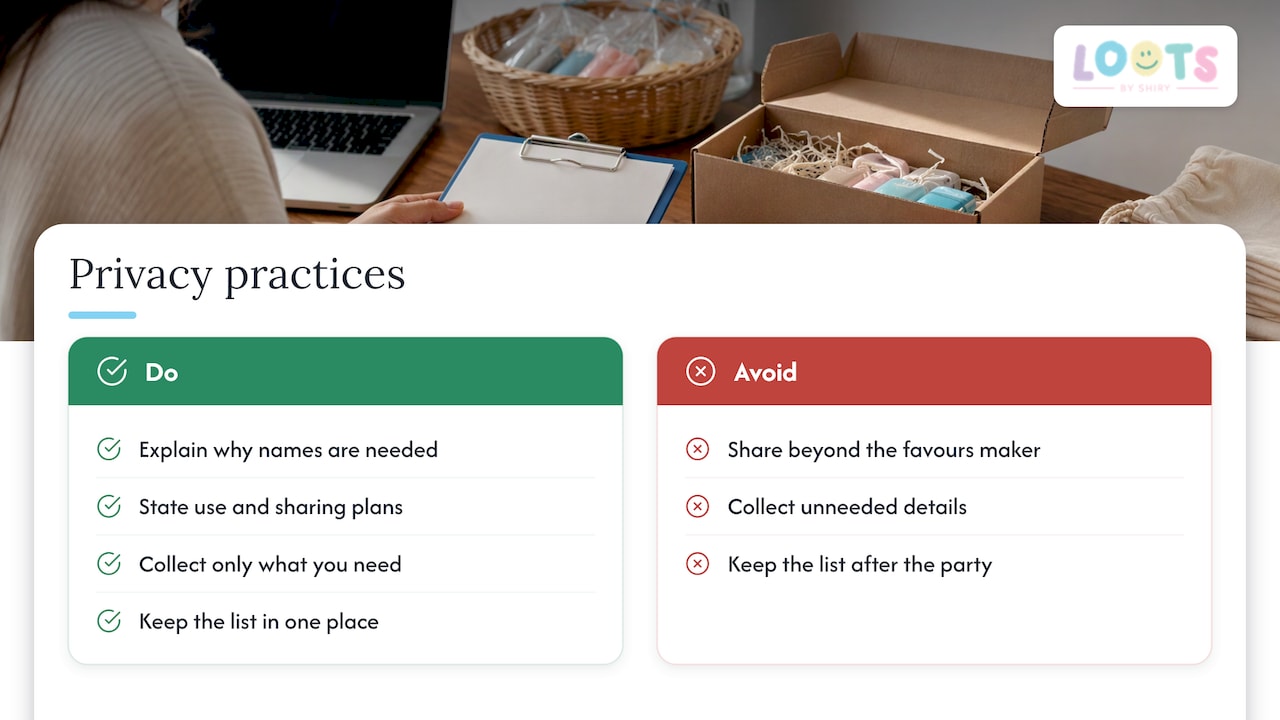
A list of names, especially children’s names tied to a party, is personal information, and you are asking people to hand it over. A few good habits keep that straightforward.
In Canada, the federal Personal Information Protection and Electronic Documents Act says organizations may collect, use or disclose personal information only for purposes a reasonable person would consider appropriate, and that consent is valid only if the person would understand its nature, purpose and consequences. The Office of the Privacy Commissioner’s PIPEDA backgrounder adds that organizations should explain why the information is needed, how it will be used and whether it will be disclosed to others.
You do not need a legal document for a birthday. You do need a clear sentence at the top of your form, such as: “We are collecting names only to personalize the party favours. The list will be shared with the maker of the favours and nobody else.” Then do what it says. Collect only what you need, keep the list in one place, and delete it once the party is over.
What we offer for group orders
We make customizable loot bags where each person’s name, patches and colours are chosen by the customer, plus pouches, tote bags and tumblers. Published prices on our site include cotton tote bags and pastel pouches at $12.00 each and colour changing tumblers at $10.00 each. On the loot bags page, wrapping is $0.50 per bag and delivery is $10.
We serve customers in Vaughan and Richmond Hill. If you have your master list ready, you can start with the loot bags. If you are still choosing between a standard range and something tailored, our page on custom orders versus the catalogue helps you decide.
Match the item to the group
A tidy list still needs the right product. A few quick pairings:
- Young children’s parties: loot bags with a name and one patch are easy for parents to confirm. See our ideas for loot bags by age.
- Themed events: pick one theme for everyone and let the name and colour vary. Our guide to building themed loot bags shows the options.
- Gifts guests reuse: pouches and tumblers stay in use long after the party. See personalized pouch ideas and tumbler personalization options for a group of 20.
- Larger events: totes suit 10 to 100 guests, and our page on tote bag personalization methods explains how to choose.
Keeping one item type per group, with name and colour as the only variables, makes the list shorter and the checking faster.
A worked example: a birthday party of 18
Say you are hosting a party for 18 children and want a personalized loot bag for each. Here is how the list could look and how the weeks run.
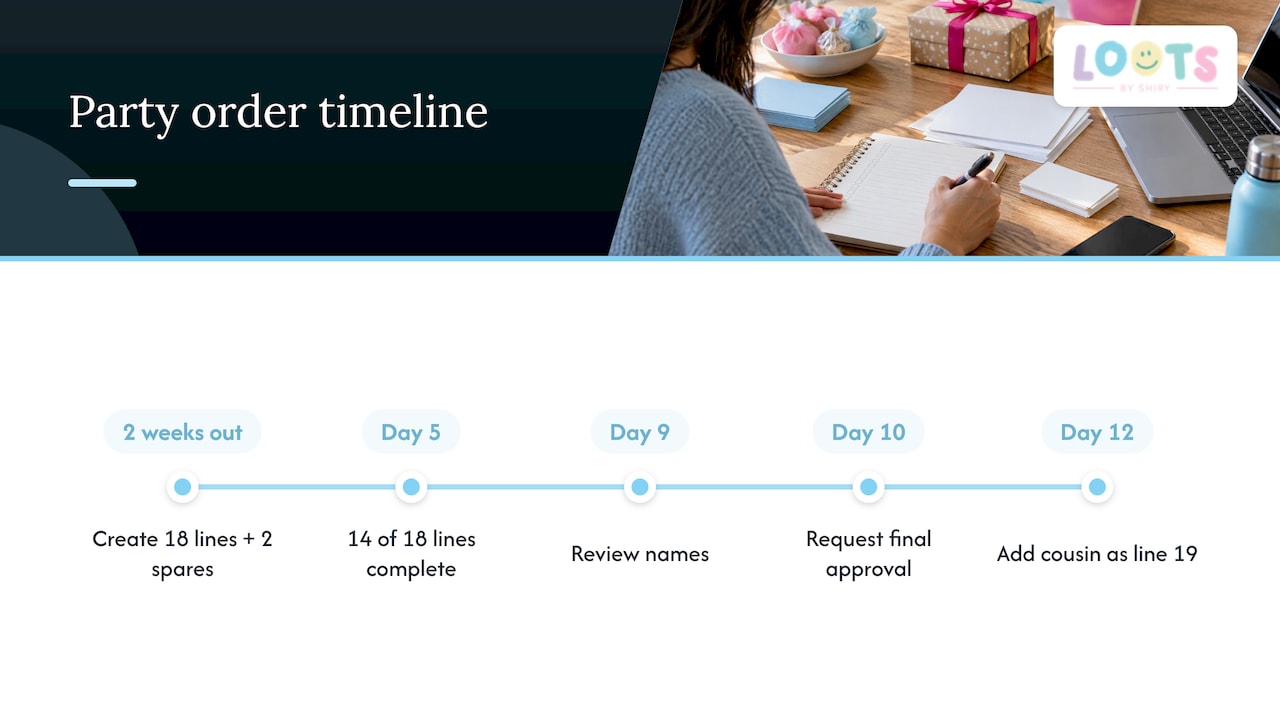
Two weeks before the party, you create the sheet with 18 numbered lines plus two spare lines. You add one example row at the top: “Line 1, Sophia-Rose, loot bag, lilac, unicorn patch, confirmed by parent.” You send the form link in the party group message and the invitation reminder, with the deadline and the privacy sentence.
By day five, 14 lines are complete. You filter the colour column for blanks and message the four parents who have not answered. Two reply with the missing choices. One writes back that her son’s name is “Jayden”, not “Jaiden”, which was how you had it from an old class list. That is the whole point of having each family confirm their own line.
On day nine, you read the list once from top to bottom. Lines 6 and 11 both read “Noah”. You keep both, because they are two different children, and add each child’s last initial in the notes so the finished bags stay matched. One name is longer than your limit, so you ask the parent which short form they prefer rather than choosing yourself.
On day ten, you send the final list to everyone who needs to approve it and write the approval sentence naming the date. A cousin is added on day twelve. She becomes line 19, marked as a revision with its own date, and the other 18 lines stay untouched. Because you ordered with a small buffer, the extra bag is already covered.
The whole process is a spreadsheet, five or six short messages, and two read-throughs. It feels like more effort than texting names as they arrive, until the first party where nothing has to be fixed.
Corporate and team orders
The same system scales to staff gifts and event kits. The difference is who confirms. In a company, ask each person to confirm their own line, because names carry titles, hyphens and preferred forms that a colleague will not guess. Add a column for the department or the table if the items are handed out at an event. Our note on corporate gift personalization etiquette in Canada covers what is appropriate to put on a gift and what is better left off.
Our view: the list matters as much as the product
We make loot bags where the customer decides the name, the patches and the colours, so we see a personalized favour as a small message to one person. That only works if the name is right. The best group orders we can picture are not the biggest or the most elaborate. They are the ones where the organizer set up one list, asked clearly and let every family confirm their own line.
That is why we think customization is worth it. A generic bag is the same for everyone and the child forgets it. A bag with their own name, their colour and a patch they picked gets kept, packed in a school bag and shown to friends. The effort of collecting names pays for itself the moment a child finds their own name on the table.
Our advice is to start with the list, not the product. Decide what you need to know about each guest, collect it once, and bring us a clean set of lines. We would rather help you with a tidy list of 15 than rescue a chaotic list of 50.
Shiry
FAQ
What is the best way to collect names for a group order?
Use one shared form or spreadsheet that every guest fills in, with one line per person and a line number on each. Ask for the name exactly as it should be printed. This keeps everything in one place, so you are never searching through chats for a missing detail.
Should I collect the names myself or let each guest enter their own?
Let each guest, or a parent, enter and confirm their own line. People know how their own name is spelled, hyphenated and capitalized. You review the list for blanks and duplicates, but you are not the one guessing at spelling.
How do I stop two guests with the same name getting mixed up?
Assign each entry a unique line number and add a note such as a last initial. Refer to the line number in every message and on the final list. That way two identical first names still point to two distinct items.
Is it okay to share the list of names with the maker?
Yes, if you have told people why you are collecting names and who will see them. Canadian privacy rules expect a clear purpose and understanding from the people involved. A one-line note on the form is enough for a party.
What if a guest is added after the list is approved?
Add them as a new line at the end, mark it as a late revision with the date, and get that one entry confirmed. Do not rework the approved lines. Ordering a small buffer above your guest count makes late additions much easier.
Sources
- Personal Information Protection and Electronic Documents Act
- Office of the Privacy Commissioner of Canada: PIPEDA backgrounder
- Photo booth guestbook ideas