
For a single tactile gift, heat transfer vinyl, hand embroidery or fabric paint deliver the most personal finish. For small event batches of several bags to a few hundred, direct-to-film printing or heat transfer strike the best balance of detail and cost, with embroidery reserved for premium runs. Large branded orders favour screen printing for cost efficiency, or sublimation when the design is full colour and the bag is polyester. Cotton and polyester respond differently to heat and dye, so fabric choice narrows your options before anything else.
TL;DR:
- Personalized tote bags can be created with a variety of methods, each offering different levels of detail, durability, and cost for specific fabric types.
- Heat transfer vinyl and direct-to-film are suitable for small runs with simple or multi-color designs, while screen printing and sublimation are better for large-volume, high-detail, or full-color projects.
- Home DIY techniques, like HTV, fabric paint, and embroidery, require preparation and careful execution to ensure quality and longevity, especially when washing.
- Larger commercial orders benefit from methods like DTF and screen printing, which balance cost, consistency, and turnaround time, with sublimation ideal for polyester fabrics and full-color designs.
- Combining methods, such as printing with embroidery or patches, can add texture and visual interest but increases complexity and cost.
Table of Contents
- The main tote bag personalization methods explained
- DIY techniques you can try at home
- Comparing professional methods for larger orders
- Choosing the right method for your project and fabric
- How Loots by Shiry approaches personalized tote projects
- Durability and care differences between methods
- Why mixing techniques often wins
- Ordering a personalized tote bag from Loots by Shiry
- Sources
- FAQ
The main tote bag personalization methods explained
Every personalization method trades off detail, durability, cost and the skill required to pull it off. Knowing what each one actually produces makes the rest of this decision much easier.
Heat transfer vinyl, known as HTV, is a coloured vinyl sheet cut into a design, weeded of excess material, then pressed onto fabric with heat. It handles names, initials and simple one- or two-colour graphics well, and it’s one of the most accessible entry points for a beginner with a home iron or a small press.
Direct-to-film, or DTF, prints a full-colour design onto a special film, which is then heat-pressed onto the bag. According to Precision Textiles, DTF suits intricate, multi-colour designs for small-to-medium runs and works across cotton and blended fabrics without the setup cost of screen printing.
Screen printing pushes ink through a mesh stencil, one screen per colour. It’s the standard choice for large runs with simple colour separations because the cost per unit drops sharply once the screens are made.
Sublimation turns dye into a gas that bonds directly into polyester fibres, producing a print that won’t crack or peel because it’s embedded in the fabric itself rather than sitting on top. It only works reliably on polyester or polyester-coated materials, which rules it out for plain cotton totes.
Embroidery stitches thread directly into the fabric, giving logos and small motifs a raised, textured finish that reads as premium. It’s slower and pricier per unit than printing, but the durability and tactile quality are hard to match.
A handful of other methods round out the toolkit:
- Laser engraving: works on certain canvas or faux-leather totes, burning a subtle etched pattern into the surface rather than adding colour.
- Fabric paint, stencilling and block printing: accessible, artisanal finishes that give each bag a slightly handmade, one-off character.
- Appliqué and patches: layered fabric shapes or woven patches sewn on for texture and dimension, often combined with another method as an accent.
Each of these methods answers a different brief: HTV and DTF for speed and detail, screen printing and sublimation for volume, embroidery for texture and longevity, and the artisanal group for anyone who wants a project to actually make with their hands.
DIY techniques you can try at home
Most home methods need less equipment than people expect, but a few preparation habits separate a clean result from a smudged one.
Before anything touches the bag, prewash cotton totes to remove sizing that can block adhesion, and slide a sheet of cardboard inside the bag so ink, paint or heat doesn’t bleed through to the back layer. If you’re embroidering or working with a loosely woven fabric, a stabilizer behind the design area prevents puckering, a tip echoed in maker guidance on choosing sturdier base materials for stitched designs.
HTV workflow:
- Design your artwork in cutting software and send it to a vinyl cutter.
- Weed away the excess vinyl, leaving only your design on the backing sheet.
- Position the design on the bag and press with a heat press or household iron at the vinyl manufacturer’s recommended temperature, usually in the range of 305 to 320 degrees Fahrenheit.
- Peel the backing according to the vinyl type: some peel hot, some need to cool first.
The most common mistake is pressing too briefly or at too low a temperature, which leaves edges that lift after the first wash.
Heat-transfer paper workflow works similarly for inkjet or laser printers. Print your design mirrored (most printer software has a “flip horizontal” setting), then press or iron it firmly and evenly, working from the centre outward to avoid trapped air bubbles.
Fabric paint and stencilling reward patience more than skill. Choose a paint formulated for textiles rather than craft paint, which cracks and washes out. Tape or spray-adhere your stencil so paint can’t creep underneath, apply thin layers rather than one thick coat, and let each layer dry before the next. Most fabric paints need heat-setting with an iron once fully cured to lock in wash durability.
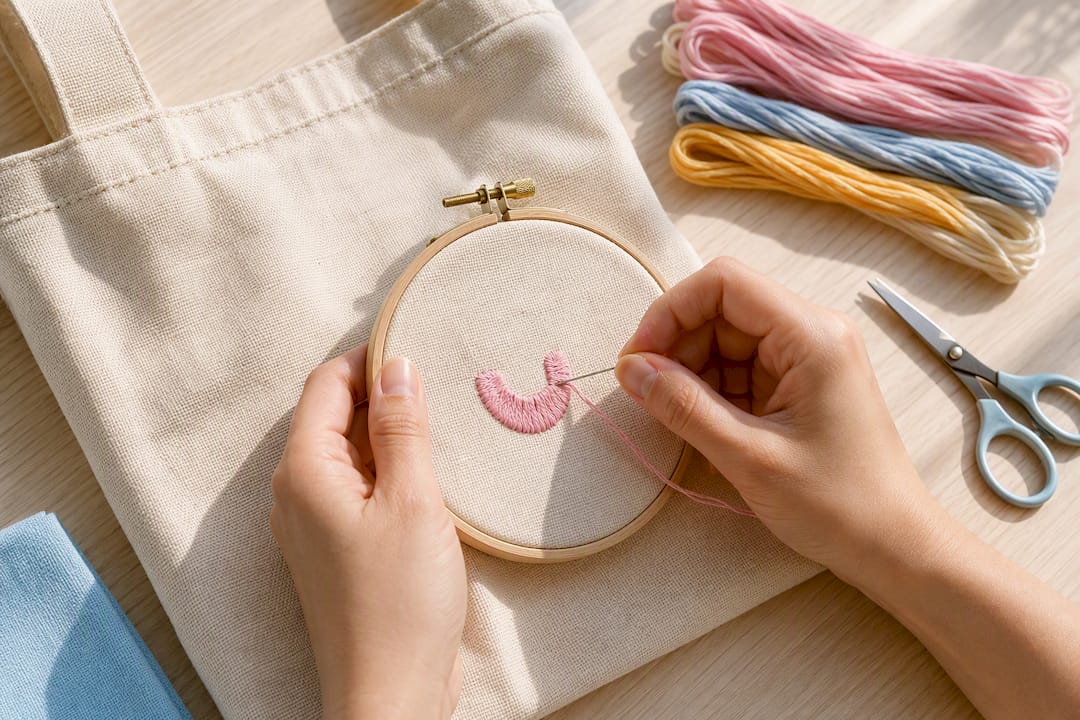
Hand embroidery starts with hooping the fabric drum-tight so your stitches sit flat rather than puckering the tote. Backstitch and satin stitch cover most lettering needs, while a simple running stitch works for outlines. Choose a cotton or polyester embroidery thread that matches the bag’s washing needs, and keep tension consistent, a loose hand produces loopy, uneven letters
Block printing, covered in hands-on sessions like the block printing and embroidery workshop at UMass Dartmouth, depends on carving a clean motif, loading the block with an even coat of fabric ink, and applying firm, consistent pressure. Registration, or lining up multiple blocks for a multi-colour design, is the hardest part and worth practising on scrap fabric first. Proper curing, usually heat-setting once the ink has dried, is what makes the print wash-resistant rather than washing out after one cycle.
Appliqué involves cutting fabric shapes, finishing the raw edges (by fusing, zigzag stitching or turning them under), and attaching the shape by hand or machine. Machine stitching is faster and more durable for anything that will see regular washing, while hand stitching gives a softer, more visible finish that some crafters prefer for the look alone.
Starter equipment costs vary a lot by method: a basic vinyl cutter and iron cost far less than a home embroidery machine, and stencils or carving tools for block printing are among the cheapest entry points of all. DIY methods save money when you’re making one bag or a handful, but the time cost climbs fast past a dozen or so, which is usually the point where it makes sense to hand the job to a professional shop instead.
Pro Tip: Always test your heat settings and paint colours on a scrap piece of the same fabric before committing to the actual bag.
Comparing professional methods for larger orders
Once a project moves past what you can reasonably hand-make, the calculation shifts to setup cost, turnaround and consistency across units.
- DTF: handles detailed, multi-colour artwork on small-to-medium runs and adheres well to cotton and blended fabrics without needing screens for each colour, per Precision Textiles. It washes durably and lets a shop turn around a design change quickly, a flexibility that industry coverage on decoration trends attributes to the absence of screen setup overhead.
- Screen printing: priced around setup (one screen per colour) plus a per-unit cost that drops as volume rises, which is exactly why it remains the most cost-effective option for large production runs.
- Sublimation: best suited to polyester and all-over, edge-to-edge designs. According to Capra Sports, the dye bonds into the fibre itself, which is what gives sublimated prints their long-term colour vibrancy and resistance to cracking or peeling.
- Commercial embroidery: carries a digitizing fee to convert artwork into a stitch file, plus a per-unit cost tied to stitch density. Denser stitching looks more premium and lasts longer but adds to both price and production time.
- Laser engraving: limited to specific materials such as canvas or faux leather, producing a subtle etched aesthetic rather than a coloured print, useful for a more understated, upscale look.
Turnaround and cost depend heavily on setup requirements: screen printing and embroidery both need lead time for screens or digitized files, while DTF and heat transfer can often go from artwork to finished bag in a single production run with no per-colour setup at all. Most shops will also want to run a sample proof before committing to a full batch, especially for a first-time order or an unusually detailed design.
Choosing the right method for your project and fabric
A short checklist narrows the field faster than researching every method from scratch. Ask yourself: what fabric is the bag made from, how detailed is the design, what’s the run size, what texture do you want the finished piece to have, and what’s your realistic budget per item.
- Single handcrafted gift: HTV, hand embroidery or fabric paint, chosen for the tactile, one-off quality rather than speed.
- Wedding or shower favour batch (10 to 100): DTF or heat transfer for detailed art, or embroidery if the budget allows a more premium finish.
- School fundraiser or large branded order (100+): screen printing for cotton designs, sublimation for full-colour polyester runs.
- Fabric notes: cotton and canvas take HTV, DTF, screen printing, paint and embroidery well; polyester is the only reliable substrate for sublimation; dark fabrics need opaque inks or a white base layer under most printed methods, since standard inks won’t show up on black or navy.
If you plan to sell personalised totes rather than give them away, any care instructions you attach need to be accurate. Care labelling guidance for textiles outlines that while care information isn’t always mandatory, any care claims that are provided must be truthful, and sellers in Quebec face additional French-language labelling requirements. It’s worth checking your washing and drying claims against the actual method used rather than copying generic care text from a template.
How Loots by Shiry approaches personalized tote projects
Loots by Shiry builds customization into the ordering process itself: customers choose names, patches and colour combinations rather than picking from a fixed catalogue. That interactive approach, more common in our loot bag and party favour lines, carries over naturally to tote bag projects for birthdays, corporate events and themed gatherings.
A typical project moves through a simple path: the client shares a brief (event type, quantities, design ideas), we work up a mockup or sample recommendation suited to the fabric and run size, then move to production with a quality check before the order ships. For an event planner juggling dozens of other details, that means one point of contact rather than sourcing artwork, a printer and a fulfillment plan separately.
Durability and care differences between methods
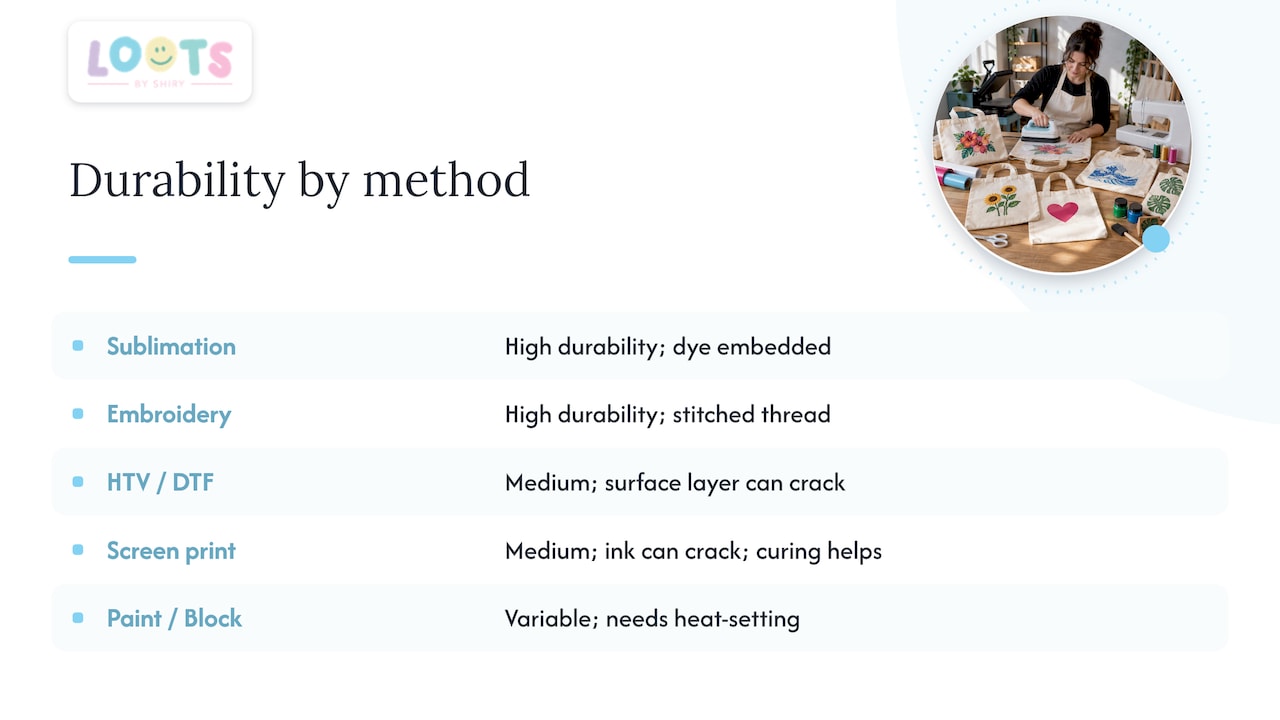
Wash performance varies more between methods than most first-time buyers expect. Sublimation, because the dye is embedded in the polyester fibre rather than sitting on the surface, tends to hold colour and resist cracking longer than surface-applied methods. Embroidery is similarly durable since the design is stitched thread rather than a coating that can peel.
HTV and DTF sit on top of the fabric and can crack or lift at the edges if pressed at the wrong temperature or washed on high heat, though both hold up well under normal cold-wash care when applied correctly. Screen printing ink can crack over many wash cycles, especially with thick ink deposits, though quality inks and proper curing extend its life considerably.
Fabric paint and block printing are the most dependent on proper curing: heat-setting after the paint or ink has dried is what determines whether a hand-applied design survives repeated washing or fades and flakes within a few cycles. Appliqué durability comes down to the stitch method, machine stitching generally outlasts hand stitching under regular wear. Across every method, following the actual care instructions for that specific technique matters more than the fabric type alone.
Why mixing techniques often wins
Some of the most memorable totes combine methods rather than relying on one. A printed base motif with hand-stitched lettering, or a DTF design accented with an appliqué patch, adds a tactile layer that a single flat print can’t. Workshop guidance on combining printed and hand techniques notes this kind of mixing often reads as more considered than either method alone.
That said, mixing adds cost and production time, so it only pays off when the recipient will actually notice the extra texture, a simple giveaway bag rarely needs it.
— Shiry
Ordering a personalized tote bag from Loots by Shiry
If you’d rather skip the heat press and vinyl weeding altogether, our Cotton Tote Bags start at $12.00 each, ready to be personalized with names, colours and design choices you select yourself.
For event orders, our loot bags line offers the same interactive customization, with wrapping available at $0.50 per bag and delivery at $10.00. Before reaching out, have your quantity, preferred fabric, artwork or text and event date ready, it speeds up the quote process considerably. Browse the full shop or get in touch for a custom quote on a larger or more detailed order.
Sources
FAQ
What are some creative ways to customize a tote bag?
Combining methods works well, try a printed base design (HTV or DTF) with a hand-embroidered name or a sewn-on patch for added texture. Stencilled fabric paint and block printing also give each bag a one-of-a-kind, handmade look that a plain print can’t match.
What are some creative embroidery ideas for tote bags?
Monogrammed initials, small floral motifs and simple line-art logos all work well in embroidery’s raised, textured stitch. Pairing an embroidered accent with a printed background design is a popular way to add dimension without embroidering the entire piece.
What are some creative ways to decorate tote bags?
Beyond printing, block printing, fabric paint with stencils, and appliqué patches all create a handcrafted look that suits gifts and small event batches. Laser engraving is an option too, though it’s limited to canvas or faux-leather totes rather than standard cotton.
Is sublimation or DTF better for tote bags?
It depends on the fabric: sublimation only works on polyester or polyester-coated material, where it produces an extremely durable, embedded print, while DTF works across cotton and blended fabrics and handles detailed, multi-colour designs well on small-to-medium runs. For a plain cotton tote, DTF is the practical choice since sublimation isn’t compatible with the fabric at all.
How do I choose a personalization method for a large event order?
For large cotton tote orders, screen printing is generally the most cost-effective option because the per-unit price drops as volume increases. For full-colour designs on polyester bags, sublimation offers strong colour vibrancy and durability across the whole run.