
The best favour tag wording is short, warm and specific: one thank-you line, the guest’s or host’s name, and sometimes the date. Keep it to roughly five to twelve words, print it in dark, plain type, and add an ingredient or allergen note if the favour is edible. Below you will find ready-to-use lines for birthdays, showers, weddings and corporate events, plus the practical rules that keep a tiny tag readable.
TL;DR
- Write one sentence of thanks, then a sign-off with a name. Skip anything that needs a second line to make sense.
- Match the tone to the event: playful for kids’ birthdays, soft for baby showers, polished for weddings and corporate gifts.
- Use high-contrast, plain type. Accessibility Standards Canada recommends common words, short sentences and clear text for readers with different needs.
- If the favour is food, the tag is not the place to guess. Check Health Canada’s allergen rules before you print.
- Personalizing the bag or pouch itself often does more than a long message on a tag.
Table of Contents
- What a favour tag needs to say
- Thank-you tag wording that works anywhere
- Birthday favour tag sayings
- Baby shower and baptism wording
- Wedding, quinceañera and bat mitzvah wording
- Corporate and event tag wording
- Tag wording by style
- When the favour is food: what the tag should (and should not) say
- Sayings that pair with specific favours
- Our perspective: put the personalization on the bag, then keep the tag short
- Where to get tags made and what to expect
- A quick method to write your own tag in five minutes
- Match the budget to the wording
- Personalized loot bags to go with your tags
- Common mistakes to avoid
- FAQ
- Sources
What a favour tag needs to say
A favour tag has one job: tell the guest that the little gift is from you, and that you are glad they came. Everything else is optional.
Three elements cover almost every event:
- A thank-you or celebration line. “Thanks for celebrating with us” does the work.
- A name. Either the host or honouree, or the guest if the tag doubles as a place card.
- A date or occasion, if there is room. It turns a gift into a keepsake, but a tag without it is still complete.
A typical structure is a single line of message followed by a sign-off such as “With love, Maya, June 14.” If you find yourself wanting a paragraph, put it on a card in the bag instead.
How long should the wording be?
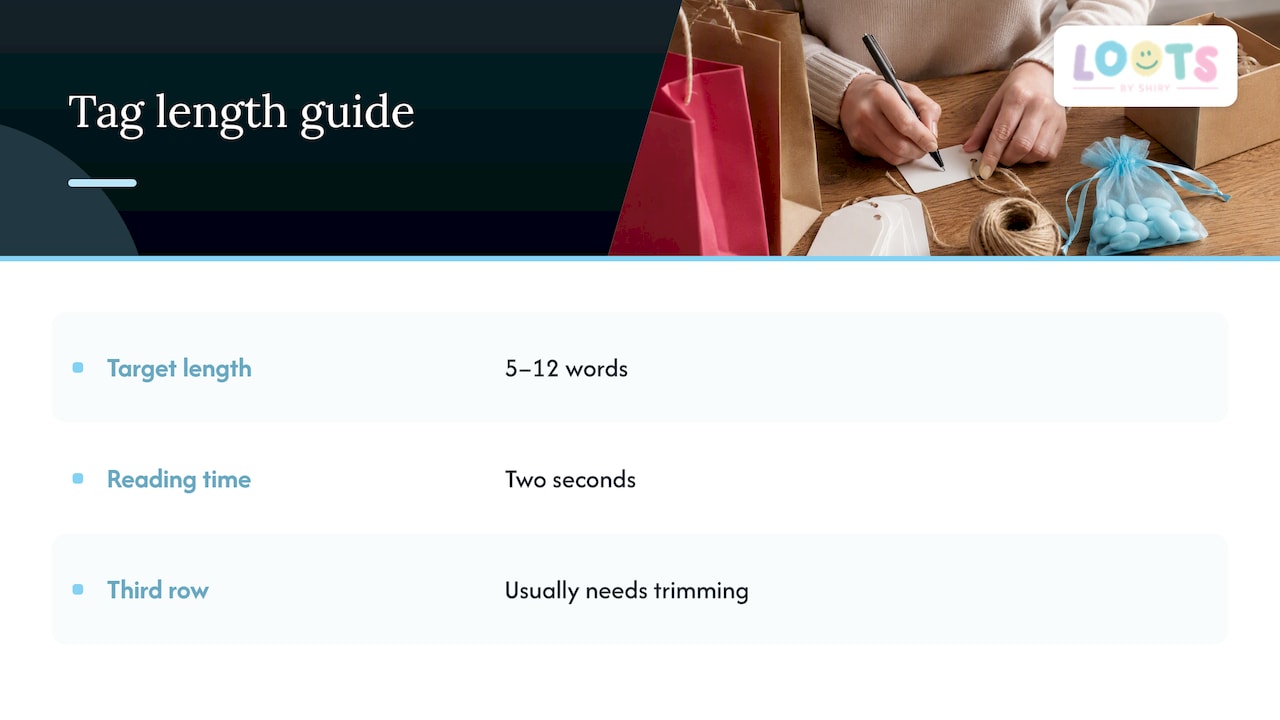
Aim for five to twelve words. That is our working rule of thumb for a tag that sits on a pouch handle or a bag ribbon: a guest should read it in two seconds while holding a cake plate in the other hand. Weddings can run a touch longer because the tags are often larger, but a line that wraps onto a third row is usually a line that needs trimming.
Plain type beats fancy type
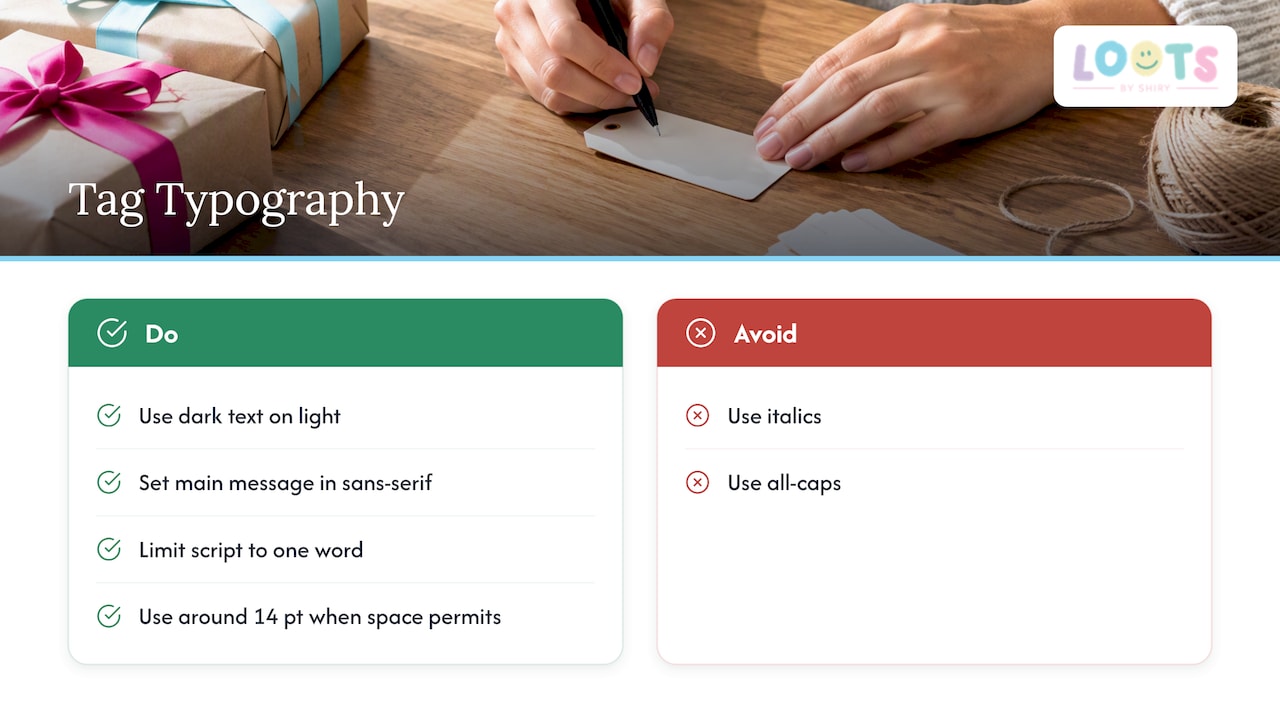
Script fonts look lovely on a mood board and awful at arm’s length. Accessibility Standards Canada’s guidance points toward high contrast and legible typefaces, and it advises against italics and all-caps for readers who struggle with them. For a tag, that translates to dark text on a light background, a clean sans-serif for the main message, and any decorative script saved for a single word such as the name. Where space permits, a type size around 14 pt keeps things comfortable.
If you are choosing a layout for the printed piece, trading card template ideas show how much a small rectangle can hold when the hierarchy is clear: a name up top, one line below, and nothing competing with them.
Thank-you tag wording that works anywhere
These lines suit almost any event and any age group. Pick one, then add a name.
- Thanks for celebrating with us.
- So glad you were here.
- Thank you for making today special.
- A little something to say thank you.
- Your company was the best gift.
- Thank you for being part of our day.
- Made with love, just for you.
- Thanks for coming. Take this home!
- We are so happy you came.
- Today was better with you in it.
For a sign-off, keep it consistent across all tags: “With love, the Patel family” or “Thanks, Ben, age 7.” Consistency is what makes a table of favours look planned rather than improvised.
Birthday favour tag sayings
Kids’ birthdays are where you can have fun. Tone can be silly, but the line still has to fit.
For children
- Thanks for helping me turn 6!
- Party’s over. Loot’s on!
- You made my birthday awesome.
- Thanks for being my party pal.
- Treasure for my favourite guests.
- Another year, another adventure. Thanks for joining!
- Great friends deserve great loot.
- Thank you for the fun, [Guest Name]!
Themed parties give you an instant script. For a construction party, “Thanks for helping us build a great day” works well, and we cover that theme in our guide to keepable construction party favours. For a pirate, space or dinosaur theme, swap one word for the theme word and keep the rest.
For teens and adults
- Thanks for making 30 look good.
- Cheers to another year with you.
- Good friends, good times, good loot.
- You are the reason this party was fun.
- Thanks for celebrating with me.
- Round [number], thanks for being there.
For milestone birthdays, add the number or the year. It reads as a keepsake instead of a throwaway.
Baby shower and baptism wording
Showers and baptisms call for softer language and often a bit more sentiment.
Baby showers
- Thanks for showering us with love.
- Little one, big thanks.
- A sweet thank you from [Parent Names].
- Thank you for welcoming our baby.
- Love is on the way. Thanks for being here.
- We are grateful for you.
- Baby [Name] says thank you.
If you are choosing what goes in the bag, our baby shower favour ideas focus on pieces guests will actually keep.
Baptisms and christenings
- Thank you for sharing this blessed day.
- With gratitude, from [Child’s Name] and family.
- Thank you for your love and prayers.
- A blessing for you, in memory of [Name]’s baptism.
- Thank you for being part of [Name]’s journey.
Baptism favours do not need to be expensive to look considered. Our post on personalized baptism favours shows how wording and presentation lift a simple item.
Wedding, quinceañera and bat mitzvah wording
Weddings are the category most search results focus on, and the tone is usually warm and brief. Keep the couple’s names and the date, and let the favour itself carry the rest.
Weddings
- Thank you for celebrating with us.
- Love, laughter and happily ever after. Thanks for sharing it.
- Our love story is better with you in it.
- Thanks for being here, [Name] and [Name].
- Forever grateful for you.
- A small token for a big day.
Quinceañeras and bat mitzvahs
These celebrations often involve large guest lists and multiple generations, so the wording should be warm without being childish.
- Thank you for celebrating my quince.
- Gracias for sharing my special day.
- Thank you for being part of my milestone.
- Mazel tov, and thank you for celebrating with us.
- With gratitude, [Name], [Date].
If you are planning one of these events, our guides to quinceañera favour ideas and bat mitzvah favours go into what to pack alongside the message.
Corporate and event tag wording
For team events, launches or client appreciation, tone matters more than cleverness. Use the company name or the event name and keep it clean.
- Thank you for being part of [Event Name].
- Appreciation, from all of us at [Company].
- Thanks for joining us at [Event], [Year].
- With thanks for your partnership.
- Great teams make great days. Thank you.
- Take this home as a reminder of a good day.
Skip jokes unless you know the room. A professional, warm sentence never goes wrong.
Tag wording by style
| Style | Best for | Example line | Name format |
|---|---|---|---|
| Playful | Kids’ birthdays, themed parties | Thanks for being my party pal! | Guest’s first name |
| Sentimental | Showers, baptisms, weddings | We are grateful for you. | Host family or honouree |
| Polished | Corporate events, milestone birthdays | Thank you for joining us. | Company or event name |
| Minimal | Any event with a small tag | Thank you. | Initials or first name |
| Cultural or bilingual | Quinceañeras, bat mitzvahs, multilingual families | Gracias for celebrating with me. | Honouree’s name |
If you cannot decide, go with minimal. Two words and a name on a good bag look more intentional than a long line crammed onto a small tag.
When the favour is food: what the tag should (and should not) say
If you are handing out baked goods, candy or snacks, wording is also a safety matter. In Canada, Health Canada’s rules require priority allergens to be declared in plain language, either in the list of ingredients or in a statement that begins with “Contains.” Those rules are written for prepackaged food sold to consumers, so a homemade party favour is not necessarily regulated the same way. They are still the best template for guest safety.
Practical rules for hosts:
- List the ingredients on or with the tag if you made the food yourself, and add a “Contains” line naming any priority allergen such as milk, eggs, peanuts, tree nuts, wheat, soy or sesame.
- Be careful with “may contain.” Health Canada’s policy on precautionary statements is meant for cases where cross-contamination can happen despite good practices. It is not a way to avoid listing something you know is in the recipe.
- Ask about allergies in the invitation. If a child has a severe allergy, a quick message to the parent beats any printed line. For families with allergy concerns, a non-food favour removes the question altogether.
If a guest has a food allergy, speak to their parent or caregiver directly, and for medical questions the family’s allergist is the right person to ask. For ideas that sidestep the issue, see our guide to allergy-friendly favours for kids’ parties in Canada and our list of non-candy party favours kids keep.
Sayings that pair with specific favours
A tag reads best when it winks at what is attached. Here is how that works with items we see most often.
Tote bags
- Carry the fun home.
- Thanks for being a great addition to our day. (for a tote guests will reuse)
- Pack up the memories.
Totes have room for more than one item, and our tote bag favour ideas walk through three to five items guests will keep.
Pouches
- A little something to tuck away.
- Small pouch, big thanks.
- Fill it with good memories.
We have collected pouch favour ideas and a comparison of pouches versus boxes if you are still deciding on the container.
Tumblers
- Sip, sip, hooray!
- Cheers to a great day.
- Stay hydrated, stay awesome.
Loot bags
- Treasure from [Host’s Name]’s party.
- This loot is for you.
- Open up. Surprise inside!
Our perspective: put the personalization on the bag, then keep the tag short
At Loots by Shiry, we build our business around the idea that a favour should feel like it was made for the guest. That is why our customers choose names, patches, colours and themes for their loot bags instead of settling for a generic package.
Here is what that taught us about tags. When the bag already carries a guest’s name, a patch or a colour that matches the theme, the tag no longer has to do all the personalizing. It can be two or three words. When the bag is plain, the tag tries to do too much, the message grows and the type shrinks.
So our advice is to decide what carries the personal touch before you start writing. If it is the bag, write a short, warm line on the tag. If it is the tag, keep the bag simple and make the tag legible. Don’t ask both to carry everything.
We also think about reuse. A tote, pouch or tumbler with a name on it gets used again, and the tag is the part that gets tossed. A message worth keeping belongs on the item, and a message that fits the moment belongs on the tag.
— Shiry
Where to get tags made and what to expect
You have three realistic routes:
- Print at home. The cheapest option. Use heavier paper, a clean template and a hole punch. It works for batches under about 30.
- Use an online or local print shop. Good for larger batches and consistent finishes, and many Canadian shops offer cardstock and kraft paper. Check proofs for spelling before approving.
- Handwrite. Charming for small groups, but only if your handwriting is neat. Use a dark pen, not a pale gel.
Whichever way you go, proof the names twice. Spelling mistakes on a guest’s name are the single most common tag problem, and it is easy to avoid by having a second person read the list.
Do you need the tags to match your invitations? Not exactly. Using the same colour palette and a similar font is enough to make the whole table feel pulled together. And if budgets are tight, the tag is a cheap upgrade: a plain favour with a good tag looks more considered than an expensive favour with none.
A quick method to write your own tag in five minutes
- Choose the tone. Playful, sentimental, polished or minimal. Use the table above.
- Write the thank-you line. Use ten words or fewer, with common words.
- Add the name. Whose? Decide between host, honouree and guest, and keep it the same on every tag.
- Add a date only if it fits. Don’t shrink the type to squeeze it in.
- Check legibility. Dark text, light background, plain typeface, nothing in all capitals.
- Add allergy information if it is food. Put it on the tag or on a card in the bag.
- Print one test tag. Hold it at arm’s length. If you cannot read it in two seconds, simplify.
Match the budget to the wording
You do not need to spend more to make a favour feel personal. If you are weighing options, our guides on party favour budgets under $5 and whether personalized favours are worth it give a clear picture. For manners around quantity and what to skip, see party favour etiquette, which recommends ordering the guest count plus a ten percent buffer.
Our own published prices for the pieces tags usually go on: cotton tote bags are $12.00, pastel pouches are $12.00 and colour-changing tumblers are $10.00. Wrapping is $0.50 per bag, and delivery is $10.
Personalized loot bags to go with your tags
If you are still looking for something to attach the tag to, our personalized loot bags let you add names, patches and colours so each guest’s favour feels like theirs. You can also browse our shop for totes, pouches and tumblers, or take a look at themed loot bag options if you want the wording and the bag to follow the same theme. Wrapping is available for $0.50 per bag, and delivery is $10.
Common mistakes to avoid
- Too many words. If it needs a comma splice, cut it.
- Low contrast. Pastel type on a pastel tag disappears.
- All capitals. They look loud and are harder to read.
- Inconsistent sign-offs. Pick one format and use it on every tag.
- Forgetting allergens. Food favours need ingredient and allergen information.
- Jokes that miss. Corporate and multigenerational events need warmth more than wit.
- Skipping proofs. One misspelled name will be the one everyone notices.
FAQ
What do you write on a party favour tag?
Write a short thank-you, such as “Thanks for celebrating with us,” and add a name. A date is a nice extra if there is room. Five to twelve words is a good range for most tags.
How long should favour tag wording be?
Keep it to about one line, or five to twelve words, so a guest can read it at a glance. If you have more to say, put it on a card inside the bag. Short wording also lets you use a larger, easier-to-read type size.
Do I have to list allergens on a favour tag?
For food you make yourself, listing ingredients and a “Contains” line for common allergens is the safest approach. Health Canada’s labelling rules apply to prepackaged food, but they are a good model for party favours too. If a guest has a severe allergy, talk to their parent or caregiver directly, or choose a non-food favour.
Can the tag double as a place card?
Yes. Put the guest’s name first and largest, with the thank-you line smaller beneath it. Use the same wording format on every tag so the table looks consistent.
What size and font should a favour tag use?
Use a plain sans-serif font in dark text on a light background, and avoid italics and all-caps. Where space allows, around 14 pt is comfortable to read. Print one test tag before you commit to the whole batch.
Sources
- Questions and answers on allergen labelling regulations, Health Canada
- The Use of Food Allergen Precautionary Statements on Prepackaged Foods, Health Canada
- Guidelines for creating accessible documents, Accessibility Standards Canada