

Personalizing a corporate gift works when the gift is about the recipient first and your brand second. Spell the name correctly, keep any logo small, stay inside a sensible budget, never give cash or near-cash, and get approval before the gift goes out. Get those five things right and personalization reads as care. Get them wrong and it reads as a sales pitch, or worse, as an attempt to influence.
This guide is for Canadian event planners, office managers and team leads who are ordering personalized gifts for clients, speakers, staff or partners. It covers what to put on a gift, what to leave off, and the Canadian tax and policy points that catch people out.
TL;DR
- Put the recipient’s name, initials or a chosen colour front and centre. Keep your logo small, or leave it off.
- Stay “reasonable and proportionate”. Many Canadian organizations require approval above roughly $250 to $500, and cash or gift cards that act like cash are off the table.
- For employees, the CRA’s $500 non-cash gift policy is a yearly total, not a per-gift limit.
- Collect names and preferences with consent, and use them only for the gift.
- Check spelling, culture, dietary and religious fit before you print anything. Personalized items are usually made to order, so mistakes are hard to undo.
Table of Contents
- What personalization is for
- The rules of good personalization
- Budget and approval: reasonable and proportionate
- The CRA rules for employee gifts
- Privacy: handle personal details with care
- Culture, faith and the Indigenous context
- Who you should not gift
- Our perspective: personalization is a courtesy, not a decoration
- Presentation: how the gift arrives matters
- A pre-order checklist for personalized corporate gifts
- Where our products fit
- FAQ
- Sources
What personalization is for
A gift is a piece of professional communication. A personalized item says “we know who you are”. A branded item says “remember who we are”. Both can be fine, but only the first one feels like a gift.
That is why the best-known etiquette advice puts the recipient in front. The reader of a conference gift guide from a Canadian bag maker is told that speakers gave you their time and audience, so handing your logo back is a missed note. The stronger gesture, the guide says, is their name or initials on the gift, with any event mark kept small.
Use that as your test for every decision below: if the recipient picked the gift up in a year, would they see themselves in it or see your marketing?
The rules of good personalization
Get the name exactly right
A misspelled name is worse than no name. Before you place an order:
- Take the spelling from the recipient’s own email signature, LinkedIn profile or a registration form, not from memory.
- Confirm how they use their name. Some people go by a nickname, a middle name or a name that does not match their legal one.
- Check accents and hyphens. Names such as Zoë, Renée or Jean-François should print the way the person writes them.
- Ask a colleague to proofread the whole list, then proof it again from the final production file.
If you are ordering for a group, keep one master spreadsheet and lock it before production. For hosts handling 20 to 30 names at once, name gift bag ideas for larger groups cover how to lay out a list and avoid doubled or missing names.
Keep the logo quiet
The common mistake is the “logo pile-up”: your logo, the event logo and a sponsor’s logo all on one item. Guidance for high-level recipients says to prioritise personalization over branding, and to use a subtle treatment such as tone-on-tone marking for the name, with required marks kept small or on a removable element.
A practical rule of thumb:
| Recipient | Name or initials | Logo |
|---|---|---|
| Keynote speaker or guest of honour | Yes, prominent | None, or very small |
| Client or partner | Yes | Small, discreet |
| Employee or volunteer | Yes | Optional, team mark is fine |
| Event attendee (bulk) | Optional | Fine, but keep it tasteful |
The more senior or more outside your company the recipient is, the less branding the gift should carry.
Choose personal, not private
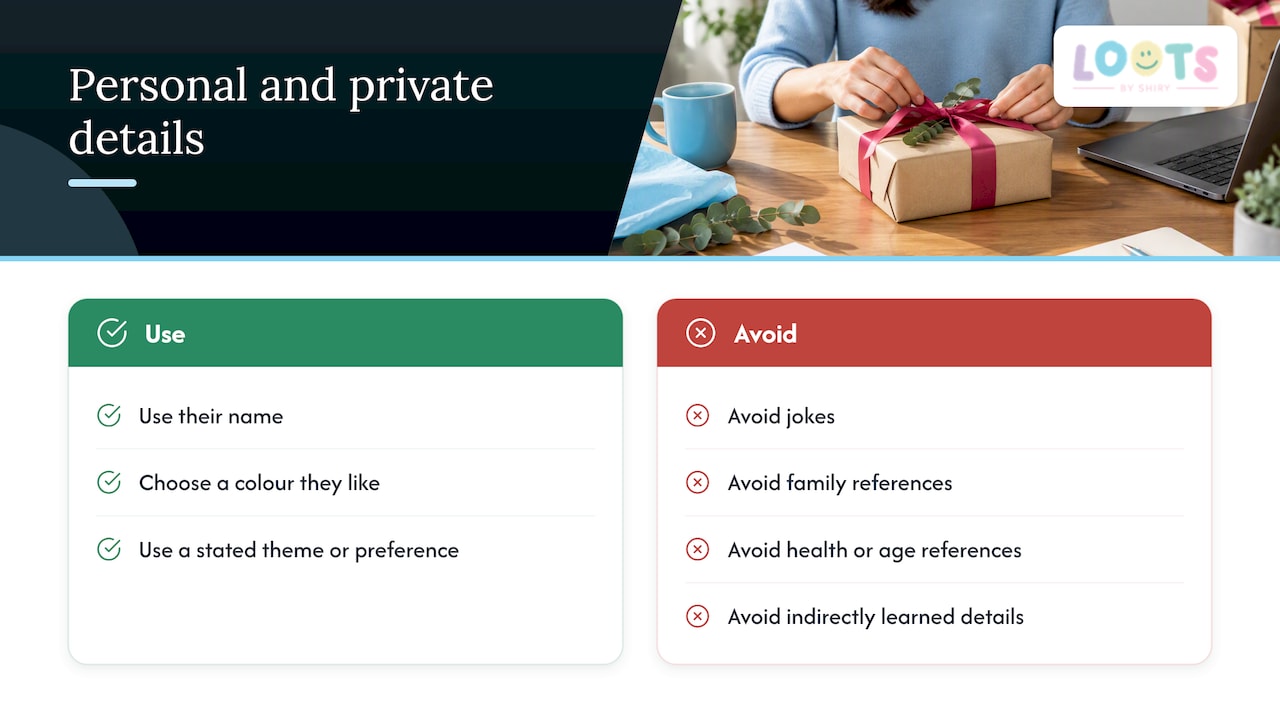
Personal means a name, a colour, a theme the person has told you they like. Private means a joke, a reference to their family, their health, their age or something you learned indirectly. Keep to the first. Advice on corporate gifting commonly warns against overly personal or humorous items that could be misread, and a professional, tasteful gift carries weight even when it is modest.
Let the recipient have some choice
One of the most respectful ways to personalize is to let people choose. A colour, a patch or a small selection from two or three items gives the recipient a say and removes the risk of guessing wrong. Some Canadian business commentary even notes that companies increasingly treat the recipient’s gift selection as a signal of their interests. If you do that, be transparent about what you are collecting and why (see the privacy section below).
Budget and approval: reasonable and proportionate
The etiquette standard in Canada is that gifts are reasonable and proportionate, so nobody can read them as an attempt to buy influence. In the policy we reviewed, a large Canadian manufacturer’s anti-bribery policy sets out general rules for giving and receiving hospitality, and many organizations require prior management approval once a gift or hospitality passes somewhere between $250 and $500. That is an example of how organizations draw the line, not a legal threshold, so check your own policy and the recipient’s.
The recipient’s rules matter as much as yours. Many employers and public bodies limit what staff may accept. An airport authority’s code of ethics, for example, lets staff accept incidental gifts of minor value in the ordinary course of work, but nothing beyond a normal expression of courtesy. If you are gifting a client in a regulated or public-sector role, ask their office what their policy allows before you send anything.
Never give cash or cash-like gifts
Cash and cash equivalents are treated as unacceptable in corporate policies because they can be construed as bribes or kickbacks. A physical, useful, personalized item is the safer choice. If your situation involves public officials, foreign or domestic, speak to your legal or compliance contact before giving anything.
Timing and discretion
Send gifts when they will not look like part of a negotiation. Avoid the week a contract is being decided or a tender is open. A thank-you after the work is done, or a seasonal gift at a neutral time of year, reads as gratitude.
The CRA rules for employee gifts
If the recipients are your own employees, tax enters the picture. According to the CRA, gifts and awards you give employees are generally taxable, but under its administrative policy, non-cash gifts and awards with a combined fair market value of $500 or less per year (including taxes) are not taxable to the employee. A few details planners miss:
- The $500 is an annual total per employee across all non-cash gifts and awards, not a limit per gift.
- Items of trivial value, such as a coffee, tea, or a branded T-shirt or mug, are generally not counted in that total.
- Cash and near-cash, including gift cards that can be converted to cash or used at multiple retailers, are taxable regardless of the amount.
- Long-service awards have their own separate $500 limit.
- Under the CRA’s employer guide, a gift has to be for a special occasion such as a holiday, birthday or wedding, and an award has to recognize an employment-related accomplishment.
These rules are in force as of the date the CRA page was last updated, so check the current page or your payroll provider before you finalize a budget. For practical ideas that fit under the limit, our guide to team gift bag ideas under the $500 rule walks through combinations that stay comfortably inside it.
Privacy: handle personal details with care
Personalization means collecting information: names, sometimes addresses, sometimes preferences. In Canada, PIPEDA requires organizations to obtain valid, informed consent for collecting and using personal information. Names and addresses may sometimes be collected on an opt-out basis, but express consent is the better habit for anything sensitive or outside what the person would reasonably expect. Using information for a different purpose than the one it was collected for needs fresh consent.
In practice:
- Tell people why you are asking (“We would like to personalize a thank-you gift for you”).
- Ask only for what the gift needs: usually a name and a delivery address.
- Do not reuse the list for marketing. If you want to email people promotional material, Canada’s anti-spam law has its own consent and identification requirements.
- Share the list with your supplier only as far as production and delivery require, and delete working copies when the order is done.
This is general information, not legal advice. If you are collecting data at scale, or from people outside Canada, talk to your privacy officer or a lawyer.
Culture, faith and the Indigenous context
Canada is a mix of cultures and faiths, so one assumption can land badly. Check, quietly, whether a holiday-themed gift suits the recipient. Neutral seasonal themes, or a gift with no holiday reference at all, are the safe default. Dietary needs and allergies matter too if the gift includes food.
Gifting to Indigenous partners deserves particular care. A university protocol guidebook explains that gifting is a relational practice of reciprocity, not a transactional one. It advises avoiding stereotypical or mass-produced “native-themed” items, favouring authentic work from local Indigenous vendors, and asking about protocols, since appropriate gifts and practices vary by Nation and context. The federal government’s guidance on working with Indigenous creative industries likewise stresses respecting cultural protocols.
The practical takeaway: do not decorate a personalized item with Indigenous-style imagery as a design choice. Ask first, and buy from Indigenous makers where that is what the occasion calls for.
Who you should not gift
The direction of the gift matters. Etiquette commentary generally advises against giving a gift to your direct supervisor, because it can create awkwardness or look like an effort to influence. A thoughtful handwritten note is considered the more appropriate and often more valued gesture. A team-wide gift from the group to a manager is a different matter, but check your workplace norms.
Our perspective: personalization is a courtesy, not a decoration
We make customizable loot bags, pouches, tote bags and tumblers, so we spend our days on exactly this question: how much of the person goes on the item, and how much of the sender.
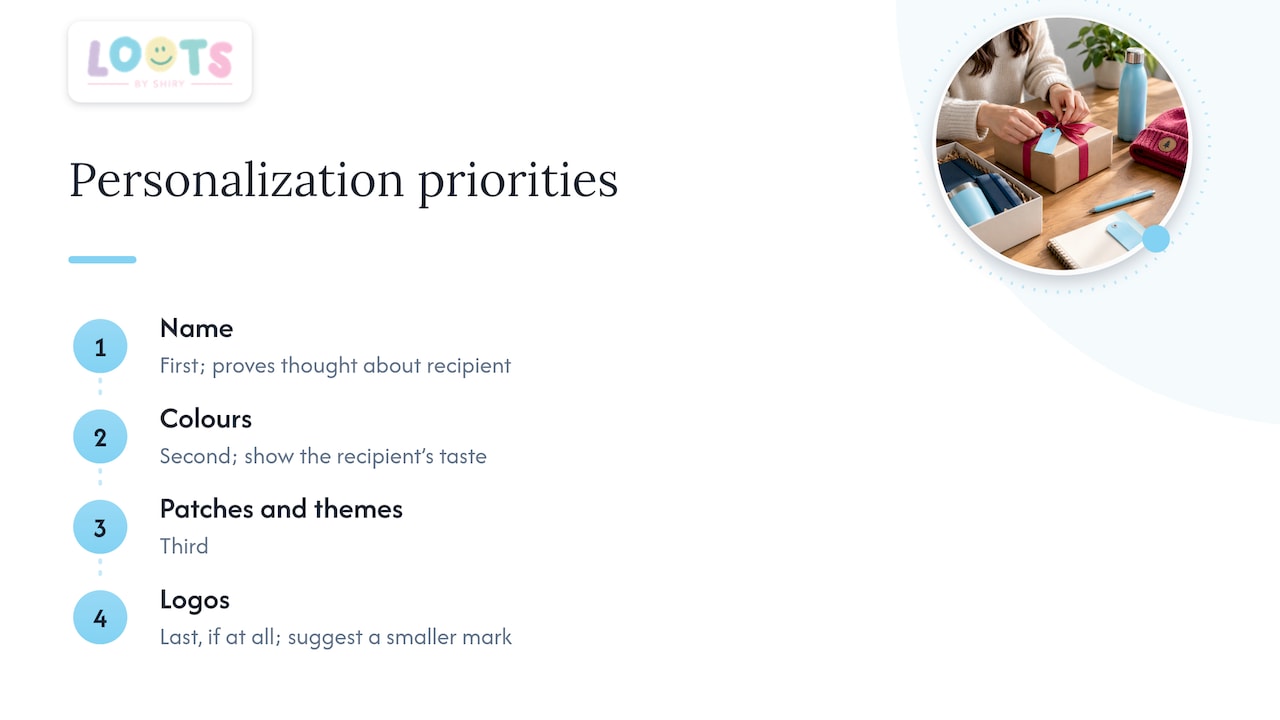
Our view is simple. The name goes on first, because it is the part that proves someone thought about the recipient. Colours come second, because they let people see their own taste in the gift. Patches and themes come third, and logos last, if at all. When a customer asks us to add a large company mark to a gift for a client, we usually suggest a smaller one, because a gift that looks like a flyer tends to end up in a drawer.
We also think the order process is part of the etiquette. Names should be confirmed before production, quantities should include a few spares for late additions, and the recipient’s choices should be collected politely and used only for the gift. Because personalized pieces are made for specific people, it helps to understand how returns work on personalized items before you order, so there are no surprises if a detail needs correcting.
— Shiry
Presentation: how the gift arrives matters
A modest gift presented well beats an expensive one tossed in a box. Keep the wrapping clean and in keeping with the relationship: a neat bag with a handwritten card is better than a heavy branded package. Our own guide on gift bag presentation for event planners covers how to stage bags at an event so they look intentional.
Write the card by hand if you can, and name something specific: the talk the speaker gave, the project the client helped finish. One sentence of specifics does more than a paragraph of general thanks.
If the gifts have to cross a border, plan ahead. Shipping and duty costs can change the value of the gift and the delivery timeline, so see our notes on ordering Canadian-made personalized favours.
A pre-order checklist for personalized corporate gifts
Use this before you place any order:
- Purpose. Is this a thank-you, a welcome, an award or a seasonal gift? Say it in one sentence.
- Recipient rules. Does their employer limit gifts? Ask if unsure.
- Budget. Is it within your own approval limit, and for employees, within the CRA’s yearly $500 non-cash total?
- Form. Is it a physical item, not cash or a gift card that works like cash?
- Name check. Has each spelling been confirmed from a reliable source?
- Branding. Is the logo smaller than the name, or absent?
- Consent. Did people agree to share the details you are using?
- Cultural fit. Any religious, cultural or dietary concerns? Any Indigenous protocols to ask about?
- Timing. Will it arrive at a neutral moment, with room for delays?
- Note. Is there a short, handwritten card with a specific thank-you?
If you want a longer version aimed at event planners, our brand gifting guidelines checklist goes through nine checks Canadian planners should not skip.
Where our products fit
If you are gifting a team, a group of speakers or a table of guests, personalized bags and small practical items are a sound choice: useful, reusable and easy to keep modest. At Loots by Shiry you can add names, patches and colours to loot bags, and the shop also carries cotton tote bags and pastel pouches at $12.00 each and colour changing tumblers at $10.00. On the loot bag page, wrapping is $0.50 per bag and delivery is $10. For group gifts that need a custom touch beyond what is listed, you can send us an inquiry for a custom order.
FAQ
Is it rude to put my company logo on a corporate gift?
Not if it is small and secondary. A discreet mark is normal for staff and bulk attendee gifts. For speakers, guests of honour and senior clients, lead with their name or initials and keep any logo minimal or leave it off.
How much should I spend on a personalized corporate gift in Canada?
There is no single legal figure for client gifts, but many organizations require approval for gifts above about $250 to $500, so keep gifts well below your own policy’s threshold. For employees, the CRA’s non-cash policy treats gifts totalling $500 or less a year as non-taxable, with some exceptions such as cash-like items.
Can I give gift cards instead?
For employees, gift cards that can be converted to cash or used at multiple retailers are taxable regardless of value, according to the CRA. For clients, cash and cash equivalents are widely prohibited in corporate policies. A personalized physical item avoids both problems.
Should I gift my boss?
Usually not individually. Etiquette advice favours a handwritten note of appreciation, because a gift to a supervisor can look like an attempt to curry favour. A group gift from the whole team is a gentler option where your workplace culture allows it.
Do I need permission to use someone’s name on a gift?
You need to have collected their details properly. Under PIPEDA, consent is required for collecting and using personal information, and using it for a new purpose requires new consent. Telling recipients that you are personalizing a thank-you gift and asking for the spelling covers the ordinary case.
Sources
- Gifts, awards, and long-service awards, Canada Revenue Agency
- Employers’ Guide: Taxable Benefits and Allowances, Canada Revenue Agency
- Guidance for businesses doing e-marketing, Office of the Privacy Commissioner of Canada
- CASL guidance on implied consent, CRTC
- Anti-Bribery and Corruption Policy, Linamar
- Code of Ethics, Vancouver Airport Authority
- Corporate event gift ideas, VENQUE
- Indigenous Protocol Guidebook, Trent University
- Doing business with Indigenous creative industries in Canada, Government of Canada
- Corporate holiday gift giving tips, Forbes
- The digital transformation of corporate event gifting, Canadian SME