

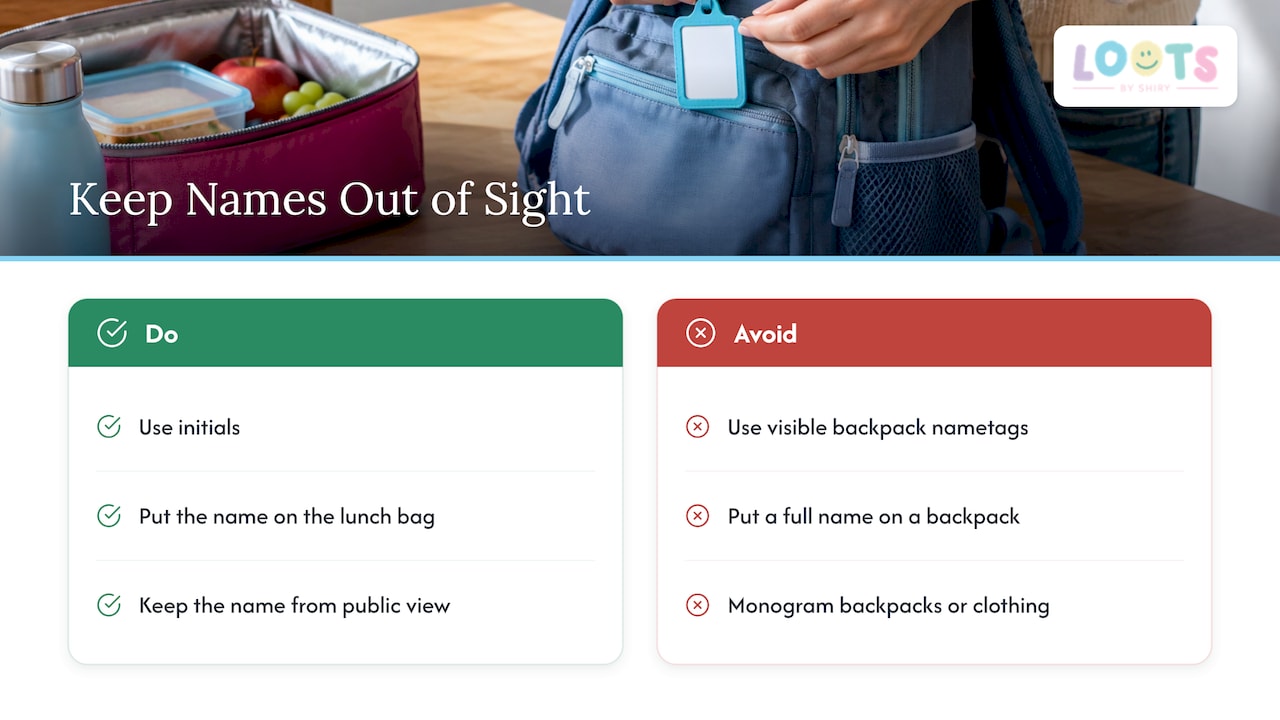
Keep a child’s full name off the outside of their bag, jacket and gear, and put it on the inside instead. On the outside, use initials, a colour or a patch that your child recognizes. That way a teacher, coach or helpful stranger can still return a lost item, and a stranger walking past can’t greet your child by name.
This guide explains why safety experts say this and where each piece of information should go. It also covers what to do for school bags, sports gear, birthday loot bags and trips, and the situations where a visible name and phone number are the right call.
TL;DR
- Avoid a visible first or full name on the outside of backpacks, lunch bags, jackets and sports gear. Strangers can use a name to seem familiar.
- Put the name inside: an inner tag, an inside pocket or the underside of a flap. Use initials, a colour or a patch on the outside.
- Leave the surname, address and phone number off anything visible in public. Keep contact details inside.
- Some children, for example those with autism who may not be able to say who they are, can benefit from an ID tag or bracelet with a phone number. Ask your local police or care team how to set it up.
- For party favours, personalize with a name on the inside or a patch and a colour on the outside.
Table of Contents
- Why a name on the outside is a problem
- What to put where
- Initials, icons and patches: identity without information
- When a visible ID is the right answer
- School, sports and trips
- Safe personalization for birthday parties and gifts
- What we offer for safer personalization
- Perspective
- FAQ
- Sources
Why a name on the outside is a problem
A child’s name is one of the first things they trust. Hearing it from an adult they don’t know can make that adult seem like someone they have met. Several safety professionals have said so publicly.
Focus on the Family Canada advises removing visible identification such as nametags on a backpack or lunch box, because strangers may use a child’s name to build trust and rapport. A crime prevention manager at a US university police department, Marvin Hart, warns that a full name on a backpack could open a door for danger. A stranger could approach and call the child by name. He suggests initials, which still let you identify the property while limiting what the public learns.
A retired Miami Beach detective sergeant told Fox News that a name on a backpack can let a predator make a child feel the person is not a stranger. He added that children wear backpacks on their backs and forget the name is there. Another safety expert quoted in the same article said that when a stranger says a person’s name in public, people tend to stop and look, and that sometimes that is all it takes to start contact.
A Georgia police lieutenant makes the same point from the patrol side: kids tend to respond when they hear their first name. He says monogramming a backpack or clothing can invite unwanted attention. His suggestion is initials, or putting the name somewhere less obvious, such as on the lunch bag.
None of this means fear. It means a small habit: the name travels with the item, but the public doesn’t see it.
What to put where
The sources agree on a pattern. The name goes inside. The outside carries something that means “mine” to your child but nothing to a stranger.
The Roberta Bondar Public School streetproofing page, from the Ottawa-Carleton area school community, asks parents to label clothing and belongings on the inside. That covers lunch boxes, knapsacks and toys. It suggests using only a last name or a code name, and warns that athletic sweaters with a name on the back advertise a student’s identity in public. The New York Department of State’s consumer protection division gives similar guidance: put the full name and other details on the inside, where initials on the outside are fine, and names on the outside, even first names alone, can create an unsafe situation.
| Item | Outside (visible) | Inside (private) |
|---|---|---|
| Backpack | Initials, a colour, or a patch | Name tag or card in an inner pocket |
| Lunch bag | Initials or a patch | Name on the inner lining or a label |
| Jacket or sweater | Nothing, or initials | Name label at the inside neck or hem |
| Sports bag | Team colours, a number or a patch | Name and a parent contact on an inside tag |
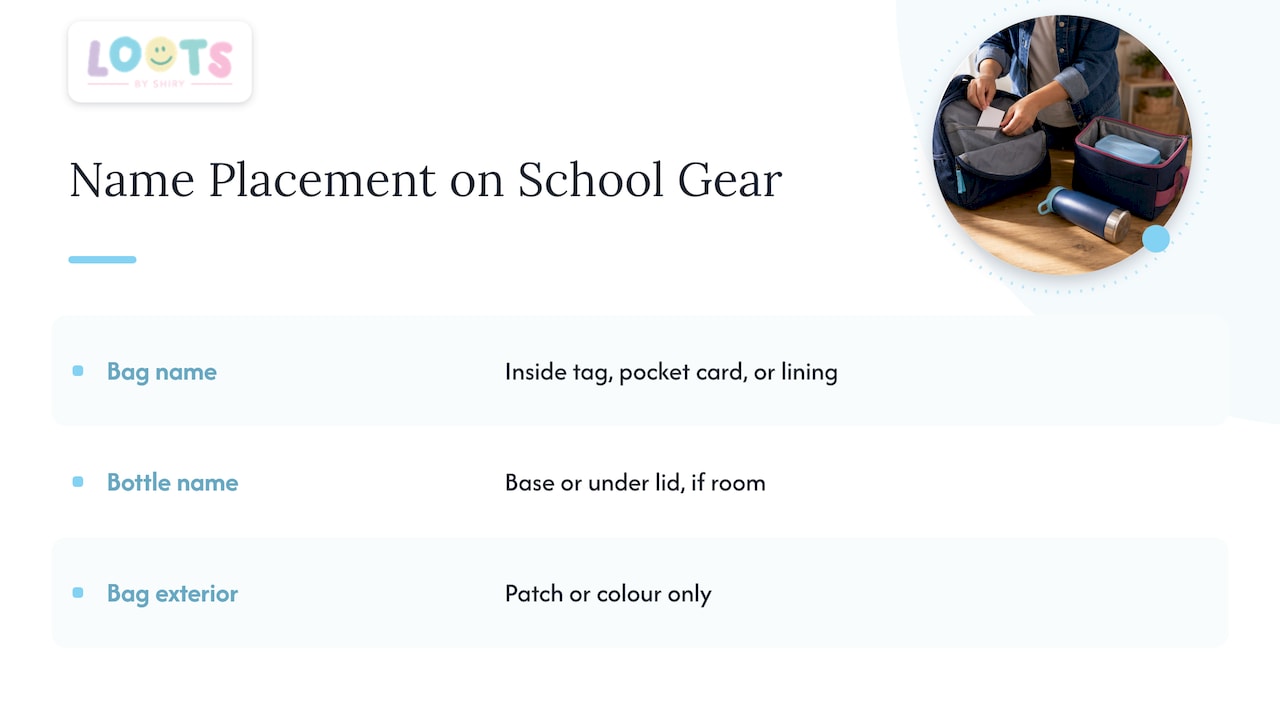
| Water bottle or tumbler | A design or colour your child knows | Name on the base or under the lid, if there is room |
| Party loot bag | Colour, theme or a patch | Name on an inside label or on a card in the bag |
A useful rule: if a stranger standing three metres away could read it, it is outside information. Keep it to something a stranger can’t use.
Phone numbers and addresses
A name alone is one risk. A name plus a phone number or address is more. A visible number can be read by anyone who walks past, and it stays there for the life of the item. Keep surnames, addresses and phone numbers off anything on show. If a contact detail is needed, it belongs on an inner tag or card that a teacher, coach or staff member would find when they open the bag.
This is also why the safest label is often small. A card tucked in an interior pocket, with the child’s first name and a parent’s number, does the work of getting a lost bag back. It doesn’t tell the public anything.
Initials, icons and patches: identity without information
Your child still needs to find their own bag at a crowded cubby or a busy hockey bench. Names are not the only way.
- Initials. Safety professionals regularly recommend them, as the sources above show. Two letters can be shared by many children, so they identify an item for your family without identifying your child to strangers.
- A patch or icon. A dinosaur, a star or a favourite animal gives your child something to spot quickly. A patch also helps children who can’t yet read their name.
- Colour. A bright, unusual colour makes a bag stand out in a pile of black and grey backpacks.
These are the same tools we use when families order from us. A bag with a colour your child chose and a patch they picked out is easy for them to spot, and a name can sit on the inside. If you want to see how we think about it, our guide on name placement on bags covers the top handle and the interior.
If you use a patch on a bag for a younger child, check how it is attached. Our page on patch safety for kids explains why we avoid detachable beads for toddlers.
When a visible ID is the right answer
The “keep the name inside” advice is for everyday gear and strangers in public. There are situations where being identifiable is the safer choice.
The Halton Police Service safety sheet for parents of children with autism recommends giving the child an identifying bracelet or clothing label with their name and a phone number to help in an emergency. It also recommends helping the child understand what the tag is for and where it is. If your child may wander or may not be able to tell a helper who they are, talk to your local police service or your child’s care team about the best way to carry ID. The right approach for your child may be different from the general rule.
The same goes for crowded trips: an airport, a festival, a theme park. Some parents use a tag with a phone number only for the day, tucked into a pocket or under clothing, and remove it afterward. That keeps the information with the child when it is useful and off the bag when it is not.
School, sports and trips
School bags and lunch kits
School is where things get lost most. Teachers often sort lost items by name, so the label has to be findable, not visible. An inside tag, an inside pocket card or a label on the inner lining all work. Put a name on the water bottle’s base or under the lid if there is room, and put a patch or colour on the outside.
The Roberta Bondar advice above, using the inside, a last name or a code, is a good school-aged default. For children who can’t read yet, a patch on the outside helps them recognize their own bag without a name.
Sports and team gear
Team bags are the hardest case, because team names and player names are often printed on jerseys and bags. A name on the back of a jersey is part of the sport, but it is worth being careful about what travels in public with it: the full name on a bag, plus the team and arena, tells a stranger where a child will be. Use team colours and a number on the outside of the bag and put the full name inside. We’ve written about this for coaches in our post on sports team loot bags.
Social media
The same logic applies online. Marvin Hart also recommends not posting a child’s teacher or school in a back-to-school photo, noting that the less information about a child’s whereabouts, the better, and that once information is online you lose control of where it goes. A photo of a child with a backpack that has a name, a school logo and a visible school sign gives three clues at once. Crop, or choose a photo where the bag is turned away.
Safe personalization for birthday parties and gifts
Party favours are meant to be personal. A name on a gift makes a child feel seen, and it also stops two guests from taking the wrong bag. You can do both: keep the personal touch and keep the information private.
Here is how we suggest hosts approach it.
- Decide what the bag will do after the party. A loot bag that becomes a school or sports bag will be seen by strangers every day. A favour that stays on a shelf won’t be. The more public the bag, the more the name belongs inside.
- Put the name where only the child sees it first. An inside label, a card tucked in with the treats or a name on a small tag inside the bag keeps the surprise and the privacy.
- Use the outside for the theme. A colour, a superhero or an animal patch tells guests whose bag is whose when it is paired with a guest list on the table. For a bigger crowd, see our ideas for personalized superhero loot bags.
- Match the item to the age. Smaller children need fewer small parts and simpler designs. Our age-based party favour safety rules and the guide to loot bags by age cover this.
- Think about the host’s information. Don’t print the child’s surname, the party address or a phone number on anything guests take home and carry around.
If you want a keepsake that isn’t a bag, a pouch works well. Our personalized pouch ideas show how to use a patch and colour outside and a name in a smaller spot. For one hero item per guest, take a look at our custom loot bag ideas.
What we offer for safer personalization
We make customizable loot bags, and you choose the name, the patches and the colours. That means you decide where each one goes. For safer personalizing, we suggest a colour and patch your child picks for the outside and a name on the inside.
Our current published prices: Cotton Tote Bags and pastel pouches are $12.00 each, and Colour Changing Tumblers are $10.00. Loot bags have their own page, where wrapping is $0.50 per bag and delivery is $10. Our loot bags page has the details and the ordering options. We deliver in Canada from Vaughan and Richmond Hill.
If you are planning a party for 10 to 100 guests and want to talk through where names and patches should go, send us a custom order request from the shop and tell us the ages of the children. For tote bags, our guide to personalizing tote bags shows the methods and the order sizes.
Perspective
We started LootsByShiry because a loot bag should feel like it was made for one child. Names are a big part of that, and we love them. A child lights up when they see their own name.
What we’ve learned from families is that the best personalization is layered. The outside is for fun: a colour your child picked, a patch of a dinosaur or a rocket, a theme. The inside is for identity: the name, tucked where the child sees it and a stranger doesn’t.
That’s why we built our bags around choices. You pick the name, the patches and the colours, and you pick where they go. A bag with a bold patch and a hidden name is more distinctive than one with a name in block letters, and it fits what safety professionals recommend. We think a thoughtful bag shows a parent cared about both the joy and the safety.
When you order, tell us how the bag will be used. A one-day party favour and a bag that goes to school every morning can be set up differently, and we’ll help you with it.
Shiry
FAQ
Is it safe to put my child’s name on their backpack?
Safety professionals generally say to avoid it. Strangers can use a child’s name to build trust, so put the name inside and use initials or a patch on the outside. A name on the inside still gets a lost bag back to you.
Are initials on the outside okay?
Generally, yes. The New York Department of State’s consumer protection division says initials on the outside are okay, while names, even first names alone, on the outside can create an unsafe situation. A patch or colour works too, and neither tells a stranger who your child is.
Should I put a phone number on my child’s bag?
Not on the outside, where everyone can read it. Put a contact number on an inside tag or a card in an inner pocket. The exception is a child who may not be able to explain who they are in an emergency. Halton Police suggest an ID bracelet or clothing label with a name and phone number for children with autism, and your local police service can advise on your child’s situation.
How do I personalize party favours safely?
Put the theme, colour and a patch on the outside and the name on the inside, on a label or a card. Leave surnames, addresses and phone numbers off completely. Choose items that suit the guests’ ages, and see our kids’ party favour safety rules for details.
What about names on jackets and sports sweaters?
A name on the back of a sweater advertises your child’s identity in public, as the Roberta Bondar Public School streetproofing tips point out. Put name labels at the inside neck or hem instead, and use team colours or a number on the outside.
Sources
- After-school safety: 13 tips for parents and their children, Focus on the Family Canada
- UAB News, back-to-school safety guidance
- Don’t personalize your kids’ school backpacks, Fox News
- Chatham County law enforcement on labelling children’s backpacks, WTOC
- Streetproofing Tips, Roberta Bondar Public School
- Back to School Basics: Information Privacy, New York Department of State
- Parent autism safety sheet, Halton Police Service