Engraving cuts the design into the tumbler, so it is permanent but single-tone. Vinyl is a coloured adhesive film applied on top, so it gives you full colour and easy changes but wears at the edges over time. Pick engraving for a keepsake with a name or simple logo. Pick vinyl for colourful, themed, or short-run party favours. Below, we walk through how each works, how they compare, and how to choose for a birthday, a team gift or a 20-cup event order.
TL;DR
- Engraving removes the coloured coating or marks the metal, so the design is part of the cup. It is one tone, usually bare steel showing through the colour.
- Vinyl is an adhesive film on the surface. It can be full colour and can be replaced, but edges can lift with heat, soaking and dishwashing.
- Materials matter: engraving suits powder-coated or bare stainless steel. Vinyl sticks best on smooth surfaces.
- Hand-washing protects both finishes. It matters most for vinyl.
- For party favours, choose by the design you want (colour or single tone) and how long the cup should last.
Table of Contents
- What actually happens to the tumbler
- Engraving vs vinyl at a glance
- Which tumblers suit which method
- How they look: colour, detail and feel
- Durability and washing
- What each method costs in Canada
- Choosing for your situation
- Common mistakes to avoid
- Our perspective
- Personalized tumblers from Loots by Shiry
- FAQ
- Sources
What actually happens to the tumbler
The simplest way to understand the difference is depth. Engraving goes into the cup. Vinyl sits on top of it.
Engraving
Laser engraving uses a focused beam to burn away a thin layer of the surface. On a powder-coated stainless tumbler, the laser removes the coloured coating and exposes the shiny steel underneath. On bare stainless it marks the metal itself. Nothing is added, so there is no layer that can peel, crack or wash off. The mark lasts as long as the cup does.
Because it is a physical change to the surface, you can feel it as a slight recess. That tactile quality is why engraving is the traditional choice for awards, retirement gifts and executive presents.
Vinyl
A vinyl decal starts as a sheet of adhesive-backed vinyl. A cutter cuts your name, shape or graphic, and the piece is pressed onto the cup. It can be printed or cut in many colours and finishes, including glossy, matte or metallic.
The bond is adhesive, which is the weak point. Heat, moisture and friction work at the edges over time. Once a corner lifts, it can catch on a hand, a bag or a sink and peel further. Vinyl is a surface treatment, so it can also collect grime, fade in strong sun or get scuffed by daily use.
Engraving vs vinyl at a glance
| Laser engraving | Vinyl decal | |
|---|---|---|
| How it is applied | Removes coating or marks the metal | Adhesive film pressed on the surface |
| Colour | One tone (the metal beneath) | Full colour, many finishes |
| Fine detail | Sharp for lines and lettering; no photos | Good for illustrations and multi-colour art |
| Feel | Slightly recessed, smooth | Slightly raised |
| Durability | Lasts the life of the cup | Edges can lift, especially with dishwashing |
| Changing it later | Not possible | Can be peeled off and replaced |
| Best surface | Powder-coated or raw stainless steel | Smooth stainless, plastic or glass |
| Typical cost pattern | Often a setup charge plus a per-piece fee | Usually the lower-cost option per piece |
| Best for | Keepsakes, logos, names | Themes, colour, short-term use |
Which tumblers suit which method
The cup decides more than people expect.
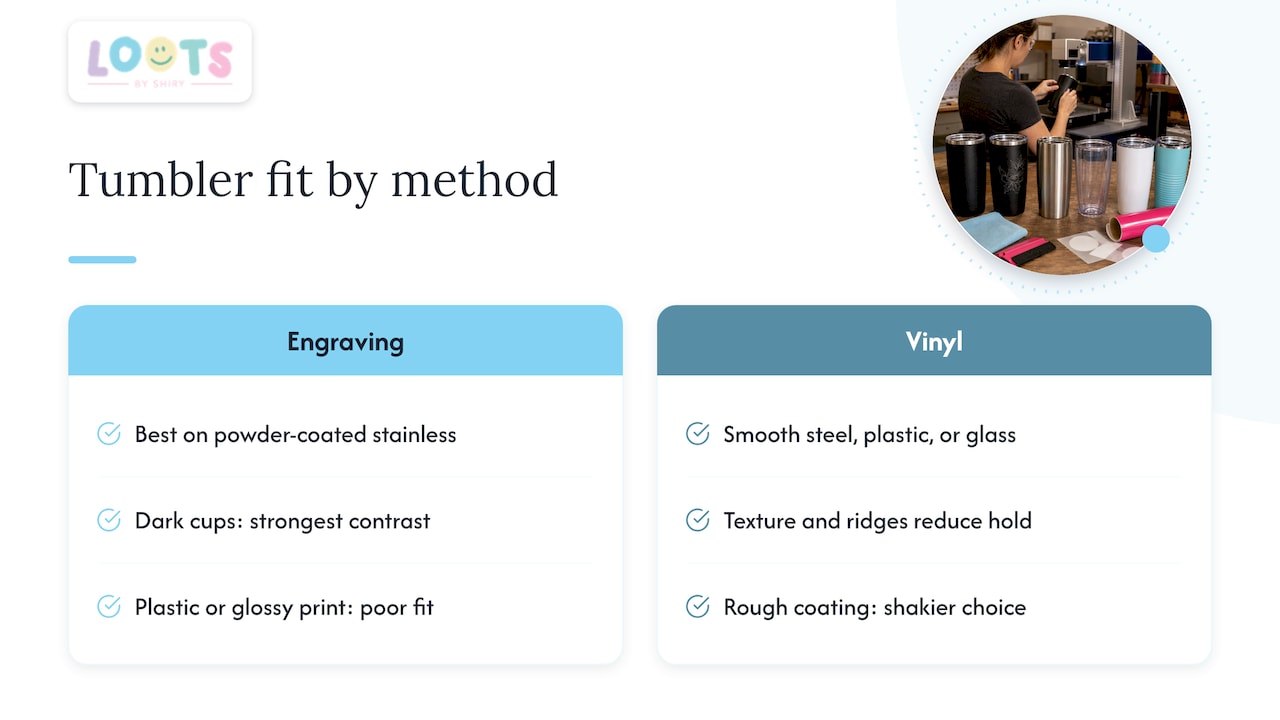
Engraving works best on powder-coated stainless steel. The laser removes the colour and reveals bright metal, giving a high-contrast mark. Dark cups such as black, navy or forest green tend to show the strongest contrast. Raw stainless can be engraved too, but the result is subtler. Cups with a plastic body or a glossy printed finish are generally not good candidates.
Vinyl needs a smooth surface. It works on stainless steel, plastic and glass when the cup is smooth and the film makes full contact. Textured finishes, ridges or some powder coats can interrupt that contact, trap air and reduce how long the decal holds. If the cup has a rough, grippy coating, expect vinyl to be the shakier choice.
Special coatings change the picture again. A colour-changing tumbler, for example, relies on a surface coating that reacts to temperature, so removing that coating with a laser would defeat the point of buying one. If you love the colour-change effect, think about how the name or design will sit on top of it instead. We cover that in our guide on how to protect prints and colour-changing coatings.
How they look: colour, detail and feel
Engraving is crisp and single-tone
Engraving is monochrome by nature. You do not choose the colour of the mark, because it is whatever the metal looks like beneath the coating. That makes it excellent for names, monograms, bold typography, simple line art and high-contrast silhouettes. Fine details can look very sharp, but the artwork has to be prepared for the process. A photograph or a gradient will not translate.
The result looks understated and premium. For adult gifts and corporate presents, that restraint is often exactly the point.
Vinyl is where colour lives
If your theme has colour (a unicorn party, a dinosaur birthday, a school team palette), vinyl is the more natural fit. You can combine several colours, choose glossy or matte, and match the design to the party. Names, stars, hearts and simple graphics all work well. The film is slightly raised, so you can feel the edge of the design.
Vinyl also gives you flexibility. It can be peeled off and replaced, so a cup can be refreshed for a new season or a new event, which engraving cannot do.
A quick way to decide on design
- One colour or fewer, mostly text: engraving is a strong match.
- Two or more colours, character art or a theme: vinyl.
- A name you may want to change later: vinyl.
- A design that should look the same in five years: engraving.
Durability and washing
This is where the two methods differ most.
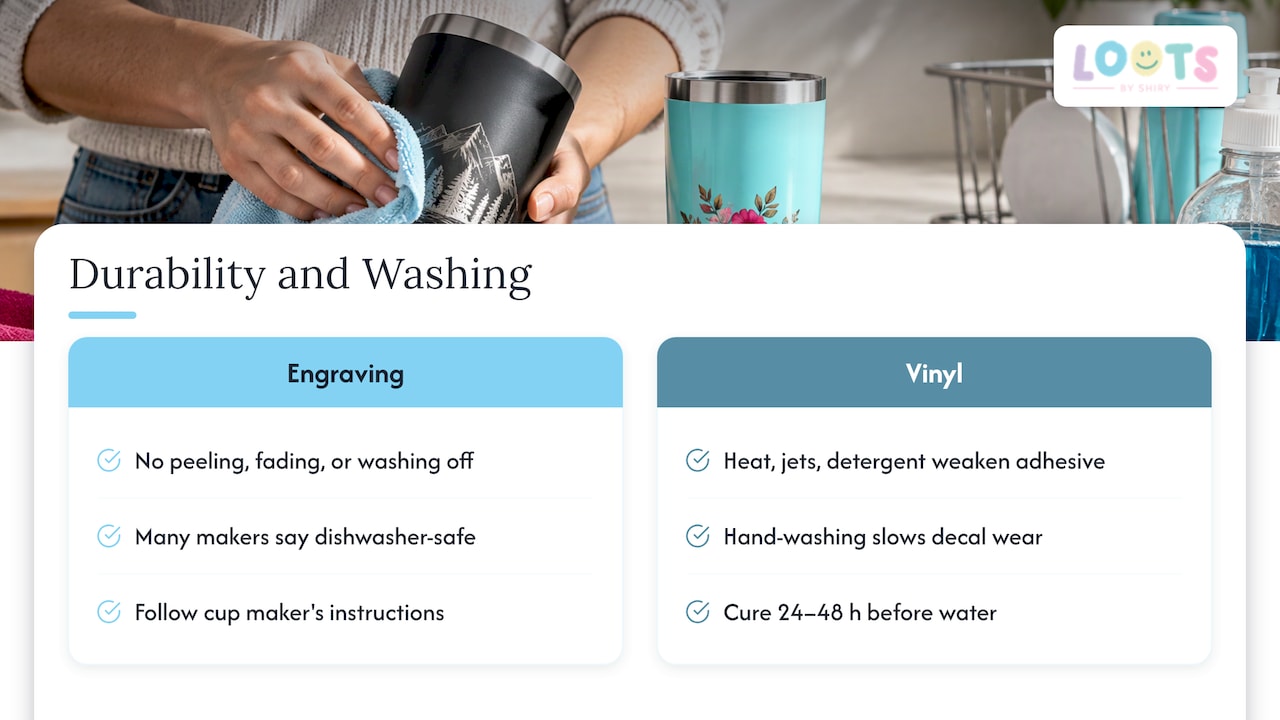
Engraving does not peel, fade or wash off, because the mark is removed material, not an applied layer. Many engraved tumblers are described by their makers as dishwasher-safe, but always follow the cup maker’s own instructions, since the powder coat colour itself can be gentler on hand-washing.
Vinyl is not generally treated as dishwasher-safe. A dishwasher combines sustained heat, strong water jets and alkaline detergent, which gradually weaken the adhesive. The first sign is usually an edge lifting. Hand-washing slows that down. Soaking the cup or running very hot water over the decal speeds it up. New decals also need time to cure before they touch water, commonly 24 to 48 hours.
A practical way to think about it: a vinyl decal can look great for the first stretch, then gradually show wear depending on how the cup is treated. If the cup will be hand-washed and used for a season, vinyl can do the job well. If it will go through a work kitchen dishwasher every day, engraving is the safer match.
Care in four habits
- Hand-wash with warm water, mild soap and a soft bottle brush.
- Avoid bleach, abrasive pads and long soaks, especially over a decal.
- Skip the microwave. Many insulated tumblers are not microwave-safe at all, so check the maker’s label.
- Let a new vinyl decal cure before first use, and follow the cup’s own care label for the dishwasher.
Our full routine is in the guide to tumbler care.
What each method costs in Canada
The cost structures are different, so a fair comparison depends on quantity.
Vinyl is generally the budget option. A decal is a small piece of material, the cutting is quick, and there is rarely a setup charge. That makes it a natural fit when you need many cups, each with a different name.
Engraving commonly adds a one-time setup charge for the artwork on top of a per-piece fee, and prices rise with more complex artwork. Spread over a large order of identical logos, that setup cost becomes small per cup. Spread over a single custom piece, it is a bigger share. Suppliers publish their own price lists, so request a current quote for your exact cup, quantity and artwork rather than relying on a ballpark.
If you are doing it yourself, there is one safety point. Laser engraving a coated tumbler releases fine particles, so a workshop needs proper ventilation and should follow the safety data sheet for the blank. In Canada, safety data sheets sit within the national Workplace Hazardous Materials Information System, so ask your supplier for the sheet for the specific cup before you start.
Choosing for your situation
A child’s birthday party
Kids lose, drop and swap cups, and a favour is meant to be fun. Vinyl’s colour and theme options usually win here, and a name on each cup stops arguments at the table. Hand-washing at home keeps it looking good. For more on what kids actually keep, see our ideas for non-candy party favours.
A themed party for adults
Bachelorette weekends, showers and team trips often want colour and a cheeky phrase, in a limited run. Vinyl handles that well and keeps costs down. If the gift is meant to sit on a desk for years, a single-tone engraved name is the more lasting choice.
A corporate or client gift
A clean engraved logo on a dark powder-coated cup reads as polished and stays legible through years of washing. If you are planning a gift programme, our note on corporate gift personalization etiquette in Canada covers names, logos and what feels appropriate.
A larger event order
When you are ordering around 20 cups or more, the questions are consistency, turnaround and budget as much as method. Our guide to picking tumbler personalization for 20 tumblers walks through those trade-offs.
Quick decision guide
| Your priority | Better match |
|---|---|
| Full colour or a theme | Vinyl |
| Lasts for years with daily washing | Engraving |
| Lowest cost per cup | Vinyl |
| Premium, understated look | Engraving |
| Option to change the design later | Vinyl |
| Dishwasher use | Engraving |
| Same-day giveaway or one event | Vinyl |
| Keepsake meant to be kept | Engraving |
Neither method is automatically better. A vivid, full-colour illustration can glow as a decal, while a clean line drawing or short phrase can land harder when the cup itself carries the design. The question is whether colour and flexibility matter more to you than permanence and feel.
Common mistakes to avoid
- Choosing engraving for a colourful design. The mark will be one tone, so a multi-colour logo will not come through as drawn.
- Putting vinyl on a rough, textured cup. Poor contact means trapped air and lifted edges sooner.
- Skipping the cure time. A decal that meets water on day one is the quickest to lift.
- Assuming every cup is dishwasher-safe. Check the cup maker’s instructions, because some insulated tumblers are not rated for dishwashers or microwaves.
- Ordering without thinking about contrast. Engraving on a pale cup is harder to read than on a dark one.
Our perspective
We make personalized loot bags and party gifts, and we see the same pattern in almost every order: the best favour is the one a guest is happy to carry home and use again.
That is why we think about tumblers the way we think about bags. A name makes it theirs. Colour makes it feel like the party. The right care keeps both looking good. When you are choosing between engraving and vinyl, start with what the guest will do with the cup, not just what looks good on the day.
For themed events where colour is half the fun, we love personalization that lets the design speak. Our colour-changing tumblers add a small moment of surprise on top, which kids and adults both notice. Whatever you choose, match the finish to the way the cup will be washed, and your favours will hold up.
Shiry
Personalized tumblers from Loots by Shiry
If you want a tumbler that fits a party theme and feels personal, our colour-changing tumblers are $10.00 each. They pair well with a custom loot bag or a pouch, so you can build a complete favour set for each guest. We are based in Vaughan and Richmond Hill and serve customers across Canada. Delivery is $10 and wrapping is $0.50 per bag on our loot bag page.
Browse the full range in our shop, or add a name, patch or colour choice to your order and we will take it from there.
FAQ
Is engraving or vinyl better for a tumbler?
It depends on the design and how long the cup should last. Engraving is permanent and suits names, monograms and simple logos. Vinyl suits colourful or themed designs and can be replaced later. For a keepsake, engraving is the safer pick, and for a party favour with a theme, vinyl fits well.
Can vinyl go in the dishwasher?
It is better not to. Heat, strong jets and detergent gradually weaken the adhesive, and edges can start to lift. Hand-wash with mild soap, avoid long soaks, and let a new decal cure for 24 to 48 hours before it touches water.
Can you engrave any tumbler?
No. Engraving works best on powder-coated or bare stainless steel, where the laser can remove the coating or mark the metal. Plastic or heavily printed cups are not good candidates. Dark colours give the strongest contrast.
Can I change an engraved name later?
No, because the mark is part of the cup. If you may want to update a name or refresh a design for a new season, vinyl is the more flexible method, since it can be peeled off and replaced.
How should I wash a personalized tumbler?
Hand-wash with warm water, mild soap and a soft brush, and avoid bleach and abrasive pads. Follow the cup maker’s label for dishwasher and microwave use. Our tumbler care guide has the full steps.