

For safe Christmas arrival, publish conservative last order dates for standard shipping in early December, expedited tracked shipping in mid-December, express or overnight shipping in late December, and international shipments earlier in December depending on the destination. These windows already build in a margin for delays. Always confirm the exact figure on the carrier’s own holiday page before you print it anywhere.
That caveat matters more than the dates themselves. Carrier cutoffs shift slightly every year, and they vary by postal zone, package weight, and whether the destination is urban or rural.
- Standard/ground: order by early December for most domestic zones
- Expedited tracked: order by mid-December
- Express/overnight: order by late December
- International: order earlier than domestic shipments, sometimes significantly earlier for customs-heavy destinations
Add your own fulfilment time on top of whatever the carrier publishes, then layer in a 1 to 3 day buffer. The carriers behind these windows include Canada Post, Purolator, UPS, FedEx, and DHL, and each one recalculates its own cutoffs closer to the season.
Key Takeaways
Publishing conservative, carrier-confirmed order-by dates with a built-in buffer is the single most reliable way to guarantee holiday delivery.
| Point | Details |
|---|---|
| Standard ships earliest | Publish standard shipping cutoffs in early December, since ground transit has the least room for delay. |
| Express buys the most time | Express or overnight cutoffs can stretch to late December, but confirm the exact carrier date first. |
| International needs its own clock | International cutoffs sit one to three weeks ahead of domestic ones due to customs processing. |
| Buffer every published date | Add 1 to 3 business days on top of fulfilment and transit time before you show a date to customers. |
| Personalized orders need separate dates | LootsByShiry calculates production time, transit, and buffer separately for personalized loot bags, with rush options available on request. |
Table of Contents
- Holiday order deadlines by carrier and service level
- How to turn carrier cutoffs into your own order-by date
- Why holiday packages get delayed and how to prevent it
- Where to put your order-by dates so shoppers actually see them
- International shipping cutoffs and customs paperwork
- How Loots by Shiry sets order-by dates for personalized loot bags
- Order personalized loot bags before the holiday rush ends
- Sources
- FAQ
Holiday order deadlines by carrier and service level
Every carrier builds its own holiday schedule around volume, staffing, and weather risk, so the deadline for the exact same package can shift by a week depending on who is shipping it. Canada Post’s national delivery standards already account for zone based transit differences, and those published delivery standards get tighter every December as sorting facilities fill up. Purolator, UPS, FedEx, and DHL each run a parallel version of the same math, but their internal cutoffs rarely match each other exactly.
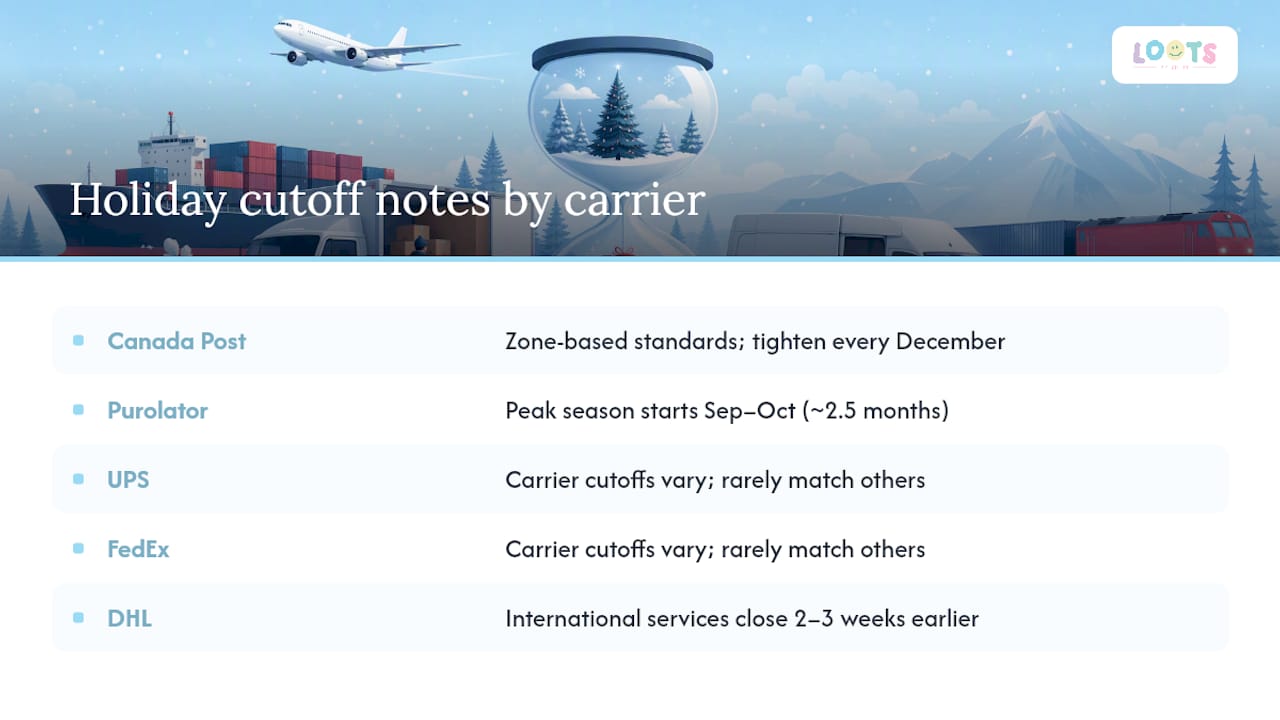
Here’s roughly how the major carriers stack up for domestic holiday shipping, based on typical seasonal patterns:
Treat every date in that table as a starting point, not a guarantee. Easyship’s Canada shipping data breaks Canada Post’s own cutoffs into local, regional, and national tiers, and the gap between a local delivery and a national one can run several business days. A package moving from Vancouver to a rural address in Newfoundland is not on the same clock as one crossing town in Toronto, even if both ship on the same carrier the same day.
This is where a lot of merchants get burned: they quote one national cutoff date on their site and apply it to every order, regardless of destination. Zone-dependent and postal-code-dependent services need a transit calculator, not a blanket rule. Every major carrier publishes one, and running your actual shipping zones through it before you finalize your holiday calendar takes fifteen minutes and can save you a wave of angry emails in late December.
Statistic Callout: Peak shipping season for small businesses commonly begins in September or October, not December, according to Purolator’s merchant guidance. That’s roughly two and a half months before most shoppers even start thinking about deadlines, and it’s exactly why building your buffer into pricing and messaging early pays off later.
International services deserve their own line in your calendar. DHL’s cross-border network tends to close out standard international options earlier than any domestic service, sometimes by two to three weeks, because customs processing adds an unpredictable extra leg to the trip. If you sell across the border or overseas, don’t assume your domestic express cutoff applies. It almost never does.
How to turn carrier cutoffs into your own order-by date
Carrier cutoffs are not customer-facing deadlines. They are the raw ingredient. Your published “order by” date needs three more things layered on top: your own fulfilment time, the carrier’s transit time for that specific destination, and a buffer for anything that goes sideways.
- Set your fulfilment SLA first. Count the business days between “order received” and “package handed to the carrier.” If you make items to order, like personalized loot bags with embroidered names or patches, that lead time needs to be separate from your in-stock items, not blended into one number.
- Pull the real transit time for that destination. Use the carrier’s own zone map or transit calculator rather than a rule of thumb. A UPS ground shipment from Ontario to Alberta and one from Ontario to Nova Scotia can differ by two or three days.
- Add your buffer. Shopify’s holiday shipping guidance recommends a 1 to 2 day cushion on top of processing time; for anything personalized or made to order, push that to 3 days given the extra production step.
- Publish separate dates by product type. Pre-orders, bulk corporate orders, and personalized goods each need their own line item on your shipping policy page, not one blanket date for the whole catalogue.
Here’s the math in practice: if your fulfilment SLA is 2 business days, the carrier’s standard transit time to that zone is 5 business days, and you want Christmas Eve arrival, you count backward: December 24 minus 5 transit days minus 2 fulfilment days minus a 2 day buffer lands your order-by date around December 13, not December 20.
Pro Tip: Run this calculation separately for your slowest shipping zone, not your average one. If your buffer works for a customer three provinces away, it works for everyone closer. Building the calendar around your fastest lane is how deadlines quietly become promises you can’t keep.
Why holiday packages get delayed and how to prevent it
Late holiday deliveries almost always trace back to the same handful of causes, and most of them are predictable enough to plan around months in advance.
- Weather disruptions stall regional networks for days at a time, particularly in the last two weeks before Christmas.
- Volume spikes push carriers past normal processing capacity, and packages that would arrive in 3 days in October can take 6 in mid-December.
- Labour disruptions at a major carrier can freeze an entire delivery network with little warning, as CBC’s coverage of Canada Post’s 2025 season made clear to merchants who relied on a single carrier.
- Stockouts force reorders that blow through your published fulfilment window before the item even ships.
- Customs paperwork errors hold international packages at the border for days while a corrected form gets processed.
The fix for most of these isn’t one big change, it’s several small ones stacked together. Split your shipping across more than one carrier so a single-provider outage doesn’t strand your whole order queue. Easyship’s multi-carrier guidance points to exactly this kind of redundancy as the most practical insurance against a carrier-specific disruption. Pre-print customs forms and return labels before peak volume hits, hold safety stock on your bestsellers, and stagger your cutoff dates by product type rather than using one date for everything.
Know when to stop promising delivery entirely. Once you’re within a day or two of your latest express cutoff, pivot your homepage and email messaging toward digital gift cards or “arrives after the holiday, guaranteed” framing instead of quietly hoping the package makes it.
Where to put your order-by dates so shoppers actually see them
A deadline nobody sees isn’t a deadline, it’s a support ticket waiting to happen. Purolator’s own merchant guidance ties visibility directly to fewer “where is my order” inquiries, and the placement matters as much as the wording.
- Product pages: show an estimated delivery window right next to the add-to-cart button, not buried in a policy link.
- Cart and checkout: repeat the order-by date at the point of payment, when the customer is already committed.
- Site-wide banner: run a rotating “order by [date] for Christmas delivery” banner starting in early December.
- Order confirmation and shipping emails: restate the expected arrival window, not just the order-by date, so the customer knows what to expect after checkout.
- Marketing reminders: send segmented email or SMS nudges tied to shipping method, not a single blast to your whole list.
A simple template works better than a clever one: “Order by December 13 for guaranteed delivery before December 24.” Add the customer’s local timezone if you sell across regions, since “order by midnight” means something different in Halifax than it does in Vancouver.
Pro Tip: Segment your last-chance reminder emails by shipping method and location. A customer buying express doesn’t need the same countdown urgency as one who ordered standard shipping two weeks ago, and sending the wrong reminder to the wrong segment trains people to ignore your emails.
International shipping cutoffs and customs paperwork
International deadlines sit ahead of domestic ones by one to three weeks, and the gap is almost entirely about customs processing, not physical transit distance. A package to a European address might travel a similar distance as one to Vancouver, but it passes through a border checkpoint that a domestic parcel never sees.
Rough send-by windows by region tend to run: late November for overseas Asia and parts of Europe, and early to mid-December for the United States, though every carrier publishes its own destination-specific table and you should treat these as a starting point only.
Before you finalize an international cutoff, confirm you have:
- A completed commercial invoice with accurate item descriptions and values
- Correct HS codes for every product category you ship
- Battery or hazmat declarations if the item contains lithium batteries or restricted materials
- Any country-specific import paperwork the destination requires
- A clear record of who signs the customs declaration on your behalf
Once you’re inside the final week before the holiday, suspend international options for guaranteed arrival and redirect those customers toward digital gift cards or a local fulfilment partner instead of gambling on a customs delay you can’t control.
How Loots by Shiry sets order-by dates for personalized loot bags
Personalized loot bags carry their own production clock, separate from anything a carrier controls. Standard turnaround runs longer than an in-stock item because each bag involves name selection, patch placement, and colour matching before it ever reaches a shipping label.

The internal math starts the same way this guide recommends: production days, plus carrier transit for the customer’s zone, plus a buffer, working backward from the delivery target. Rush requests get flagged separately and routed through a shorter production queue, with the customer notified at order confirmation about which timeline applies.
Order personalized loot bags before the holiday rush ends
There’s still time to get personalized gifts under the tree, but the window for full customization is tighter than the window for an in-stock item. LootsByShiry runs a shorter production queue specifically for the pre-holiday rush, so a bag with a name, a patch, and a colour choice doesn’t require the same lead time as a fully custom, made-from-scratch order.

If you need personalized loot bags for a holiday party, birthday, or last-minute gift, select expedited processing at checkout and confirm your timeline with support before you finalize colours and names. Rush orders get prioritized in the production queue once flagged, and support can verify whether your specific delivery date is realistic before you pay for shipping you don’t need. For anyone weighing options after the season, the refund and returns policy covers what happens if a gift doesn’t land the way you pictured it.
Browse the current loot bags collection and check the personalization lead time listed on the product page before you commit to a delivery date.
Sources
- Ask an Expert: Shipping Tips, Tech, and Tactics for Small Businesses | Purolator
- 12 Holiday Shipping Tips for Store Owners To Prepare for 2026 – Shopify Canada
- Holiday shipping deadlines Canada — Easyship
- Delivery standards by service – Parcels (Canada) | Canada Post
- CBC coverage of Canada Post and holiday mail concerns
FAQ
What is the latest date to order for standard Christmas shipping?
Standard shipping order-by dates typically fall in early to mid-December, depending on the carrier and destination zone. Always confirm the exact date on the carrier’s own holiday page since it shifts slightly each year.
How much buffer should I add to a carrier’s cutoff date?
Add 1 to 3 business days beyond the carrier’s published cutoff, with the higher end reserved for personalized or made-to-order products that need extra production time.
Are international shipping deadlines earlier than domestic ones?
Yes, international cutoffs generally sit one to three weeks ahead of domestic deadlines because of customs processing and cross-border handling delays.
What happens if I miss the order-by date for a personalized loot bag?
Contact LootsByShiry support directly to check whether an expedited processing option or rush queue slot is still available for your delivery date before you place the order.
Why do carriers change their cutoff dates every year?
Cutoffs shift based on projected shipping volume, staffing levels, and calendar placement of weekends and holidays, so a date that worked last year isn’t guaranteed to apply this year.