

The simplest rule: pick a per-attendee spending range based on your event type, then put most of that money into one keepable, lightweight item instead of spreading it across several cheap ones. A single quality item gets used; a bag full of trinkets gets binned. Decide your tier below, then move to the sample packs to see what that number actually buys.
TL;DR:
- A general audience conference fits the $6 to $12 tier, while executive events and speaker dinners can justify $13 to $25 or more.
- Bags, notebooks, and mobile power banks rank among recipients’ preferred categories, while bulky apparel, oversized totes, and glass drinkware raise weight or breakage concerns.
- Custom bulk orders often need three to six weeks, so events less than three weeks away should use local suppliers or suppliers advertising rush turnaround.
- Add a 10% attendee buffer, include shipping, taxes, and customization in per person costs, and finalize choices about 90 days before the event.
- Digital swag alone suits virtual events; for live events, pair a physical item with a digital extra that adds no shipping or weight cost.
Table of Contents
- Quick budget ranges and sample pack examples
- What to prioritise: quality, utility and weight
- Item ideas organized by budget tier (detailed suggestions and sourcing notes)
- Sourcing, ordering and logistics
- Stretching a small budget: sponsorships, tiered swag and consolidation
- Packaging and presentation: weight, bag choice and perceived value
- Planner checklist: per-attendee cost calculator and ordering timeline
- How to forecast and adjust swag bag budgets based on event size fluctuations
- Comparison of digital swag options versus physical swag in terms of budget impact
- Author perspective and brand expertise
- How Loots by Shiry can help you stay on budget
- FAQ
- Sources
Quick budget ranges and sample pack examples
Most swag budgets fall into four tiers, and each one buys a noticeably different experience. A $3 to $5 per-attendee budget covers a basic bag with one small branded item, like a pen or sticker sheet, plus maybe a mint tin. At $6 to $12, you can add a mid-weight item such as a notebook or a simple tote, with room for a filler or two. The $13 to $25 range opens the door to a genuine keepable, a tumbler, a compact charger or a better tote, paired with one or two smaller extras. Above $25, you’re typically building a VIP or speaker pack: a premium item like a quality duffle or a personalized gift, often with better packaging.
Sample pack ideas by tier:
- Cheap ($3 to $5): basic tote, pen, sticker sheet or small notepad.
- Mid ($6 to $12): branded notebook, lanyard, and a simple drawstring or tote bag.
- Premium ($13 to $25): colour changing tumbler, compact phone accessory, better quality tote.
- VIP/Speaker ($25 and up): custom duffle or personalized loot bag, higher-end drinkware, a handwritten note or card insert.
Promotional products score consistently well with recipients across Canada, with items like bags, notebooks and mobile power banks ranking among the top categories for favourable response, according to the ASI Ad Impressions Study. That data point alone should shape where your tier’s money goes: toward one of those categories rather than toward three or four smaller novelty items.
A conference with a general audience usually sits comfortably in the mid tier. A smaller, high-profile event, think an executive roundtable or a speaker dinner, justifies the premium or VIP tier because the per-head cost is spread over fewer people and the perceived value matters more to that audience.
What to prioritise: quality, utility and weight
An analysis of delegate bags found that a single quality item attendees actually keep, a well-made notebook, for instance, consistently outperforms a bag stuffed with cheap fillers, and that weight and perceived usefulness are the two biggest factors in whether something gets kept or tossed, according to the conference delegate bag autopsy. This changes how you should think about allocation. Instead of asking “how many items can I fit in this budget,” ask “what’s the one thing someone will actually use next week.”
Utility beats novelty almost every time. A phone accessory, a notebook, a drinkware item, these get used because they solve a small daily problem. A stress ball or a branded keychain usually doesn’t. Weight matters too: anything bulky or heavy gets left behind, especially if attendees are flying home or carrying the bag through a conference floor all day. A guide to swag items attendees actually keep breaks down which categories tend to survive the trip home and which get binned at the hotel.
A $10 budget might mean spending most of it on a notebook or small tumbler and the rest on a sticker, a card insert or a small sweet.
Pro Tip: If you’re unsure where to cut, cut the filler items first, not the main item. One good thing beats three forgettable ones.
Item ideas organized by budget tier (detailed suggestions and sourcing notes)
Here’s a more detailed breakdown of what actually works at each price point, along with notes on customization and what to watch for.
- Cheap tier items: pens, sticker sheets, small notepads, simple drawstring bags. Customization is usually limited to a single logo print; unit costs typically run under $2 per item.
- Premium tier items: colour-changing tumblers, compact chargers, better totes with reinforced stitching. These support more detailed customization, names, colour choices, patches, and run roughly $10 to $20 depending on finish.
- VIP tier items: custom duffle bags, personalized loot bags, curated gift sets. These are built around full personalization and often include wrapping or presentation touches, pushing unit cost to $20 and above.
Sustainable, high-utility items are worth weighting toward if your audience skews toward professionals who attend multiple events a year. Reusable drinkware, seed-paper notebooks and compact chargers are recommended for conference swag because attendees are more likely to keep and actually use them, according to MPI’s guidance on sustainable giveaways. These items also tend to double as quiet brand exposure for weeks after the event, since a notebook or tumbler gets used at a desk or in a bag long after the conference badge is thrown out.
A few categories deserve a specific callout because they score well with recipients but come with trade-offs:
- Food gifts and apparel (fleece, jackets) generate strong attendee excitement in survey data, but they raise both unit cost and shipping weight significantly, per the ASI Ad Impressions Study.
- Bags, notebooks and mobile power banks rank among the highest-desired categories without the same weight penalty.
- Glass or ceramic drinkware looks premium but adds breakage risk and shipping cost, consider powder-coated metal or BPA-free plastic tumblers instead.
If you want to add a food element for a VIP tier without blowing the weight budget, something like customized cake pops works well as a small, individually wrapped addition rather than a full apparel item.
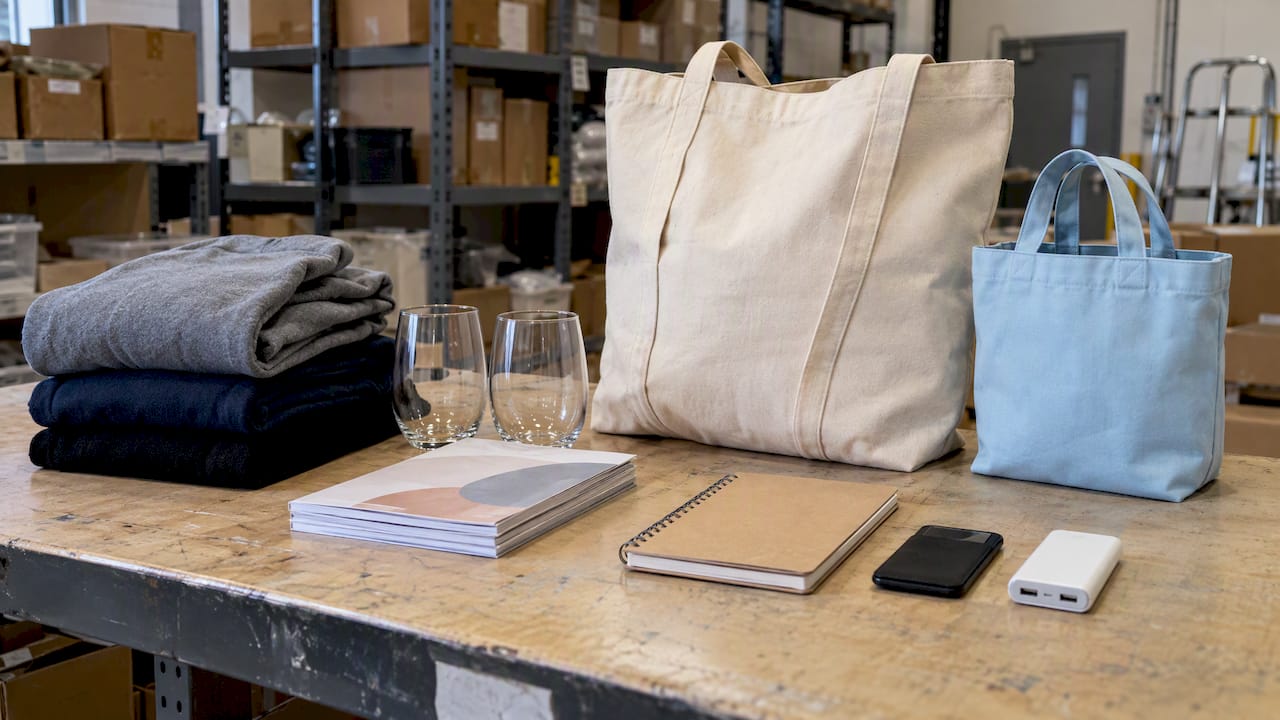
Items that commonly increase weight and cost unnecessarily include thick branded apparel, glass drinkware, printed catalogues or booklets, and oversized tote bags meant to hold several other items. Lighter alternatives that still feel substantial include a well-made notebook, a slim phone wallet, a compact charger or a smaller, better-finished tote. A planner’s guide to custom tote bags walks through fabric weight and print method choices that affect both feel and shipping cost.
For themed or personal events layered into a corporate calendar, like a retirement send-off or a milestone celebration tied to a conference, a single-vendor approach for favours can simplify the kind of juggling that usually comes with coordinating multiple vendors for personalized items.
Sourcing, ordering and logistics
Where you source swag changes both your cost per unit and your flexibility on timing. Bulk custom suppliers offer the lowest per-unit price but usually require a minimum order quantity and a longer lead time, often three to six weeks for a fully customized run. Local printers can turn around smaller orders faster, sometimes within a week or two, but at a higher per-unit cost. On-demand fulfilment, ordering exactly what you need with no inventory sitting around, avoids waste but tends to cost more per piece and may have its own minimums depending on the supplier. A hybrid approach, bulk-ordering your main item and sourcing fillers on demand, often balances cost and flexibility best.
A few things to ask any supplier before you commit:
- What’s the minimum order quantity, and does it change the per-unit price significantly?
- What’s the realistic lead time including a proof-approval round, not just production?
- Are shipping, taxes and customization fees included in the quoted price, or added after?
- What’s the policy on packaging, returns or reprints if something arrives wrong?
If your timeline is tight, under three weeks before your event, your safest options are smaller local orders or suppliers who explicitly advertise rush turnaround, even if that means paying a premium per unit.
Stretching a small budget: sponsorships, tiered swag and consolidation
Sponsorship is one of the most direct ways to upgrade swag without raising your own spend. Offer sponsors visibility, like their logo on the main item or a card insert, in exchange for covering part or all of production cost. Avoid giving a sponsor so much space that the item feels like an ad rather than a gift; one logo placement is usually enough.
Tiered swag lets you concentrate value where it has the most impact. Give general attendees the mid-tier pack and reserve the premium or VIP items for speakers, sponsors or top clients. This keeps your average cost down while still making the people who matter most feel noticed.
Consolidation tactics that stretch a budget further:
- Choose one standout item instead of three mediocre ones, concentration beats spread.
- Share branding space across a sponsor and your own logo on a single item.
- Add a digital add-on, like a discount code or exclusive content link, instead of a second physical item.
Packaging and presentation: weight, bag choice and perceived value
The bag itself shapes how an item feels before anyone even opens it. A cotton tote feels casual and reusable, works well for conference-style events, and keeps shipping weight low. A pastel pouch feels more personal and gift-like, suited to smaller or more intimate events. A small duffle reads as premium but adds both cost and weight, better reserved for VIP packs where the heavier feel supports the higher price point.
Lighter, more compact packaging tends to improve keep-rate because attendees don’t want to carry something bulky through an airport or back to their hotel room. It also lowers your own shipping and carrying costs if you’re transporting bags to the venue yourself.
- Cotton totes: light, reusable, lower cost, best for general attendee packs.
- Pastel pouches: compact, personal feel, good for smaller gatherings.
- Small duffles: premium feel, higher weight and cost, best reserved for VIP tiers.
Pro Tip: A simple ribbon tie or a small printed insert card can raise perceived value noticeably without adding meaningful weight or cost, usually under $0.50 per bag.
Planner checklist: per-attendee cost calculator and ordering timeline
A clear checklist keeps a swag budget from quietly ballooning once shipping, taxes and fees get added in.
- Define your goal for the swag (brand recall, thank-you gesture, sponsor visibility) before picking items.
- Set your per-attendee budget tier based on event type and audience.
- Choose your main keepable item first, then add one or two light fillers.
- Calculate shipping, customization fees and any applicable taxes into the per-unit cost, not just the item price.
- Add a 10% buffer for last-minute attendee count changes, a one-per-guest-plus-buffer approach avoids running short without overordering heavily.
A simple milestone timeline keeps ordering on track: finalize your budget and item choices around 90 days out, submit designs and proofs by 60 days, place your final order by 30 days, and confirm delivery and packaging details by 14 days before the event.
How to forecast and adjust swag bag budgets based on event size fluctuations
Attendee counts rarely stay fixed once registration opens, and your swag budget needs room to move with them. Start by basing your initial order on your most confident early estimate, then build in the 10% buffer mentioned above rather than ordering to the exact number. If registration climbs past your buffer, check with your supplier early about reorder lead times before you’re forced into rush pricing.
When numbers shrink, the smarter move is usually to upgrade the remaining bags rather than cancel an order outright, since minimum order quantities often mean you’ve already committed to the cost. A smaller final headcount is actually a good opportunity to shift leftover budget into the main item’s quality rather than eating the cost of unused inventory.
For recurring events, track actual attendance against your initial estimate each time. If you consistently overorder or underorder by a notable margin, adjust your baseline estimate for the next event rather than repeating the same guess. Building a small cushion into your timeline, ordering fillers on demand while locking in your main item early, also gives you flexibility to scale either direction without redoing your entire order.
Comparison of digital swag options versus physical swag in terms of budget impact
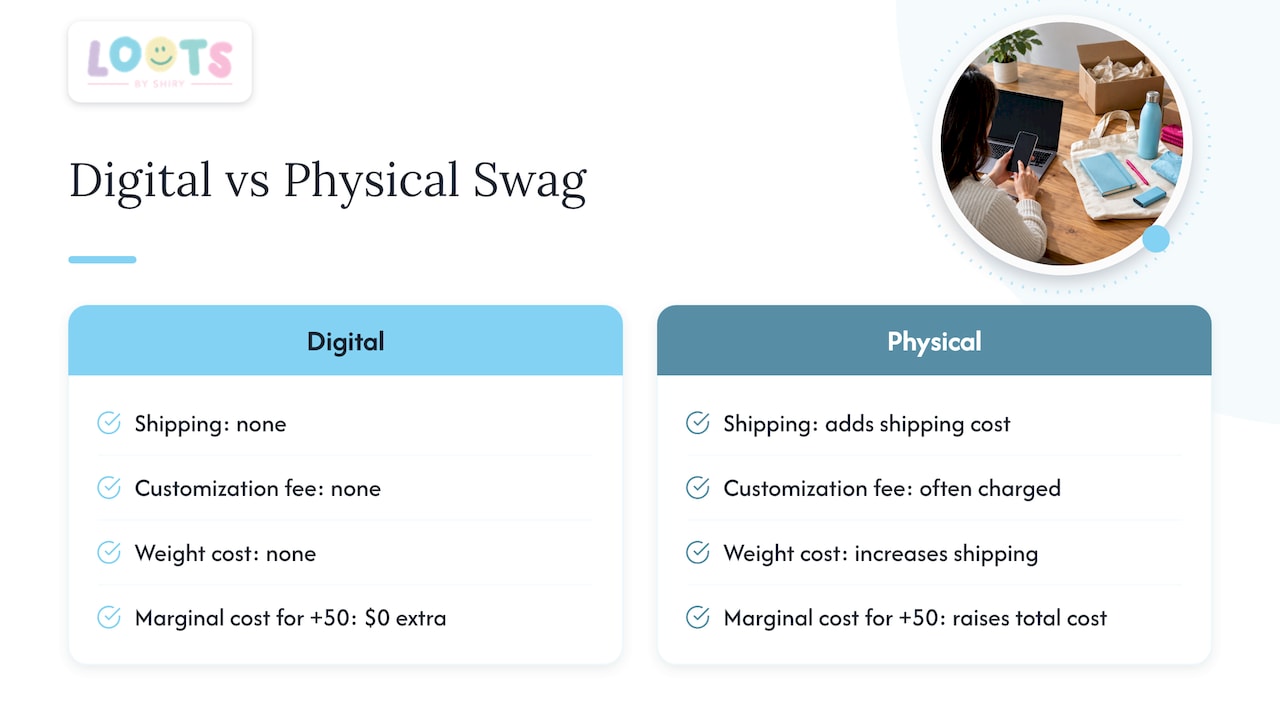
Digital swag, think e-gift cards, downloadable content, discount codes or digital badges, carries essentially no shipping, customization fee or weight cost, which makes it an easy way to stretch a tight budget or add value without increasing your physical order. It also scales instantly: adding 50 more attendees costs nothing extra.
The trade-off is impact. A digital add-on doesn’t sit on a desk or get carried around the way a notebook or tumbler does, so it tends to support brand recall rather than drive it on its own. The strongest approach for most budgets is pairing one physical keepable item with a digital extra, letting the physical piece carry the memorability and the digital piece carry the low-cost scalability. Relying on digital swag alone usually only makes sense for virtual events where there’s no physical bag to build around in the first place.
Author perspective and brand expertise
Working with personalized gifts has shown us that customization earns its cost when it makes someone feel specifically chosen, a name, a colour they picked, a patch that means something to them. It adds little when it’s rushed or generic, just a logo slapped on a stock item.
Customization is worth the extra lead time for VIP packs, speaker gifts or small, high-stakes gatherings. For a 500-person conference giveaway, a well-chosen stock item often serves the budget better than a rushed custom run.
— Shiry
How Loots by Shiry can help you stay on budget
We build customizable loot bags with options to choose names, patches, colours and themes, so your swag feels personal instead of generic, without requiring you to manage a custom production run yourself. Our Loot Bags line handles the design input, wrapping and delivery, which takes the sourcing friction most planners hit off your plate.
- Browse sample packs across Cotton Tote Bags, pastel pouches, and tumblers to see unit options at a glance.
- Request wrapping per bag or have us handle delivery directly to your venue.
- Personalize names, colours and patches without managing a separate printer or fulfilment house.
| Option | What it includes | Price |
|---|---|---|
| Pastel Pouches | Customizable pouch, personalization options | $12.00 |
| Colour Changing Tumblers | Customizable tumbler | $10.00 |
| Wrapping (per bag) | Added presentation touch | $0.50 |
| Delivery | Delivery to your location | $10 |
If you’ve already settled on your budget tier, the fastest next step is to view the loot bag options and request a quote for your attendee count.
FAQ
What are some inexpensive swag bag ideas?
Pens, sticker sheets, small notepads and simple drawstring bags are among the cheapest options, typically under $2 per item. For a slightly better feel without much added cost, a branded notebook or a simple cotton tote bag still fits a modest budget.
Are swag bags worth it?
They’re worth it when the budget goes into one quality, useful item rather than several cheap fillers, since a single keepable item tends to get used long after the event while cheap giveaways often get discarded. The delegate bag autopsy found that concentration on one quality item outperforms a bag full of low-value extras.
How much should a loot bag cost?
Costs vary widely by event type, from $3 to $5 per attendee for a basic pack up to $25 or more for a premium or VIP pack with a personalized keepable item. The right number depends on your audience size and how much perceived value you want the bag to carry.
What can I put in goody bags for cheap?
Stickers, small notepads, a pen and a simple card insert keep costs low while still filling the bag. If you have a little more room, a lightweight branded item like a notebook adds perceived value without pushing the budget much higher.
Sources
- ASI Ad Impressions Study (Canada 2026)
- Conference swag bag ideas: sustainable giveaways for events
- The conference delegate bag autopsy: what gets kept and what gets binned