
The branded giveaway trends worth your budget in 2026 are sustainable materials, personalization, tech-enabled “smart swag,” premium kitting for remote onboarding, wellness and desk tech, and limited-edition runs. These picks reflect Gen Z preferences and current industry data, not guesswork. The rest of this article shows how to pick the right item for your audience, measure what it actually does for your brand, and run a giveaway or contest without tripping over Canadian law.
TL;DR:
- Personalization, including names and color choices, significantly increases item retention and effectiveness, especially for VIP and event-specific giveaways.
- QR and NFC-enabled swag stand out at launch events and conferences, but privacy transparency and simple call-to-action paths are essential for success.
- Remote onboarding kits and specialty desk tech are more effective when designed as high-quality, purposeful items that meet clear utility standards.
- Running legally compliant contests in Canada requires skill-testing questions for chance-based draws, clear data privacy notices, and often excludes Quebec residents to simplify rules.
Table of Contents
- Quick shortlist: the top branded giveaway trends for 2026
- Why these trends work in 2026: data and market context
- Trend deep dives: practical ways to apply each trend
- How to choose giveaways that fit your objective, audience and budget
- Running legal, compliant contests and giveaways in Canada
- Why personalized loot bags and curated kits work: Loots by Shiry’s approach
- Comprehensive cost breakdowns for 2026 giveaway budgets
- Author perspective: how I’d plan a 2026 event giveaway programme
- Loots by Shiry: how we help planners create personalised, keepable giveaways
- FAQ
- Sources
Quick shortlist: the top branded giveaway trends for 2026
Planners rarely need a catalogue. They need a short list of what works, for whom, and at what price point.
- Sustainable merchandise: matters because recipients increasingly judge brands by what they give away; best for trade shows and client gifting, with reusable tote bags and bamboo or recycled-cotton items as accessible entry points.
- Personalization: works because a name, initials, or a chosen colour turns a giveaway into something people keep rather than toss; best for VIP gifting, employee milestones, and loot bags at events where the item becomes a souvenir, not just a sample.
- Smart swag (QR or NFC-enabled items): fits launch events and conference booths where you want a scan to lead directly to a landing page, a discount, or a sign-up form.
- Premium kitting for remote onboarding: addresses the reality that new hires and remote clients never see a swag table, so the “event” happens at their door.
- Wellness and desk tech: suits office gifting and client retention programs, where a genuinely useful item like a charging pad or a quality mug outperforms a pile of pens.
- Limited-edition or co-branded runs: creates urgency around a launch or anniversary, best distributed on-site with pre-show registration to build anticipation.
Budget lanes tend to fall into mass (low cost per unit, higher volume, suited to trade-show floors) and premium (higher cost, lower volume, suited to VIP or client-retention lists). Distribution follows the audience: on-site handouts for conferences, direct-to-home kits for remote teams, and online giveaways for social campaigns where a mailed item becomes part of the entry mechanic.
Why these trends work in 2026: data and market context
These trends aren’t stylistic guesses. They track how recipients actually respond to promotional items.
A large majority of Canadians say they view a brand more favourably after receiving a promotional item and say they’re more likely to do business with that brand afterward, according to ASI’s 2026 Canadian Ad Impressions Study. The study also found that utility drives retention, with many recipients keeping items specifically because they are useful, supporting the choice of fewer, better items over many throwaway trinkets.
Younger recipients respond even more directly to personalization and digital integration. PPAI’s consumer research found that 68% of Gen Z respondents say branded merchandise positively affects their perception of a brand, 63% made a purchase influenced by promotional products, and 70% favour items with a digital or interactive component, which is exactly the logic behind QR-enabled swag and personalized kits.
Market sizing backs the sustainability push too. The Canadian sales volume study puts distributor sales at CAD 2.03 billion in 2025, with sustainable products making up roughly 21.7% of that volume. That’s not a niche preference anymore, it’s over a fifth of the market.
- Buyers are bifurcating: some want the cheapest item that still works, others want fewer, premium pieces that double as retention tools.
- Technology adoption (AI and AR features in promo) is still limited across Canadian distributors, which means a well-executed QR or NFC campaign still stands out rather than blending into a crowded field.
- Planners serving both ends of the budget split should pick one flagship premium item and one reliable mass item rather than splitting a single budget across the middle.
Trend deep dives: practical ways to apply each trend
Sustainability done credibly
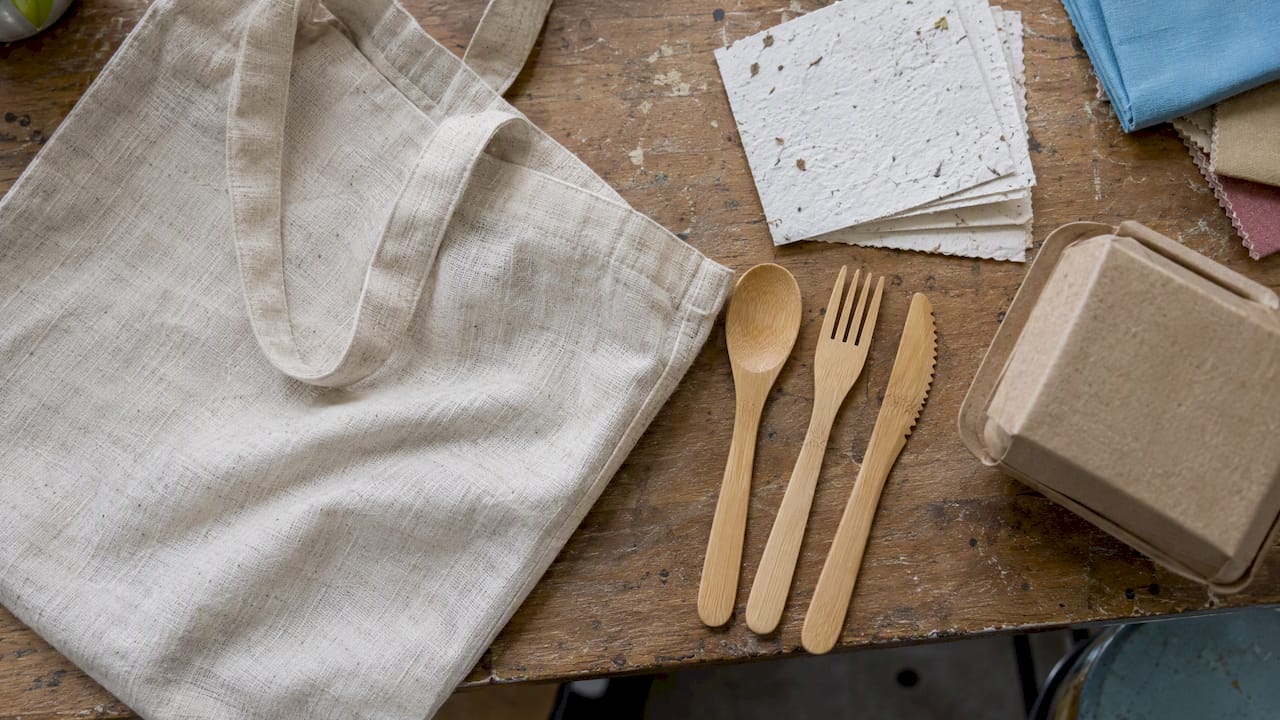
Recipients notice greenwashing fast, so claims need to hold up. Look for certifications like Global Organic Textile Standard for cotton goods or Forest Stewardship Council for paper packaging, and avoid vague language like “eco-friendly” without a backing standard. Recycled-cotton tote bags, bamboo utensil sets, and seed-paper cards are credible entry points because the material itself is checkable. If you’re sourcing packaging rather than the item itself, plantable or compostable options from eco-focused suppliers add a sustainability layer without inflating the per-unit cost much.
Pro Tip: Print the certification logo directly on the item or its tag, not just in your campaign copy, so the claim travels with the product.
Personalization that’s worth the lead time
Personalization works best when the audience list is finite and known ahead of time: VIP clients, new hires, wedding or birthday guests, conference speakers. Variable-data printing (names, initials, or a chosen colour swapped per unit) adds cost and lead time compared to a single static run, so build in at least two to three weeks for anything beyond a basic name print. Loot bags with swappable patches or colour choices are a practical middle ground: the base bag is produced in bulk, and the personal touch is added at the finishing stage, which keeps costs predictable while still making each one feel individual.
Smart swag: QR and NFC without the privacy headache
Embed a QR code on a tag, sticker, or the item itself, pointing to a mobile-optimized landing page, never a desktop site that makes someone pinch and zoom. NFC chips (tap-to-connect) work well in premium items like tumblers or tech accessories where the unit cost already supports the extra component. Whatever you choose, disclose clearly what data you’re collecting when someone scans, since a landing page that asks for an e-mail address or phone number needs the same privacy notice you’d use for any data collection point.
- Keep the scan-to-action path to one tap and one form field wherever possible.
- Use unique UTM parameters per campaign so you can separate booth traffic from mailed-kit traffic in your analytics.
- Test the landing page on an actual phone, not just a browser’s mobile view, before the item ships.
Kitting and remote onboarding boxes
A kitted program works because it recreates the “event” for someone who’ll never stand at a booth. A simple new-hire kit might include a notebook, a drinkware item, a desk accessory, and a printed welcome card, packed to survive a courier run without rattling or crushing. Direct-to-home logistics add real cost: packaging that protects fragile items, a packing slip, and often a flat courier fee per box, so price the kit as a bundle rather than adding up individual item costs and assuming shipping is free.
Wellness and desk tech that doesn’t disappoint
A giveaway item branded “wellness” only works if it performs like a real product. A charging pad that charges slowly or a water bottle that leaks does more brand damage than no gift at all. Set a quality threshold before you order: check for a warranty or defect-replacement policy from the supplier, and order a sample unit before committing to a full run. Desk tech (chargers, cable organizers, portable speakers) tends to sit in the premium lane, while wellness basics (water bottles, stress items, notepads) can work in either lane depending on material quality.
Limited-edition and on-site personalization runs
Limited runs create urgency, especially around a product launch or anniversary; this strategy can be enhanced through premium brand merchandise collaboration to amplify your reach and impact. On-site customization stations, where attendees pick a colour, add a patch, or get a name printed while they wait, work best with pre-show registration so you know roughly how many units to stock and staff for. This is where personalization options that let attendees choose colours or patches on the spot turn a standard giveaway table into something people line up for.
How to choose giveaways that fit your objective, audience and budget
Most giveaway decisions collapse once you answer four questions in order.
- Start with the objective: awareness calls for high-visibility, lower-cost items distributed widely; lead generation calls for an item tied to a QR scan or sign-up; retention calls for fewer, better items sent directly to existing clients; VIP gifting calls for premium, personalized pieces.
- Segment the audience: Gen Z recipients respond to digital and interactive elements, professionals respond to usable desk or travel items, and clients or employees respond to personalization that signals they were considered individually rather than mass-mailed.
- Pick the budget lane: mass-market items typically run low per unit and suit on-site handouts, while premium items cost more per unit but suit mailed kits or VIP tables where quantity is lower and expectations are higher.
- Build in lead time: variable-data personalization, on-site stations, and kitted boxes all need longer production windows than a single static run, so confirm branding approvals and sample QA before the final order goes in.
Track scan rates through unique UTM parameters, use distinct promo codes per channel to trace conversions back to a specific giveaway, and run a short post-event survey (even a one-question NPS) to catch favourability shifts while the event is still fresh.
Running legal, compliant contests and giveaways in Canada
Any giveaway that involves a random draw or requires an entry step brings contest law into play, and the rules are specific.
- A giveaway awarded purely by chance needs a skill-testing question to avoid being treated as an illegal lottery under the Criminal Code, as outlined in Canadian contest guidance.
- CASL requires express, separate opt-in for marketing e-mails. Entry into a contest can never be conditional on agreeing to receive marketing messages.
- PIPEDA requires a privacy notice at the point of data collection, explaining what personal information you’re gathering and why.
- Including Quebec residents adds RACJ registration and French-language requirements, so many national campaigns simply exclude Quebec rather than build a bilingual, registered version.
- Keep short rules (visible right where someone enters) separate from long rules (a dedicated page with full terms, prize details, and privacy information), and build fulfilment timelines that account for verification and prize delivery, not just the draw date.
Why personalized loot bags and curated kits work: Loots by Shiry’s approach
Personalization and keepability aren’t separate trends, they’re the same idea from two angles: people keep what feels like it was made for them. Loots by Shiry builds on that directly, letting customers choose names, patches, and colour combinations for each loot bag rather than shipping a fixed, generic design. That interactive input is the point: the customer’s choices drive the final product, which is a different model from ordering a stock item in bulk.
This approach fits conference swag where attendees want something distinct from the table next to them, VIP gifting where a client’s name or chosen colour signals they weren’t an afterthought, and return gifts for birthdays or themed events where the bag itself becomes part of the memory. The emphasis stays on checkable specifics: named colour and patch choices, not vague claims about uniqueness.
Comprehensive cost breakdowns for 2026 giveaway budgets
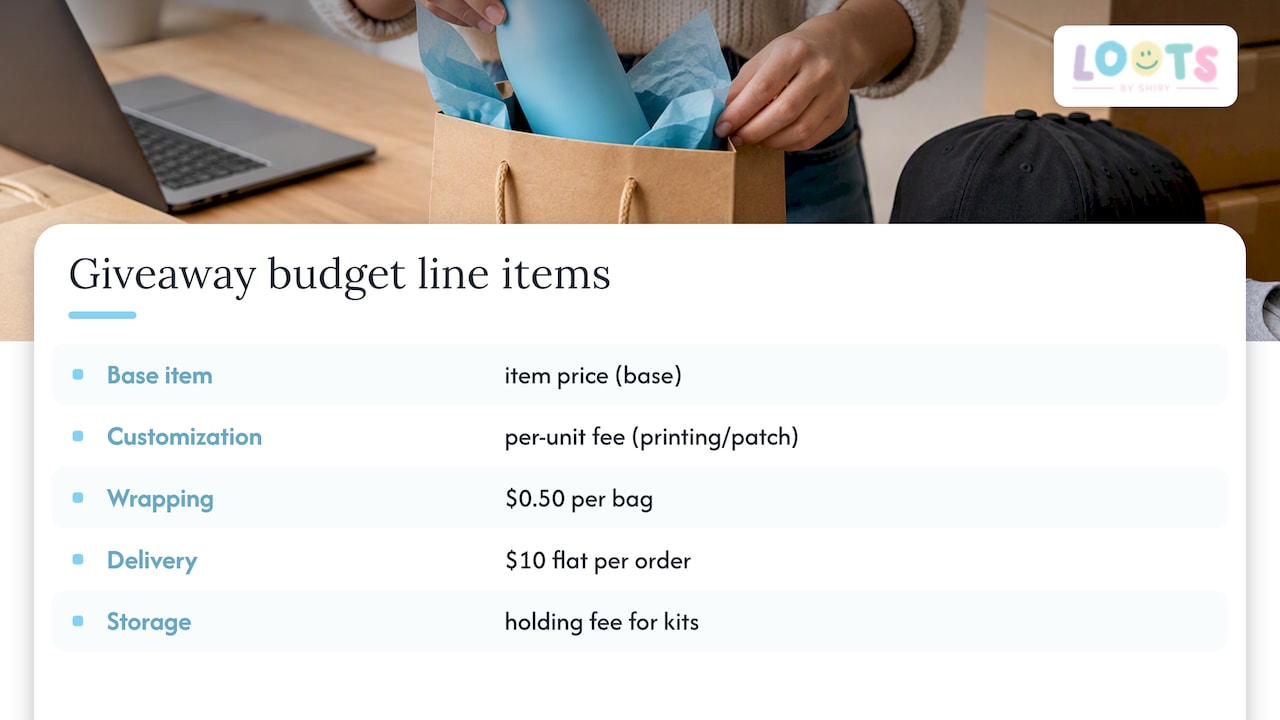
The sticker price on a promotional item is rarely the full cost. Customization (variable-data printing, patches, or colour changes) typically adds a per-unit fee on top of the base item. For loot bags specifically, wrapping runs an additional $0.50 per bag, and delivery adds a flat $10 per order, costs that are easy to miss if you’re only budgeting the item price itself.
Storage is another hidden line, particularly for kitted programs ordered ahead of a launch date: holding finished kits for weeks before a mail date means factoring in either your own storage space or a supplier’s holding fee. Shipping for direct-to-home kits scales with box size and weight, not just distance, so a bulkier kit with a tumbler and a notebook costs noticeably more to mail than a flat tote bag.
Build a line-item budget that includes: base item cost, customization or personalization fee, wrapping or packaging, delivery or shipping, and any storage or holding cost if kits sit before distribution. Request a full quote covering every stage before committing to quantities, since a supplier’s published per-item price rarely reflects what lands in your final invoice.
Author perspective: how I’d plan a 2026 event giveaway programme
Treat procurement as a sequence, not a single order: confirm the objective, pick one flagship item and one backup mass item, request a physical sample before committing to full quantity, build in buffer time for personalization or QA, and lock in fulfilment and tracking (UTM links, promo codes) before the event date, not after. For a real campaign, I’d pair a premium personalized kit for VIP attendees with a reliable utility item (a tote or tumbler) for general attendees, then follow up both groups with a QR-driven survey.
With a tight budget, skip the tech layer and spend on material quality instead. With a generous one, invest in personalization before you invest in flashier tech, since a name on an item outperforms a QR code nobody scans.
— Shiry
Loots by Shiry: how we help planners create personalised, keepable giveaways
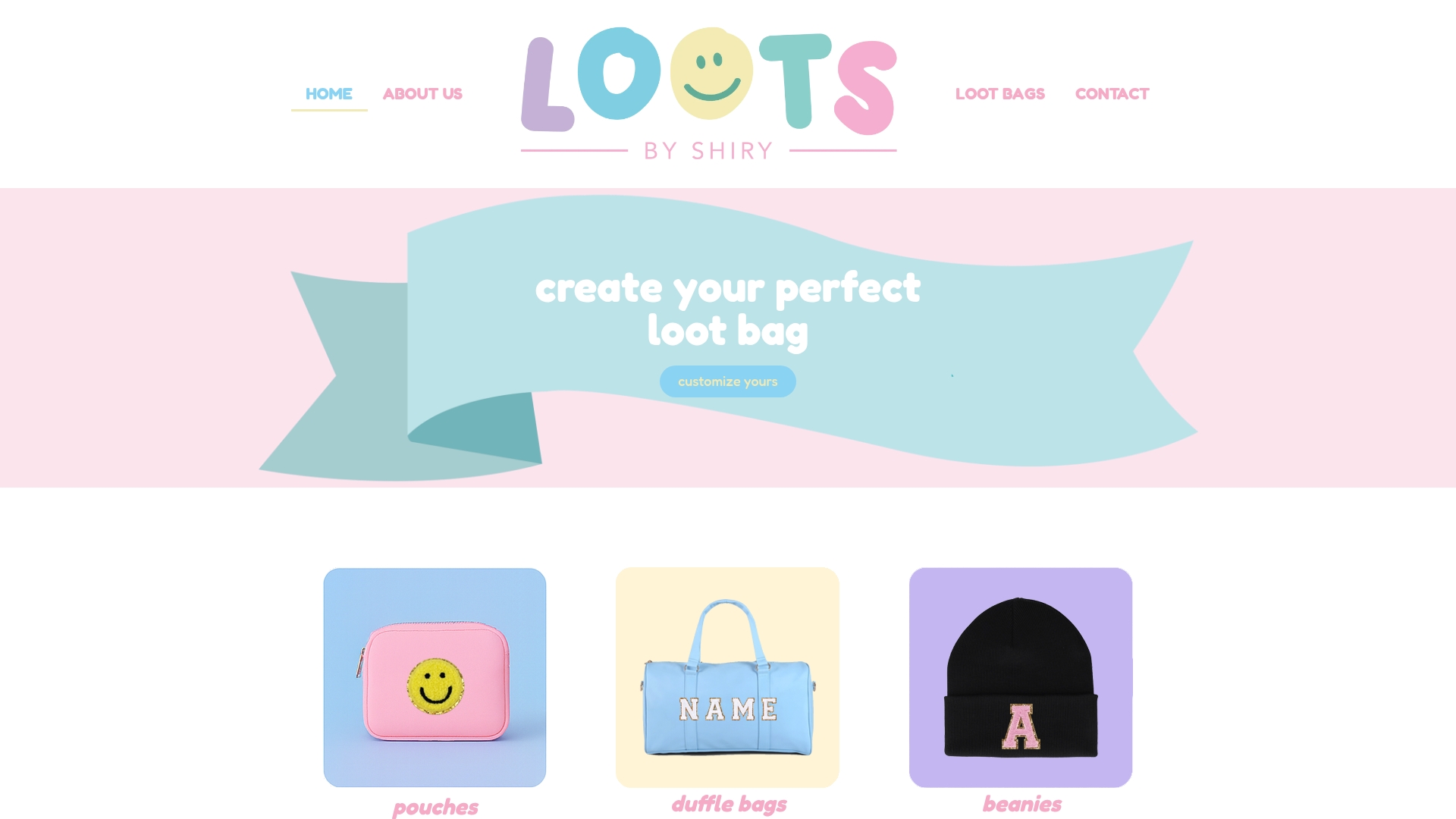
If you’ve read this far, the trend that matters most for your next event is personalization that recipients actually get to choose. Some companies build loot bags around that idea: customers pick names, patches, and colours, so the final product reflects their input rather than a generic template. Alongside loot bags, the shop carries Cotton Tote Bags, pastel pouches, and Colour Changing Tumblers, all of which work as flexible fill-ins for conference kits or VIP gift bags when you want variety without a long customization queue.
For event planners building a kit from scratch, this fits conference swag, corporate milestones, and VIP gifting where a generic bag would undercut the moment. Visit the loot bags page to see customisation and fulfilment options, request a sample, or place an order to see how a personalized bag changes what attendees actually keep.
FAQ
What are some popular giveaway items in 2026?
Tote bags, drinkware, and tech accessories lead popular categories, alongside personalized items like loot bags and kitted welcome boxes for remote teams. Demand is shifting toward fewer, higher-quality pieces rather than large volumes of low-cost trinkets, a shift reflected in Canadian promotional product guidance.
What are the key promotional product trends for 2026?
The leading trends are sustainable materials, personalization, QR or NFC-enabled “smart swag,” premium kitting for remote onboarding, and limited-edition runs tied to launches. These picks align with Gen Z’s preference for digital and personalized promotional items.
What are some trending giveaway items?
Reusable tote bags, colour-changing tumblers, charging accessories, and personalized loot bags with chosen names or patches are all trending because they combine daily utility with a personal touch. Items from Loots by Shiry’s shop, including Cotton Tote Bags and pastel pouches, fit this pattern directly.
What are the best giveaways to attract customers?
The best giveaways match the audience and the moment: a useful, branded item for broad awareness, and a personalized piece for VIP or retention-focused gifting. Utility matters most for keepability, since promotional items kept specifically for their usefulness show the strongest retention rates.
How do I run a compliant giveaway contest?
Any chance-based draw needs a skill-testing question to avoid being treated as an illegal lottery, plus a no-purchase entry option. Keep short rules visible at entry, link to full long rules on a separate page, and follow CASL and privacy requirements for any data you collect, with extra registration steps if Quebec residents are eligible.
Sources
- ASI’s 2026 Ad impressions study: 3 key findings from Canada
- PPAI consumer study: Why promo clicks with Gen Z
- Running a legal contest/giveaway/sweepstakes in Canada (KickoffLabs)
- Promotional products Canada: The complete guide for businesses in 2026