
For most Canadian events, the best custom tote bag is a mid-weight cotton canvas tote with reinforced handles and screen printing for bulk logos. That combination holds up through a full event day, photographs well, and costs far less per unit than premium alternatives at volume. Before you place a bulk order, request a pre-production sample first — it is the single step that prevents the most expensive surprises.
LootsByShiry offers personalized cotton tote bags with custom names, patches, and colour choices, making them a strong fit for birthday parties, corporate events, and themed celebrations throughout Canada.
Table of Contents
- Which tote style fits your event?
- How do materials affect brand perception?
- Which printing method should you choose?
- What quality checks should you request before a bulk run?
- What does it cost and how long does it take?
- What should you send your vendor?
- How do different materials hold up during event use?
- How should you package and ship bulk orders within Canada?
- Why do environmental certifications matter for tote bags?
- LootsByShiry makes personalised event totes easy to order
- Key takeaways
- What event planners often get wrong about tote bags
- FAQ
Which tote style fits your event?
Matching the bag silhouette to how guests actually use it determines whether the tote gets reused or tossed. Open-top canvas totes are the most common choice for general attendee giveaways: they speed registration, offer a large printable front panel, and cost less than zippered variants at event scale.
- Conference or tradeshow: Flat open-top tote. Slim profile packs flat for easy distribution; guests fill it themselves as they collect materials.
- Wedding welcome bag or gala: Gusseted tote with medium-drop handles. Stands upright when loaded with gifts, holds its shape for photos, and feels more considered than a flat bag.
- VIP or corporate gift: Zippered tote or structured canvas with a bottom panel. The closure signals premium; pair it with a personalised tumbler for a full kit.
- Festival or charity run: Lightweight flat tote. Easy to hand out quickly; bold one-colour logo reads from a distance.
- Retail or product launch: Gusseted shopper. Holds product boxes without collapsing; a 4.5″ gusset reduces your usable print width by roughly 1–2″, so account for that in your artwork.
A slim flat tote works for anything where guests carry paper and light items. Switch to a gusseted style the moment the contents include anything boxy or heavy — a bag that tips over at the registration table reflects poorly on the event.
How do materials affect brand perception?
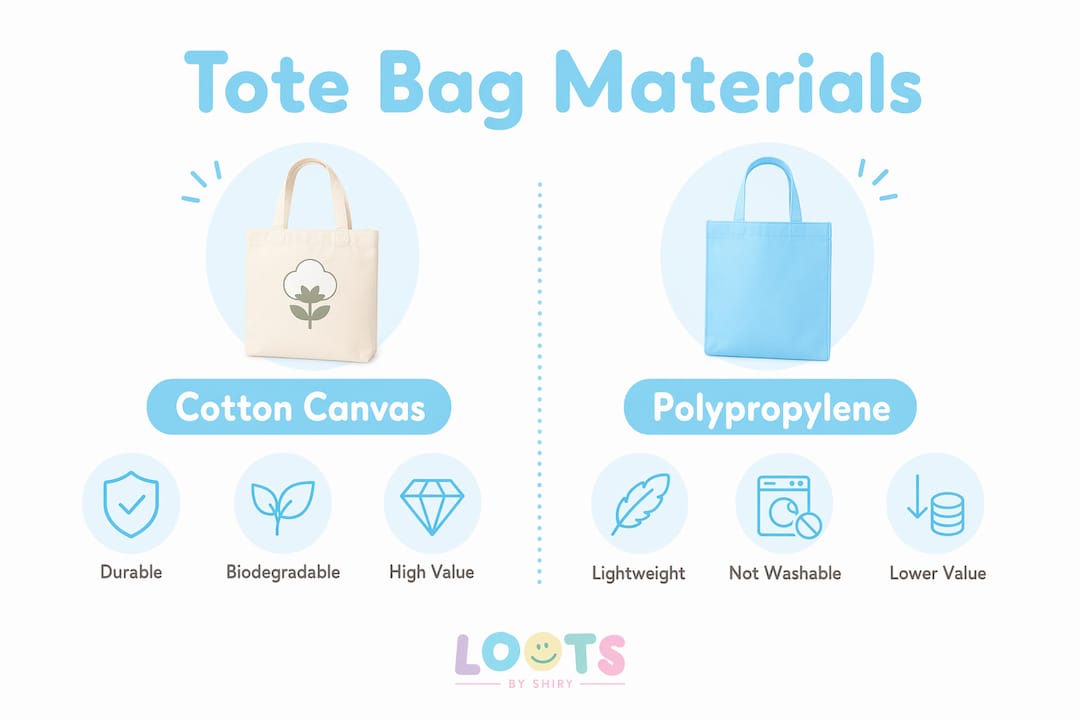
Cotton and canvas are perceived as higher-value and more sustainable than non-woven polypropylene, which is chosen mainly for strictly budget-driven, high-volume giveaways. Material choice also affects how the bag photographs — natural canvas reads warmly at daytime festivals and outdoor events, while non-woven PP can look flat under indoor lighting.
| Material | Typical GSM / Weight | Best for | Sustainability | Perceived value |
|---|---|---|---|---|
| Lightweight cotton | 200–300 GSM | High-volume giveaways, conferences | Biodegradable; composts in 1–5 months | Mid |
| Cotton canvas | 200–300 GSM | Events, gifts, branded merchandise | Biodegradable; 50+ wash durability | Premium |
| Heavy canvas | 300+ GSM | VIP kits, daily-use gifts | Biodegradable; longest lifespan | Premium |
| Non-woven polypropylene | — | Budget mass giveaways | Not biodegradable (#5 plastic) | Budget |
| Recycled polyester | Varies | Eco-focused campaigns | Supports recycled-material programmes | Mid–Premium |
For events where sustainability is part of the brand message, reusability matters more than a single eco label. A 300 GSM canvas tote someone carries for two years does more environmental good than a certified-organic bag that gets used once.
Which printing method should you choose?
Screen printing is most cost-effective for simple, high-volume logos; DTF or heat transfer is better for smaller quantities or full-colour photographic designs because it avoids setup fees and supports unlimited colours.
Screen printing suits orders of 50+ units with one to three colours. Plastisol or water-based inks absorb into cotton canvas fibres for vivid, wash-resistant results. Each additional colour adds a setup charge, so keep bulk logos simple.
DTF (Direct-to-Film) / heat transfer is the right call for small batches, full-colour artwork, or photographic designs. No colour limits, no screens to burn. The trade-off is a slightly different hand feel on the print area and lower wash durability compared to screen printing on canvas.
Embroidery and woven patches add a tactile, premium look that screen printing cannot replicate. Use embroidery for corporate gifts, VIP bags, or any order where the bag itself is the gift rather than a vessel for other items. Patches are particularly useful when you want to personalise individual bags with names or icons — exactly what LootsByShiry does with its custom loot bag options.
For branded merchandise that needs to stand out beyond a single event, pairing a quality tote with a thoughtful decoration method is one of the most effective moves. A useful overview of branded merchandise strategy covers why the bag itself often outlasts the event in brand recall.
What quality checks should you request before a bulk run?
Fabric weight alone does not equal quality — handle reinforcement, seam allowance, and bar-tacking are what determine whether a bag survives an event day without a handle tearing off.
- Fabric GSM verification: Confirm the delivered fabric matches the specified GSM (200–300 for standard; 300+ for heavy-duty) against the purchase order.
- Dimensional tolerance: Measure width, height, and gusset depth against spec. A 1 cm variance is acceptable; more than that affects how contents fit.
- Stitch count: Minimum 8 stitches per inch on handles, 6 SPI on side seams. Specify bonded nylon thread (T-70 or T-90) for handle attachment.
- Bar-tack inspection: Check every handle join for bar-tacking at stress points. This is the most common failure point on cheap totes.
- Print adhesion (ASTM D3359): Request a tape adhesion test on the pre-production sample to verify the print will not peel after handling.
- Handle burst strength (ASTM D5034): Ask for this test result when bags must carry heavy loads — conference kits, product samples, or gift sets.
- Wash/fade check: If reusability is part of your brand message, request a wash test showing colour retention after 10+ cycles.
Pro Tip: Insist on a pre-production photo sample within three business days of proof approval, and require a pre-shipment photo audit from the actual production line. Agree on AQL thresholds upfront: AQL 2.5 for major defects and AQL 4.0 for minor defects under ANSI/ASQ Z1.4-2008.
What does it cost and how long does it take?
Production for custom canvas or cotton totes generally runs 10–14 business days from proof approval; add 1–2 weeks for shipping and packing at event scale. Budget 4–6 weeks total for a large event order.
| Material | Typical per-unit range (CAD) | Best for | Lead time |
|---|---|---|---|
| Non-woven polypropylene | $1.35–$2.00 | Budget mass giveaways (500+) | 7–10 business days |
| Standard cotton | $2.85–$6.95 | Mid-tier events, branded giveaways | 10–14 business days |
| Canvas (premium) | $6.70–$14.95 | VIP kits, corporate gifts | 10–14 business days |
Hidden costs to watch:
- Setup / screen fees: Per colour, per placement. Keep logos to 1–2 colours for bulk orders.
- Colour separations: Complex artwork requires art prep time; budget for it.
- Packaging and unitising: Individual poly bags, tissue inserts, or belly bands add cost and time.
- Rush production: Typically adds 20–40% to the base price for a 5–7 business day turnaround.
- Customs and duties: Imported goods may attract duties; local Canadian production avoids this entirely and shortens lead times.
What should you send your vendor?
A complete spec sheet prevents the most common ordering problems: washed-out prints, wrong handle length, and bags that arrive without packaging. Lock a full spec and approve a pre-production sample before any bulk production begins.
Vendor spec checklist:
- Finished dimensions (W × H × gusset depth in cm or inches)
- Fabric type, GSM or oz. weight, and colour
- Handle style (cotton webbing, self-fabric, rope), drop length, and bar-tack requirement
- Gusset and bottom panel details (flat vs. boxed)
- Colour values (PMS or Pantone) for fabric and print
- Print placement, size, and decoration method
- Packaging: individual poly bag, tissue, belly band, or bulk carton
- Labelling: hang tag, woven label, or care label requirements
Sample approval steps:
- Receive pre-production photo sample within 3 business days of artwork approval.
- Verify GSM, dimensions, stitch count, and bar-tacking against spec.
- Check print colour match against approved Pantone values.
- Sign off with agreed AQL thresholds (AQL 2.5 major / AQL 4.0 minor).
- Authorise bulk production in writing only after sign-off.
Order extra units beyond your confirmed guest count to cover late additions and packing damages. For 500+ pre-filled bags, budget 2–3 days of manual labour for packing — it is a consistently underestimated line item.
How do different materials hold up during event use?
Cotton canvas handles the physical demands of an event day better than most alternatives. It resists tearing when loaded with brochures and bottles, and the natural fibre does not stretch out of shape the way lightweight polyester can under a heavy load. For events where bags are pre-filled and stacked, a 200–300 GSM cotton canvas holds its structure through transport and distribution without creasing badly.
Non-woven polypropylene is lightweight but not washable, and the handles are the weak point: the attachment method matters more than the fabric itself. If you choose non-woven for a budget run, specify a reinforced handle weld or stitched attachment rather than a simple heat-seal join.
After the event, cotton canvas washes cleanly and the print survives repeated cycles — which is the whole point of a reusable bag. A tote that guests actually keep and use extends your brand’s visibility well past the event date.
How should you package and ship bulk orders within Canada?
Flat-packed delivery with tissue inserts protects print quality and maintains a premium look on arrival. For high-volume orders, bulk cartons (typically 50–100 units per carton) are the most cost-efficient shipping format. If you are pre-filling bags before the event, individual poly bags keep each tote clean during transport and make distribution faster at registration.
Canadian domestic shipping avoids customs delays and duties that can add unpredictable costs and time to imported orders. Free shipping thresholds vary by supplier — confirm the minimum order value that qualifies before finalising your quote. For time-sensitive events, ask about rush courier options to specific provinces; transit times from a central Canadian warehouse to Atlantic Canada or the territories can add 2–3 business days beyond standard estimates.
Why do environmental certifications matter for tote bags?
Certifications give buyers a verifiable way to back up sustainability claims rather than relying on marketing language. The most relevant ones for custom tote bags in Canada are GOTS (Global Organic Textile Standard) for organic cotton, GRS (Global Recycled Standard) for recycled polyester, and OEKO-TEX Standard 100 for chemical safety in any fabric.
GOTS certification confirms the cotton was grown without synthetic pesticides and processed without harmful chemicals through the entire supply chain. GRS verifies the recycled content percentage in polyester or other synthetic materials. OEKO-TEX Standard 100 tests for over 100 harmful substances and is the most accessible certification for event buyers who want basic safety assurance without the full organic premium.
For most event planners, OEKO-TEX Standard 100 is the practical minimum to request. GOTS is worth the premium when the event’s brand positioning centres on environmental responsibility and the tote will be reused. Avoid vague claims like “eco-friendly” or “green” from suppliers who cannot name a specific certification — those terms carry no enforceable standard.
LootsByShiry makes personalised event totes easy to order
Generic tote bags are forgettable. What guests actually keep is a bag with their name on it, a colour they chose, or a patch that matches the event theme.
LootsByShiry specialises in exactly that: personalised loot bags and cotton tote bags with custom names, patches, and colour selections built for birthdays, corporate events, and themed celebrations across Canada. The process is straightforward: choose your style, select colours, add names or patches, and request a pre-production photo sample before your bulk run is confirmed. Small-batch personalisation is available, so you are not forced into a large minimum order when you only need bags for a smaller gathering. For planners building a full welcome kit, LootsByShiry’s colour-changing tumblers pair well with tote bags for a cohesive VIP pack.
Browse the full range and start your custom order at LootsByShiry’s shop.
Key takeaways
The best custom tote bag for most Canadian events is a 200–300 GSM cotton canvas with bar-tacked handles and screen printing, ordered 4–6 weeks before the event date with 10–15% extra units.
| Point | Details |
|---|---|
| Best all-round choice | 200–300 GSM cotton canvas with screen printing suits the majority of Canadian event use cases. |
| Request key tests | Ask for ASTM D3359 (print adhesion) and ASTM D5034 (handle burst strength) on pre-production samples. |
| Order timeline | Budget 4–6 weeks total: proofing, 10–14 business days production, shipping, and pre-packing time. |
| Extra units rule | Order 10–15% above your confirmed guest count to cover late additions and packing losses. |
| LootsByShiry | Offers personalised cotton tote bags with custom names, patches, and colours for events across Canada. |
What event planners often get wrong about tote bags
The most common mistake is treating the tote as an afterthought — ordering it last, skipping the sample, and discovering a handle failure or washed-out print two days before the event. A pre-production sample costs almost nothing relative to a reorder of 300 bags on a rush timeline.
The second mistake is choosing material based on price alone. A non-woven bag at $1.50 per unit looks like a bargain until guests leave it behind at the venue. A 250 GSM cotton canvas at $4.00 per unit goes home, gets used at the grocery store, and keeps your logo visible for months. That is a fundamentally different return on the spend.
For anyone planning an event in Canada and wanting bags that guests will actually keep, the spec and sample process outlined here is the starting point. If you want to skip the sourcing complexity entirely, LootsByShiry handles personalisation, sampling, and small-batch production for events of all sizes. Reach out through the LootsByShiry shop to discuss your event specs or request a sample.
FAQ
What is the best tote bag material for a Canadian event?
Cotton canvas (200–300 GSM) is the best all-round choice: it is durable, biodegradable, photographs well, and holds screen-printed logos through 50+ washes.
How far in advance should I order custom tote bags in Canada?
Order several weeks before your event to allow for proof approval, production, domestic shipping, and pre-packing time.
What is the minimum order quantity for personalised tote bags?
It depends on the supplier. LootsByShiry supports small-batch personalised orders, making it practical for intimate celebrations and smaller corporate events without a large minimum.
How do I avoid handle failures on bulk tote bags?
Specify bar-tacking at all handle stress points, bonded nylon thread (T-70 or T-90), and a minimum of 8 stitches per inch on handles. Request an ASTM D5034 burst-strength test result on your pre-production sample.
Are affordable custom tote bags available with no minimum order in Canada?
Yes. Several Canadian suppliers offer no-minimum orders on custom tote bags, with prices starting around $2.85–$6.95 CAD per unit for lightweight cotton styles at small quantities.