
The right loot bag is the one your favours slide into easily, with a little room at the top to close or fold. Measure your tallest and widest item, add roughly an inch of clearance, then check that number against the bag’s listed width, height and gusset. This guide shows you how to do that, with worked examples for small treats, a keepsake plus a treat, and bulky items like tumblers.
TL;DR
- Measure the real items stacked as you will pack them, not each item alone. The bag must fit the bundle.
- Check which order the seller lists dimensions in (length, height, width) before comparing two bags.
- Leave about an inch of clearance at the top so the bag closes without crushing anything.
- Two to four small items is the sweet spot for a kids’ party bag. Larger keepsakes call for a pouch, tote or box.
- Order one test bag first, pack it exactly as you will on party day, then place the full order.
Table of Contents
- Why loot bag sizes are so confusing
- How to read loot bag dimensions
- Measure your favours first
- Worked examples: from your items to a bag size
- How many items fit in a loot bag?
- Matching size to the type of favour
- Bag type matters as much as bag size
- Coordinating bag size with theme and colour
- Perspective
- Order a test bag, then the full set
- Loot bags and related items at Loots by Shiry
- Common sizing mistakes to avoid
- FAQ
- Sources
Why loot bag sizes are so confusing
There is no single standard loot bag. A flat paper bag, a gusseted bag with handles, a drawstring pouch and a tote can all be sold as a “loot bag”, and each is described differently. Two listings that both say “8 inches” can mean different things: one may be the width, another the height.
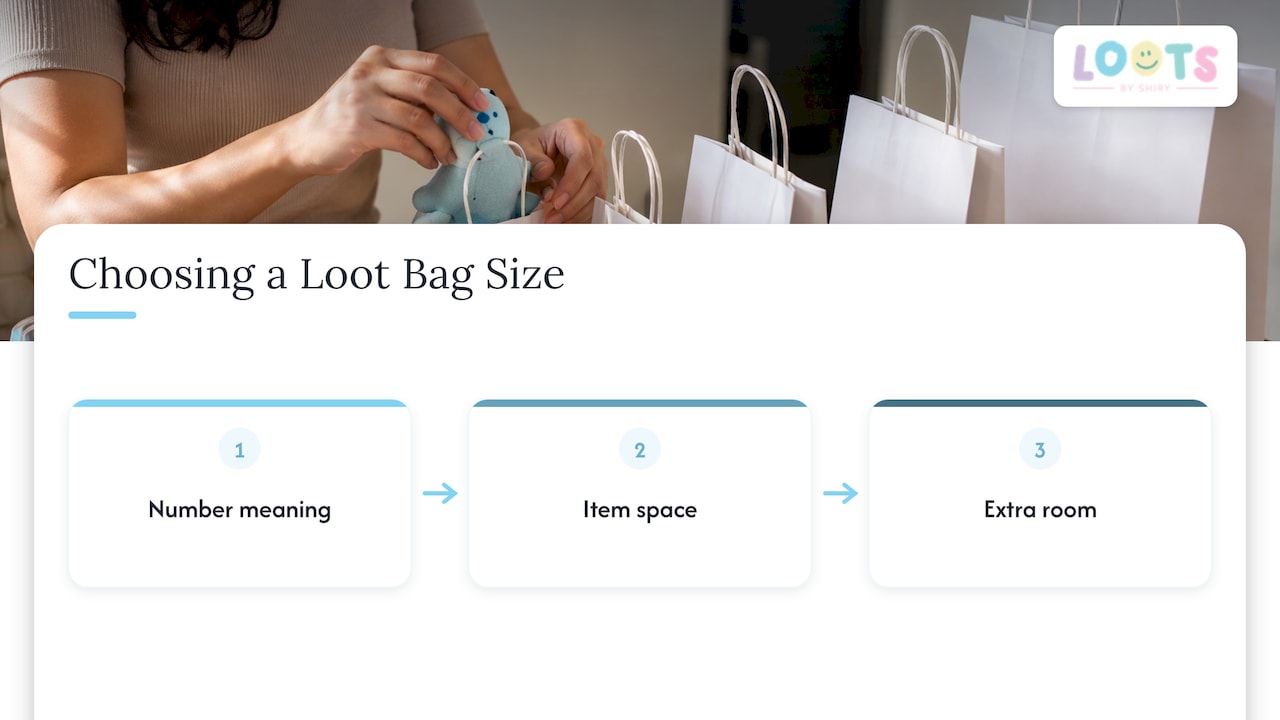
That is why the size question is really three questions: what do the numbers mean, how much do my items take up, and how much room do I want to leave? Answer those in order and the choice gets easy.
How to read loot bag dimensions
Know the order of the numbers
Packaging manufacturers do not all use the same convention, so read the seller’s own explanation first. One packaging maker, for example, describes standard bags as length × height × width and measures the inside from seam to seam. Others list width first, then height. When a listing shows only two numbers, treat the bag as flat, with no gusset, unless the page says otherwise.
A quick way to decode any listing:
- Two numbers (for example 5 × 7): a flat bag. The first is normally the width, the second the height.
- Three numbers (for example 8 × 3 × 5.5): a gusseted bag. Look for a note saying which number is the depth of the bottom fold.
- A single number for a pouch: often the width. Ask or check the product page for the height.
Why the gusset matters
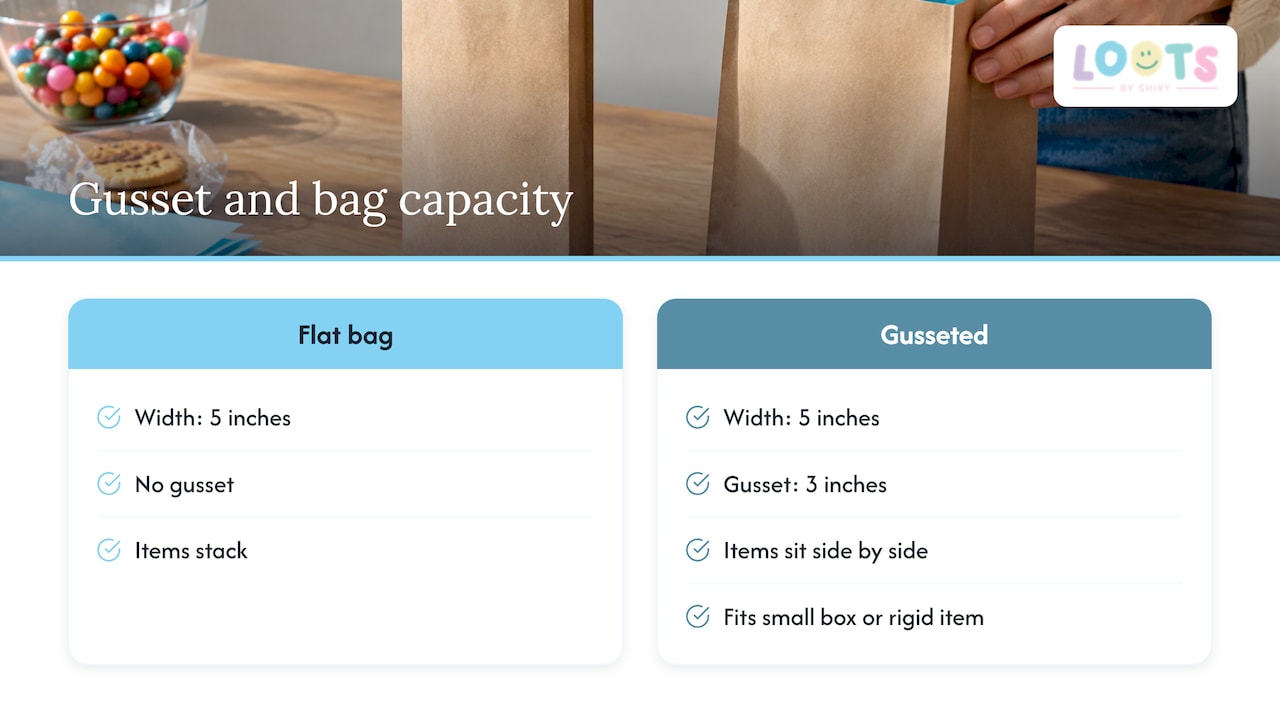
The gusset is the fold at the sides or bottom that lets a bag open into a box shape. A bag that is 5 inches wide with a 3-inch gusset holds far more than a flat bag that is 5 inches wide, because the items can sit side by side instead of stacking on top of each other. If your favours include a small box or a rigid item, the gusset number is the one that decides whether it fits.
Inches or centimetres?
Canadian sellers use both, sometimes in the same listing. A quick conversion: 1 inch is 2.54 cm, so a 9-inch bag is about 23 cm. Pick one unit before you start measuring and convert everything to it.
Measure your favours first
Before you look at a single bag, measure what is going in it. A tape measure and a kitchen table are enough.
- Lay out the whole bundle. Put every item for one guest together, including any box, card or tissue paper.
- Find the tallest point. Stand the bundle the way it will sit in the bag and measure from the bottom to the highest edge.
- Find the widest point. Measure across the widest item, or across two items if they will sit side by side.
- Measure the depth. This is how thick the bundle is front to back. It decides whether a flat bag is enough or you need a gusset.
- Add clearance. Add about an inch to the height for closing or folding, and a half inch to the width and depth so items slide in without a fight.
A packaging guide makes the same point: measure the widest and tallest points of the product, including boxes and inserts, leave room for items to slide in, and test a small quantity with real products. We would add one thing from experience with party orders: always test with the actual items, because a stack of five stickers and a bouncy ball behave very differently from the numbers on paper.
Worked examples: from your items to a bag size
The numbers below are illustrative arithmetic, not product specifications. Swap in your own measurements.
| What goes in | Bundle size (W × H × D) | Add clearance | Bag you need (minimum) |
|---|---|---|---|
| Chocolate bar, sticker sheet, small bouncy ball | 3 × 6 × 1.5 in | +0.5 in wide, +1 in tall | About 3.5 × 7 in, a small flat bag or pouch |
| Mini notebook, pencil, wrapped candy, mini toy | 4 × 6 × 2 in | +0.5 in wide, +1 in tall | About 4.5 × 7 in with a 2 in gusset |
| Small plush, bubbles, candy bag, stickers | 5 × 8 × 3 in | +0.5 in wide, +1 in tall | About 5.5 × 9 in with a 3 in gusset |
| Reusable cup plus a treat bag | 4 × 8 × 4 in | +0.5 in wide, +1 in tall | A pouch or tote with a wide opening, not a narrow paper bag |
The pattern is simple. Add up the stack, add clearance, and round up to the next size the seller offers. If you land between two sizes, go with the bigger one. A slightly roomy bag looks generous. A bag that bulges looks cheap and tears.
How many items fit in a loot bag?
Party planners tend to overfill. For young guests, two to four small items is usually plenty: one trinket or toy, one treat, something to write or stick, and maybe one themed extra. Past that, the bag starts to look cluttered and the bag size you need jumps up.
If you are deciding what to include, our guide to loot bags by age breaks down what suits toddlers, school-age kids and tweens. For a leaner approach, one keepsake and one treat is a format many parents like because it keeps the bag small and the cost predictable.
Matching size to the type of favour
Small and flat items
Stickers, temporary tattoos, pencils, erasers and wrapped candy are shallow. A small flat bag or a small pouch is enough, and a gusset is optional. These are the cheapest bags to fill and the easiest to ship or carry.
Bulky or irregular items
A plush toy, a ball, a bottle of bubbles or a cup does not stack. Measure these at their widest point, not their length, and choose a bag with a gusset or a pouch with a wide opening. Soft, squishy items are forgiving. Rigid items with corners are not.
Boxed favours
If you are giving a rigid box, such as a small cookie box or a trinket box, a box often beats a bag, because the container is the presentation. If you are weighing the two, a food-gift specialist covers how to choose between bags and boxes for shipping and gifting in a way that applies to treats at a party too. Our own comparison of pouches versus boxes covers when a reusable pouch wins over a display box.
Treats that need to stay fresh
Cookies, cake pops and baked goods usually go in a clear treat bag first, then into the larger loot bag. Count the inner bag as part of the bundle when you measure. Forgetting it is one of the most common reasons a bag looks too small on party day.
Bag type matters as much as bag size
Two bags with the same dimensions can behave differently.
- Paper bags with handles hold their shape and look tidy, but the opening is fixed. They work well for flat and boxy items.
- Drawstring pouches stretch a little and close at any height, so they forgive a slightly overfilled bundle. They also get reused.
- Tote bags have the biggest opening and the most capacity. They suit a keepsake-led favour with three to five items. See our tote bag favour ideas for what fits.
- Duffle bags suit sleepover, sports or teen parties where the favour is the bag itself.
If the bag will be kept and reused, size it for what a child will actually carry afterward, such as a swim kit, snacks or a few small toys. That is a different question from “what fits on party day”, and it is often the better one.
Coordinating bag size with theme and colour
Theme affects size in a practical way. A dinosaur party with a plush and a fossil kit needs a bigger bag than a tea party with a ribbon and a cookie. If a themed event involves a visit or an activity, your favours might also include a printed card or a certificate, which adds a flat item to the stack. Planners working out what the whole party looks like sometimes look at birthday party ideas that include a themed activity to decide how much the favour needs to carry.
Once size is settled, choose colour. Our post on party bag colour palettes lists five palettes with accessibility tips, and three ways to build a themed loot bag explains how names, patches and colours come together without making the bag busier.
Perspective
We started Loots by Shiry because most party favour bags felt generic. A plain bag with a name on it was fine, but guests rarely kept it. Size is where that either works or does not.
Here is what we tell every parent and planner: pick the size from the favours, not from the bag. Pack one test bag, close it, shake it, and carry it by the handle. If it feels right in your hand, it will feel right in a child’s.
We also lean toward bags that get reused. A pouch or tote that a child takes to school or swimming is a favour that keeps working long after the cake is gone, and a name or patch on it makes it theirs. That is why we let you choose names, patches and colours, and why we care about getting the size right before the personalization goes on.
Shiry
Order a test bag, then the full set
The single most useful step is a trial run.
- Order one bag, or use a spare bag you already have, in the same style.
- Pack it exactly the way you will on party day, with tissue, inner treat bags and all.
- Close it, lift it by the handle and set it down. Check that it stands, closes and does not split.
- Adjust the item count or step up one size, then order the full quantity.
For group orders, build the extra time in. Custom names and patches take longer to produce than blank bags, so settle the size early and leave personalization for the next step.
Loot bags and related items at Loots by Shiry
If you already know the number of guests and the items you plan to pack, you can start a personalized loot bag order and choose names, patches and colours. Wrapping is $0.50 per bag and delivery is $10. Check the product page for the dimensions of the style you pick before you finalize your item list.
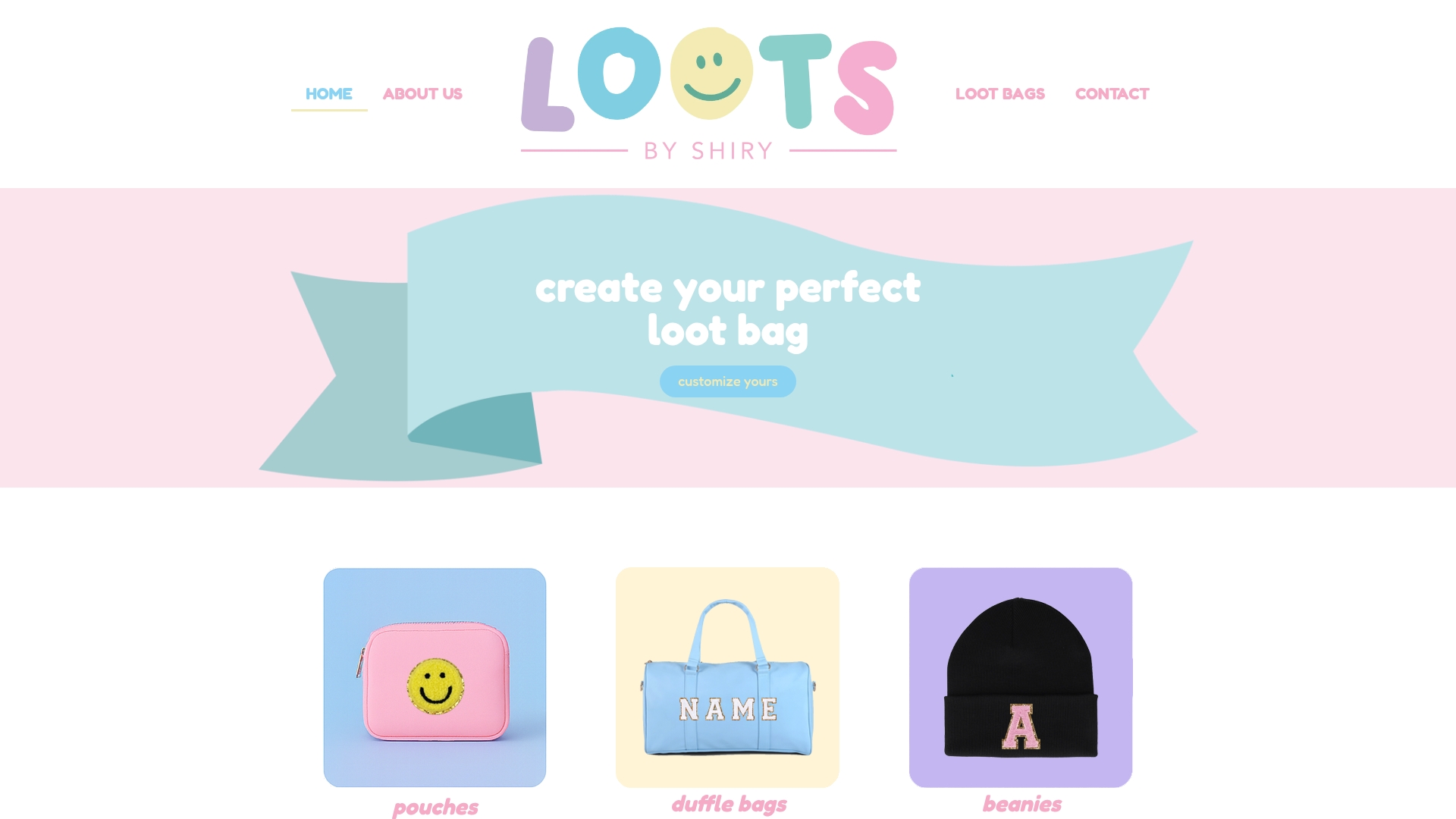
If the favour itself is the keepsake, our shop has cotton tote bags and pastel pouches at $12.00 each and colour changing tumblers at $10.00. We serve families and planners in Vaughan and Richmond Hill, and you can ask about custom orders if your plan does not fit a standard style.
Common sizing mistakes to avoid
- Measuring items one at a time. The bundle is bigger than the sum of its parts once you account for air gaps and corners.
- Ignoring the gusset. A wide, flat bag is not the same as a deep one.
- Forgetting the closing room. If the top has to fold, tie or take a sticker, it needs height.
- Mixing units. Do not compare a centimetre listing with an inch listing by eye.
- Buying the full quantity first. One test bag costs very little compared with a box of the wrong size.
- Choosing for the table, not the hand. A bag that looks good on a display shelf can be awkward for a small child to carry.
FAQ
What is the standard size of a loot bag?
There is no single standard. Sellers describe bags in different orders and formats, so sizes vary by type: flat paper bags, gusseted bags, pouches and totes all differ. Size the bag from your favours instead: measure the bundle, add about an inch of clearance and pick the next size up.
How do you tell the size of a bag?
Check the listing for the order the numbers are given in. Many packaging sellers use length × height × width, and measure the interior seam to seam. If only two numbers appear, assume a flat bag with no gusset unless the page says otherwise.
How many items should go in a kids’ loot bag?
Two to four small items is a comfortable range: a small toy or trinket, a treat, something like stickers or a pencil, and one themed extra. More than that and the bag has to grow, which raises the cost without making the favour feel better.
Is a goody bag the same as a loot bag?
In practice, yes. Both words describe a small bag of favours given to guests, and the choice is mostly regional. We cover the difference in more detail in our post on goody bags versus loot bags.
Should I choose a pouch, a box or a bag?
Choose a bag or pouch for soft, mixed items and for anything you want a child to reuse. Choose a box for rigid, fragile or food items where the container is part of the presentation. Our pouches versus boxes guide goes through the trade-offs.